
Most brands will run into one of six 3PL pricing models: per-order, per-unit, per-pallet, subscription, cost-plus, or a hybrid blend of these. The one number that actually lets you compare offers apples-to-apples isn’t the sticker price on any single fee line. It’s your all-in cost per order (CPO), and it shifts based on your volume, your SKU mix, and how heavy your average package is.
TL;DR:
- The all-in cost per order is affected by volume, SKU mix, and package weight, making it the most accurate way to compare fulfillment offers.
- Shipping costs, which can represent 60 to 70 percent of total outbound spend, are the most critical line item to negotiate, especially carrier discounts.
- For small brands shipping fewer than 500 orders per month, per-order pricing is usually most cost-effective, while larger or multi-unit orders benefit more from per-unit pricing.
- Tiered discounts apply at order thresholds like 1,000 or 5,000, but rates often change at the start of the next billing cycle, not immediately after crossing the threshold.
- Hidden fees such as long-term storage surcharges, SKU count charges, or dimensional-weight passthroughs are common pitfalls to watch for in contracts.
Table of Contents
- What Are the Main 3PL Pricing Models?
- What Fees Show Up on a 3PL Invoice, and What Should They Cost?
- How Do You Calculate Cost Per Order?
- Which 3PL Pricing Model Fits Your Business?
- How Do Volume Tiers and Discounts Actually Work?
- What Hidden Fees Should You Watch for in a 3PL Contract?
- How Usiprep Approaches Pricing Transparency
- An Operator’s Take on Reading a 3PL Quote
- Ready to See Your Own Numbers?
- Sources
What Are the Main 3PL Pricing Models?
Every fulfillment quote you’ll ever get boils down to how the provider charges for the work of receiving, storing, and shipping your inventory — see this detailed step by step order fulfillment process for e-commerce to understand why. The label on the invoice changes, but the mechanics behind it fall into six recognizable patterns.
- Per-order pricing charges a flat or tiered fee for each order processed, regardless of how many units are inside. It’s common with single-item DTC brands where order count and unit count are nearly the same thing.
- Per-unit pricing charges by the individual item picked and packed. This fits multi-unit orders, like a supplement brand shipping three bottles per box, where per-order pricing would undercharge for the extra labor.
- Per-pallet pricing bills by pallet position for storage and by pallet for receiving. It’s the default for B2B replenishment and bulk inventory that doesn’t move as individual parcels.
- Subscription or flat-rate pricing bundles a set volume of orders or units into one monthly fee. Predictable, but it can penalize you in slow months when you’re still paying for capacity you didn’t use.
- Cost-plus pricing passes through the 3PL’s actual costs (labor, space, materials) plus a fixed markup. Transparent in theory, but it requires real trust in the provider’s reporting.
- Hybrid models mix elements, like a flat account fee plus per-unit picking plus pass-through shipping. Most mid-size brands end up here whether they planned to or not.
A small brand shipping 200 single-SKU orders a month usually does best on per-order pricing. A brand running kitted bundles with five to eight units per order almost always saves money under per-unit terms instead, because per-order pricing would leave the provider underpaid for the extra handling and they’ll build that risk into a higher base rate.
What Fees Show Up on a 3PL Invoice, and What Should They Cost?
A rate card is really nine or ten separate line items stitched together. Knowing what’s “normal” for each one is the fastest way to spot a quote that’s padded or a category you’re not being charged for at all.
Pick and pack usually carries the most negotiating room. Industry medians put the first-pick order fee between $1.30 and $3.50, with additional-unit picks running $0.25 to $0.85 each. At real scale, that order fee median compresses to roughly $1.50 to $1.80.
| Fee category | Typical range | Main cost driver |
|---|---|---|
| Receiving (per pallet) | $5–$15 | Carton count, labor time to check in |
| Pallet storage (per month) | $16–$25 | Region, warehouse occupancy, season |
| First pick (per order) | $1.30–$3.50 | Order volume tier |
| Extra unit pick | $0.25–$0.85 | Units per order |
| Kitting / project labor (hourly) | $35–$75 | Complexity, custom packaging |
| Account/setup fees | $0–$1,500+ | Integration complexity, onboarding scope |
Packaging, shipping, and returns don’t fit neatly into a benchmark table because they’re pass-through costs tied to your product’s weight and box size rather than a flat provider rate. Shipping alone often represents 60 to 70 percent of total outbound spend, with a median parcel cost near $6.55 across many brands. That’s the line item most worth negotiating hard on, because it’s also the biggest one.
When you’re collecting quotes, insist on comparing the same month, the same order volume, and the same unit mix across every provider. A rate card quoted on 500 orders means nothing next to one quoted on 5,000. Ask each provider for a sample invoice built around your actual numbers, not their standard template.
How Do You Calculate Cost Per Order?
The formula is simple even when the invoice isn’t: add up every cost bucket for the month, then divide by order count.
Total monthly cost = receiving + storage + pick & pack + packaging + shipping + returns + account/tech + projects/surcharges. CPO = total monthly cost ÷ monthly orders.
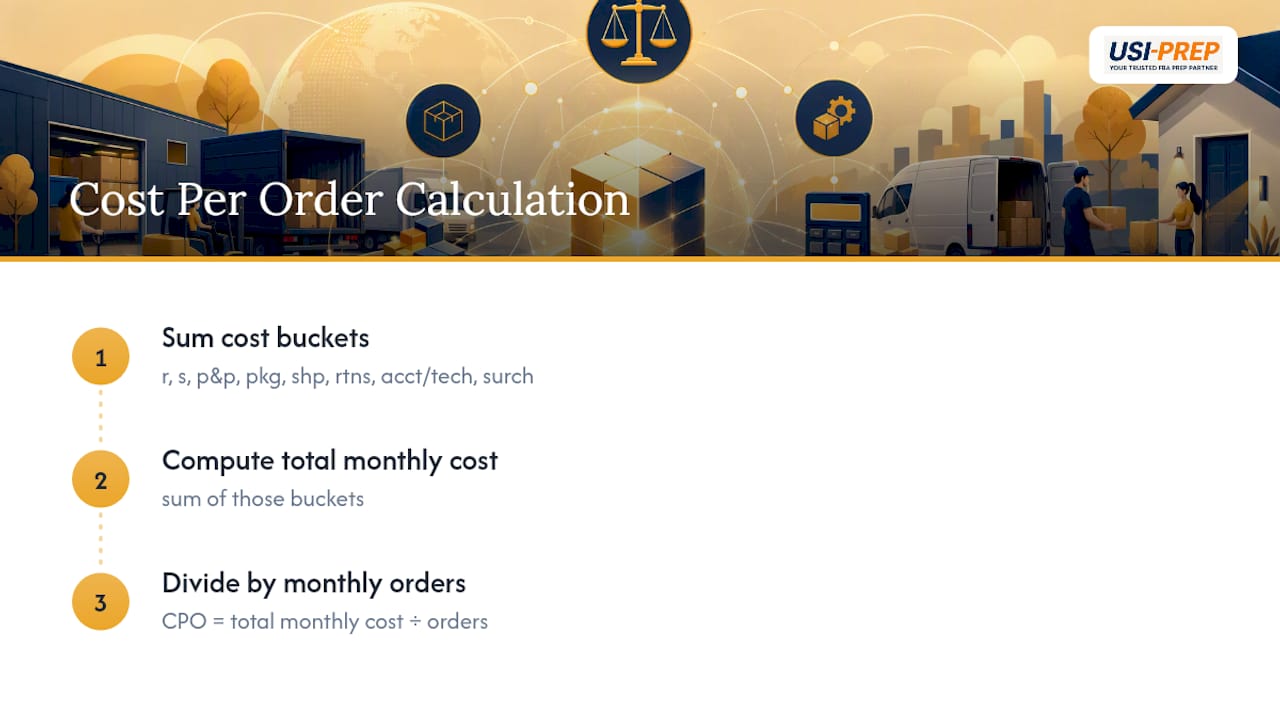
Here’s how that plays out at two different volumes, using worked figures from FreightWaves’ cost model:
That’s because shipping and packaging scale almost linearly with orders. Storage and account fees are the ones that get diluted at scale, while picking costs stay stubbornly per-unit no matter your size.
The biggest levers on your own CPO, in order of impact, are usually shipping rate, pick fee structure, storage duration, and return rate. If you want to model this against your own unit economics before signing anything, per-unit pricing mechanics are worth understanding in more depth, especially if your orders carry more than one item.
Which 3PL Pricing Model Fits Your Business?
Before you request a single quote, get honest about four numbers: orders per month, average units per order, your SKU count, and how seasonal your demand curve is. Those four answers point toward a pricing model almost by themselves.
- Under 500 orders/month, single-SKU: per-order pricing usually wins because it’s simple and your unit count barely varies.
- Multi-unit orders, kits, or bundles: per-unit pricing captures the real labor difference between a one-item order and a six-item order.
- B2B replenishment, wholesale, or pallet-level shipping: per-pallet pricing matches how the freight actually moves.
- Steady, predictable volume with low variance: subscription pricing can lock in a rate, but only if you’re confident you’ll use most of the bundled capacity every month.
- Complex, evolving fee structures where trust in the provider’s cost reporting is high: cost-plus works, though it demands more oversight on your end.
- Most growing brands with a mixed catalog: hybrid pricing, whether you chose it deliberately or not.
Pro Tip: Ask any provider you’re seriously considering to model a blended quote against your last three months of real order data, not a hypothetical average month. A 30-day test period at the quoted rate will expose problems a spreadsheet estimate never will.
How Do Volume Tiers and Discounts Actually Work?
Providers apply tiered pricing at thresholds like 1,000, 5,000, and 10,000 orders per month, and order-fee medians drop meaningfully as accounts cross each band. The catch is that most contracts apply the new tier at the start of the next billing cycle, not the day you cross the threshold, so a strong month doesn’t always show up in savings right away.
- Push for multi-node commitments. Committing volume across two or three warehouse locations often unlocks a better blended rate than negotiating one facility at a time.
- Add a review clause. A quarterly or semiannual rate review tied to your actual order data keeps you from being stuck on outdated tiers as you grow.
- Ask whether carrier discounts get passed through. Some 3PLs mark up shipping on top of their own negotiated carrier rate; you want to see the actual carrier discount reflected in your invoice.
- Get definitions in writing. “Storage day,” “receiving unit,” and “order” need explicit contract definitions, along with SLA metrics for receiving speed and pick accuracy.
What Hidden Fees Should You Watch for in a 3PL Contract?
The fee categories that don’t show up on the headline rate card are usually the ones that inflate your actual bill. Long-term storage surcharges after a specified duration, SKU-count fees once your catalog crosses a threshold, and dimensional-weight passthroughs on oversized items are the most common surprises.
- Accessorial charges for anything outside standard pick and pack, often billed by the minute or the task.
- In/out fees on FIFO inventory rotation, which some providers charge separately from standard receiving.
- Rework or project hourly rates, typically $35 to $75 an hour, for relabeling or kit assembly done after receiving.
- Peak-season surcharges layered on top of standard rates during Q4, sometimes without a clearly stated end date.
If a rate card uses vague language like “additional fees may apply,” ask for the specific contract clauses that define those fees before you sign anything.
How Usiprep Approaches Pricing Transparency
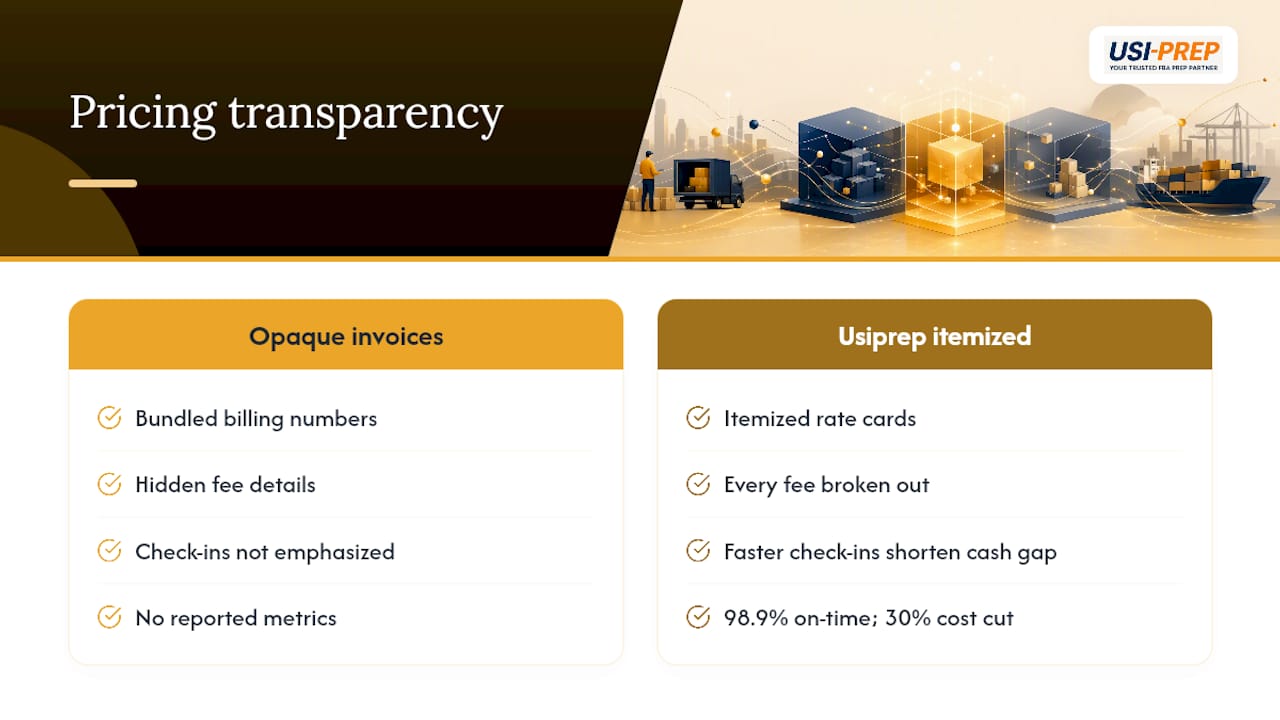
The company was built by individuals with experience as Amazon sellers who experienced opaque fulfillment invoices, and the itemized rate cards reflect an effort for transparency. Every fee, from receiving to pick and pack to returns, is broken out instead of buried in a bundled number.
Faster inventory check-ins matter more than most brands realize: the sooner a shipment clears receiving, the sooner it’s sellable, which shortens the gap between cash spent on inventory and cash coming back in from sales. Usiprep reports a 98.9% on-time delivery rate and has helped brands cut fulfillment costs by 30% through this kind of line-by-line visibility. If you want to see what that looks like against your own order data, ask for a sample invoice modeled on a real month.
An Operator’s Take on Reading a 3PL Quote
Most brands lose leverage in an RFP by asking for a single blended rate too early. Share your real order history first, three months minimum, including seasonality spikes, before anyone quotes you a number.
Pick one negotiable lever and focus there instead of nitpicking every line: shipping rate pass-through usually has the most room to move. And walk away from any provider who won’t commit definitions for “storage day” or “order” to writing. Vague language in those two terms is where disputes start six months into a contract, not on day one.
— Akbar
Ready to See Your Own Numbers?
Reading benchmark ranges only gets you so far. What actually matters is what your specific order mix, unit count, and shipping weight would cost on a transparent rate card instead of a bundled one.
Usiprep builds itemized rate cards around your real numbers, not a generic average brand, and backs it with faster check-ins that get inventory sellable sooner. Whether you’re prepping for Amazon FBA or running multi-channel fulfillment, you can request a sample invoice modeled on your own order data before committing to anything. If you’re specifically prepping inventory for FBA, the FBA prep requirements checklist is a useful starting point to see where your current process might be adding hidden cost. Get a modeled month from Usiprep and compare it directly against what you’re paying now.