
Walmart Fulfillment Services (WFS) is a full-service logistics solution that stores your inventory, picks and packs orders, ships to customers, handles returns, and provides customer support for Walmart Marketplace sellers. If you have been asking what is Walmart Fulfillment Services and whether it fits your business, the short answer is this: WFS gives you access to one of the world’s largest retail supply chains without building your own logistics operation. Rates average 15% lower than competing fulfillment providers, there are no monthly fees, and sellers gain two-day delivery capability from day one.
What is Walmart Fulfillment Services and how does it work?
WFS is an end-to-end fulfillment service that covers every step from inbound storage to final delivery. You ship your inventory to Walmart’s fulfillment centers. From there, Walmart handles picking, packing, shipping, customer service, and returns on your behalf.
The operational workflow follows a clear sequence:
- Inbound receiving: Walmart accepts your shipment and checks inventory into the fulfillment center, typically within 2 business days of arrival.
- Storage: Your products sit in Walmart’s network until an order is placed.
- Picking and packing: Walmart staff pull and package the item using Walmart-branded packaging for Walmart.com orders.
- Shipping: Orders ship with two-day delivery capability to customers across the country.
- Returns: Customers can return WFS orders at 4,600+ physical Walmart stores, which is a return network most third-party logistics providers cannot match.
WFS also supports multi-channel fulfillment. When you fulfill orders from other sales channels through WFS, Walmart ships those orders in unbranded packaging. This keeps your brand neutral outside the Walmart platform.
Pro Tip: Set up multi-channel fulfillment through WFS early. Consolidating inventory in one location while serving multiple channels cuts your warehousing costs and reduces the risk of stockouts across platforms.

What products are eligible for WFS?
Not every product qualifies for WFS. Eligible items must be non-perishable, weigh up to 500 lbs, and meet Walmart’s size requirements. Inventory must ship from within the United States or be customs cleared before it arrives at a fulfillment center.
The inbound compliance requirements are strict. Follow these steps to avoid receiving delays and penalties:
- Palletize correctly. Walmart specifies exact pallet configurations. Deviations cause rejections at the dock.
- Submit your ASN before the shipment arrives. The Advance Shipment Notification must be accurate and submitted ahead of delivery. Late or incorrect ASNs trigger receiving delays.
- Match your PO exactly. Walmart treats the purchase order as the source of truth. Any discrepancy between the PO, ASN, and received inventory harms your seller health metrics.
- Label every unit and carton. Walmart’s labeling requirements are non-negotiable. Unlabeled or mislabeled units get flagged during receiving.
- Verify size and weight data. Incorrect product dimensions in your catalog create fulfillment errors downstream.
There are no minimum inventory requirements to use WFS. That said, sending in too little inventory too infrequently hurts your search visibility on Walmart Marketplace.
Pro Tip: Before your first WFS shipment, download Usiprep’s FBA prep requirements checklist and cross-reference it with Walmart’s inbound specs. The overlap is significant, and catching errors before shipment saves you days of delay.
How does WFS pricing compare to other fulfillment providers?
WFS pricing is transparent and does not include monthly fees or setup costs. You pay for storage and fulfillment based on item size and weight. Rates average 15% lower than competing fulfillment services, which is a meaningful cost advantage at scale.
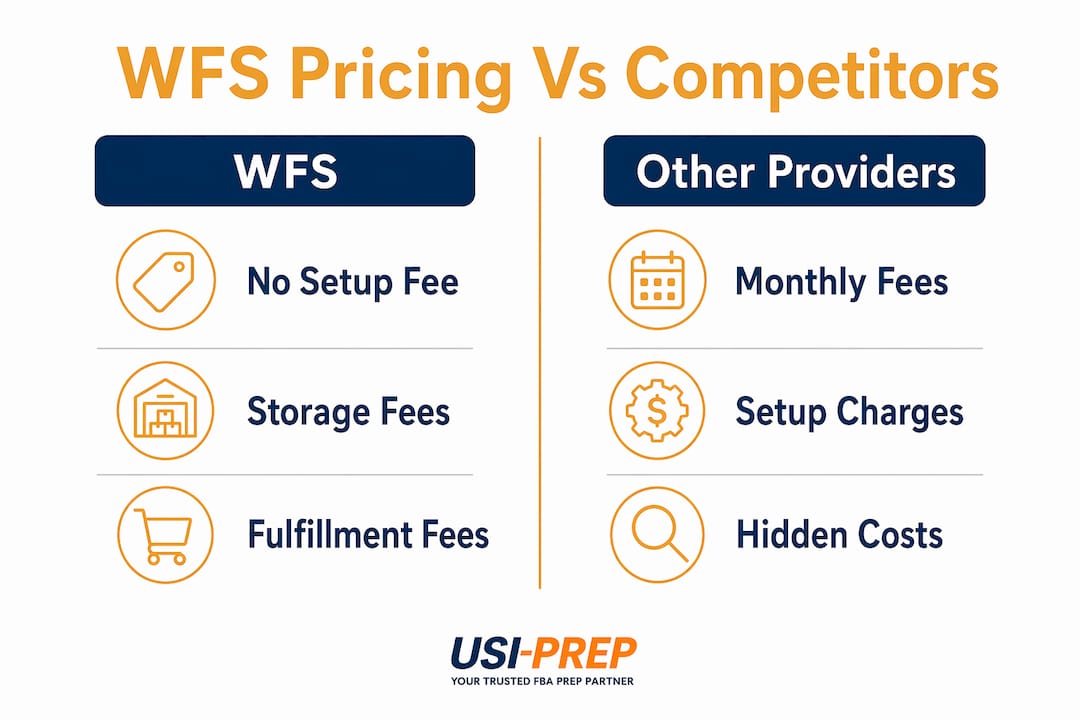
The fee structure breaks down into three main categories:
| Fee Type | What It Covers | Key Detail |
|---|---|---|
| Fulfillment fee | Picking, packing, and shipping per order | Based on item weight and size tier |
| Storage fee | Monthly cost per cubic foot | Applies to all inventory in Walmart fulfillment centers |
| Long-term storage surcharge | Items stored over 12 months | Charged on top of standard storage fees |
| Inbound shipping | Cost to send inventory to fulfillment centers | Walmart Preferred Carrier rates reduce this cost |
No monthly subscription. No setup fee. No hidden enrollment charge. This structure makes WFS accessible to sellers at any volume level.
The 15% cost advantage over competitors matters most for sellers moving mid-to-high volumes. At lower volumes, the savings are real but less dramatic. Understanding your fulfillment cost components before committing to any provider is the right first step.
WFS vs. other fulfillment options: what should sellers consider?
Sellers on Walmart Marketplace have three main fulfillment paths: WFS, seller-fulfilled (you ship directly), and Walmart Simplified Shipping Settings.
| Option | Speed | Cost Control | Buy Box Impact | Returns Handling |
|---|---|---|---|---|
| WFS | Two-day delivery | Walmart sets rates | Strong positive impact | 4,600+ store locations |
| Seller-fulfilled | Varies by carrier | Full control | Depends on performance | Seller manages |
| Simplified Shipping Settings | Varies | Full control | Moderate positive impact | Seller manages |
WFS gives you the strongest Buy Box advantage. Walmart’s algorithm favors WFS listings because the platform can guarantee delivery speed and return handling. Seller-fulfilled listings can compete, but only if your shipping metrics are consistently strong.
Walmart Simplified Shipping Settings is a viable middle ground. It uses real-time transit data to generate accurate delivery estimates, which can increase sales conversion. Sellers who want to control their own logistics but still show competitive delivery windows use this option effectively.
The key trade-off is control versus convenience. WFS removes logistics complexity but puts Walmart in charge of your customer experience. Seller-fulfilled keeps you in control but demands consistent operational performance. For sellers who want to evaluate fulfillment providers carefully before committing, comparing these options side by side on cost and speed is worth the time.
How to maximize your success with Walmart Fulfillment Services
Success with WFS depends on inventory discipline, inbound compliance, and understanding how Walmart’s algorithm rewards sellers.
- Keep at least 50 active SKUs stocked. Experienced sellers recommend maintaining a minimum of 50 active items with continuous replenishment. Stockouts hurt your organic search ranking on Walmart Marketplace directly.
- Use Walmart Preferred Carrier for inbound shipments. Preferred Carrier rates reduce your inbound freight costs and improve receiving reliability.
- Submit ASNs before every shipment. Inbound compliance errors/WFS%20basics/walmart-fulfillment-services-wfs-overview) cause receiving delays and penalties that damage your seller health score. Accuracy here is not optional.
- Monitor your seller health dashboard weekly. Fulfillment accuracy, on-time delivery rate, and return rate all feed into your seller health metrics. Declining metrics reduce your Buy Box eligibility.
- Consider the Inventory Transfer Service. Walmart offers an Inventory Transfer Service that moves existing inventory into WFS fulfillment centers, reducing the logistics burden of onboarding.
- Watch for long-term storage fees. Items sitting in Walmart fulfillment centers for over 12 months trigger surcharges. Forecast demand carefully and avoid overstocking slow-moving SKUs.
Pro Tip: Walmart’s 2026 Prepaid Consolidation program merges smaller shipments into single national purchase orders. If you qualify, this reduces your inbound freight complexity and cost significantly.
Key Takeaways
Walmart Fulfillment Services gives Marketplace sellers direct access to Walmart’s national logistics network, with rates averaging 15% lower than competing providers and no monthly fees.
| Point | Details |
|---|---|
| WFS covers end-to-end logistics | Storage, picking, packing, shipping, returns, and customer support are all included. |
| Pricing beats most competitors | Rates average 15% lower than other fulfillment providers, with no monthly or setup fees. |
| Inbound compliance is critical | ASN accuracy, palletization, and PO matching directly affect your seller health metrics. |
| Inventory volume drives visibility | Maintaining at least 50 active SKUs with steady replenishment protects your search ranking. |
| Multi-channel fulfillment is available | WFS ships non-Walmart orders in unbranded packaging, supporting broader sales channel strategies. |
Why WFS is worth taking seriously, even if you’re cautious about it
I have worked with sellers who avoided WFS because they did not want to hand control to Walmart. That instinct is understandable. But the math usually wins the argument.
Walmart’s hub-and-spoke logistics network is one of the most efficient supply chains in the world. When you plug into WFS, you are not just getting warehouse space. You are getting cross-docking infrastructure, national carrier relationships, and a return network spanning 4,600+ stores. Building that yourself is not realistic for most sellers.
The compliance requirements are where sellers get burned. The purchase order is Walmart’s source of truth, and any mismatch between your PO, ASN, and received inventory creates problems that ripple through your seller health score. I have seen sellers lose Buy Box eligibility not because of bad products, but because of sloppy inbound documentation. That is entirely preventable.
My honest recommendation: treat WFS as a growth tool, not a shortcut. Stock it properly, comply precisely, and monitor your metrics weekly. Sellers who do that consistently see the cost and visibility benefits the platform promises. Sellers who treat it like a set-and-forget solution run into avoidable problems within the first 90 days.
— Akbar
How Usiprep helps sellers get WFS-ready faster
Preparing inventory correctly before it reaches a Walmart fulfillment center is where most sellers lose time and money. Usiprep was founded by former Amazon sellers who know exactly what inbound compliance failures cost at scale.
Usiprep delivers 98.9% on-time delivery and has helped brands cut fulfillment costs by 30%. Whether you need help with FBA prep, inbound shipment compliance, or outsourced order fulfillment, Usiprep provides full visibility at every step. Start with the FBA prep requirements checklist to confirm your inventory is ready before it ships to any fulfillment center.
FAQ
What is Walmart Fulfillment Services in simple terms?
Walmart Fulfillment Services is a logistics program where Walmart stores your inventory, fulfills orders, handles returns, and provides customer support for sellers on Walmart Marketplace. It functions similarly to Amazon FBA but operates within Walmart’s supply chain network.
How much does WFS cost?
WFS charges fulfillment fees based on item weight and size, plus monthly storage fees. There are no monthly subscription or setup fees, and rates average 15% lower than most competing fulfillment providers.
What products can I sell through WFS?
Eligible products must be non-perishable, weigh up to 500 lbs, and meet Walmart’s size requirements. Inventory must ship from within the U.S. or be customs cleared before arriving at a WFS fulfillment center.
Does WFS help with Buy Box eligibility?
Yes. WFS listings receive a strong Buy Box advantage because Walmart can guarantee two-day delivery and standardized return handling. Seller-fulfilled listings can compete but require consistently high shipping performance metrics.
Can I use WFS for orders outside Walmart.com?
Yes. WFS supports multi-channel fulfillment for orders from other sales channels. Non-Walmart orders ship in unbranded packaging, keeping your brand presentation neutral on other platforms.