
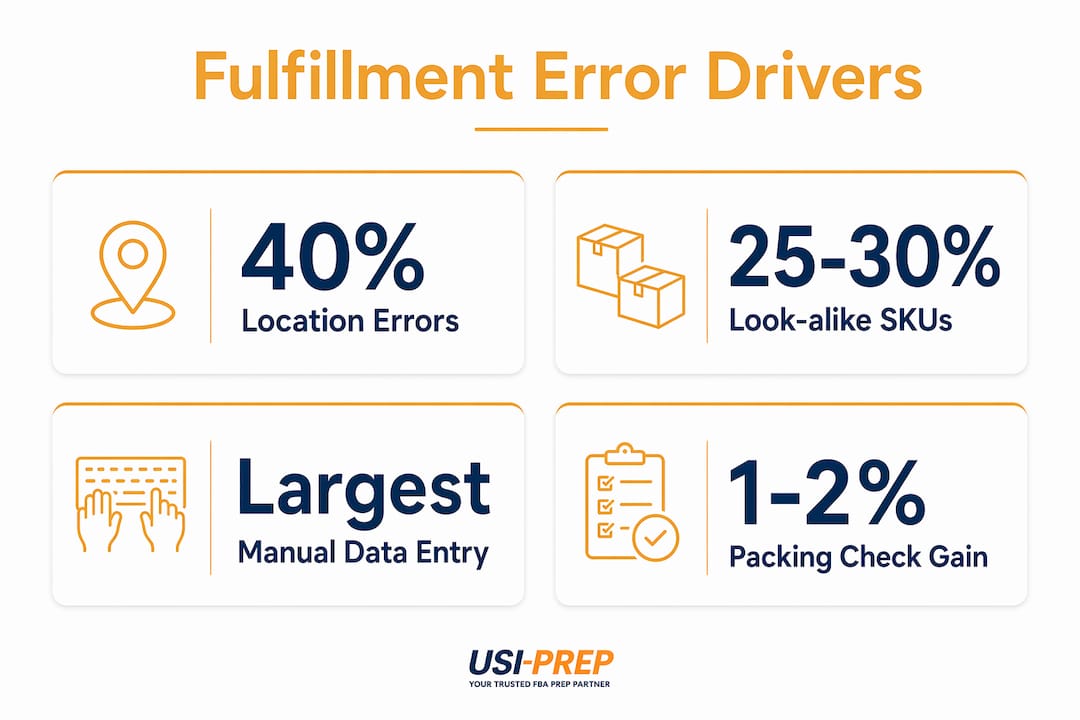
Fulfillment errors are mistakes that occur during the picking, packing, and shipping stages of order processing, caused primarily by inventory inaccuracies, human error, and fragmented systems. Location accuracy issues cause roughly 40% of all warehouse mispicks. That single statistic reveals how much of your error rate is structural, not accidental. Understanding how fulfillment errors happen is the first step toward fixing a problem that costs eCommerce sellers real money and real customers.
How fulfillment errors happen in warehouse operations
Warehouse errors almost always trace back to bad location data. When inventory is put away in the wrong bin or received without proper logging, pickers follow the system to the wrong spot and grab the wrong item. The error starts before the picker ever touches a product.
Look-alike SKUs cause 25–30% of picking errors, and the problem hits new employees hardest. A seasoned picker recognizes that two nearly identical boxes contain different products. A new hire follows the label and grabs whichever one is closest. Without barcode scanning at the point of pick, there is no checkpoint to catch that mistake.

Unclear pick tickets compound the problem. When a ticket lists a product description instead of a scannable SKU, pickers interpret rather than verify. Interpretation introduces error. Warehouse layout matters too. Storing similar products in adjacent bins is a common setup mistake that turns a minor distraction into a mispick.
Pro Tip: Separate look-alike SKUs by at least two bin locations and use color-coded bin labels to give pickers a visual secondary check before scanning.
| Error source | Typical contribution to mispick rate |
|---|---|
| Location inaccuracy | ~40% of mispicks |
| Look-alike SKUs | 25–30% of picking errors |
| Unclear pick tickets | Varies by warehouse setup |
| Poor warehouse layout | Compounds all other factors |
Fixing warehouse errors requires fixing the data first. Cycle counts, receiving audits, and put-away verification are the three practices that keep location data clean. Without them, even the best picker is working from a flawed map.
How do manual processes and disconnected technology cause errors?
Manual data entry across disconnected systems is the largest single source of eCommerce order errors. Every time an order moves from a sales channel to an order management system (OMS) and then to a warehouse management system (WMS) by hand, there is a window for a typo, a skipped field, or a misread quantity. That window stays open all day, every order.
Disconnected platforms create a second, less obvious problem: time lag. Cancelled orders are sometimes still picked because the WMS processed the order before the cancellation update arrived from the sales channel. The picker did nothing wrong. The system just did not know yet. That kind of error is invisible until the customer calls.
Inventory sync failures cause overselling and downstream order errors. When your storefront shows 50 units in stock but your warehouse has 12, you will sell items you cannot ship. The fix is real-time integration between your sales channels, OMS, WMS, and shipping software. Without it, you are running your business on stale data.
- Audit every handoff point where order data moves between systems.
- Identify which transfers are manual and replace them with automated feeds.
- Set up inventory sync alerts that flag discrepancies above a defined threshold.
- Test cancellation workflows to confirm your WMS receives updates within minutes, not hours.
- Run a monthly reconciliation between your sales channel inventory and your physical count.
Pro Tip: If you are setting up outsourced fulfillment, require your provider to demonstrate real-time system integration before you sign. Ask specifically how cancellations propagate to the warehouse floor.
Disconnected OMS, WMS, and shipping platforms create errors that go unnoticed until customer complaints arrive. By then, the cost includes the return, the reshipping, and the lost trust.
What are common packing and shipping mistakes and their impact?
Packing errors are the last internal failure point before a wrong order reaches your customer. The most common mistakes include packing the wrong item, packing the correct item in the wrong quantity, and shipping a damaged product that was not caught during receiving. Each one generates a return, a replacement shipment, and a customer who now questions your reliability.
Scan-to-verify at packing stations typically improves order accuracy by 1–2 percentage points. That may sound small, but at 10,000 orders per month, a 1% improvement means 100 fewer wrong orders shipped. Weight and dimensional checks add a second layer. If a packed box weighs less than the expected range for that SKU, the system flags it before the label prints.
- Wrong item packed: Caught by scan-to-verify when the barcode does not match the order.
- Wrong quantity: Caught by weight check when the box falls outside the expected range.
- Damaged goods: Caught by a receiving inspection process before items enter pickable inventory.
- Wrong carrier selected: Caught by shipping software rules that match service level to order type.
- Address errors: Caught by address validation tools integrated into the shipping workflow.
Shipping mistakes add cost beyond the obvious. A package sent via ground service when the customer paid for two-day shipping creates a refund request and a negative review. An address error means a returned package, a reshipping fee, and a delay that the customer blames on you. Scan-to-verify and weight checks are the two most cost-effective controls available at the packing stage.
Returns driven by fulfillment errors carry a compounding cost. You pay to ship the wrong item out, pay to bring it back, and often pay to reship the correct item. That is three logistics events for one order. Sellers who track their error-driven return rate separately from standard returns consistently find it is higher than they expected.
How does scale and seasonal demand growth make errors worse?
Growing businesses hit operational walls where manual processes collapse under demand, creating visibility gaps and errors. A workflow that handles 200 orders per day without issue can produce chaos at 800 orders per day if nothing has changed except volume. The process did not break. It was always fragile. Volume just exposed it.
Seasonal spikes are the most predictable stress test in eCommerce, and they are still the most common source of error spikes. Planning without precision on seasonal demand leads to predictable error spikes and customer attrition. Sellers who treat Q4 as a surprise every year will lose customers to sellers who planned for it in Q2.
- Capacity mapping: Know your warehouse’s maximum throughput before peak season, not during it.
- Temporary labor planning: Hire and train seasonal staff at least four weeks before volume increases.
- Process documentation: Written pick-and-pack procedures let new workers reach acceptable accuracy faster.
- Contingency inventory buffers: Safety stock prevents stockouts that force substitutions and errors.
- Live shopping fulfillment spikes: Flash sales and live events create sudden volume surges that require pre-staged inventory and dedicated packing lines.
“Proactive peak season planning and flexible labor models are essential to avoid fulfillment error spikes.” — Inbound Logistics
Manual workflows that work at low volume become error-prone as order volume grows unless systems scale with them. The sellers who avoid seasonal error spikes are not the ones who work harder during peak. They are the ones who built the right systems before peak arrived. Reviewing your fulfillment center features before a growth phase is far cheaper than fixing errors after one.
Key Takeaways
Fulfillment errors are systemic failures rooted in location inaccuracy, disconnected technology, and manual processes that break down under volume.
| Point | Details |
|---|---|
| Location data drives mispicks | Roughly 40% of mispicks trace to inaccurate bin locations, not picker mistakes. |
| Manual entry multiplies errors | Every manual data transfer between systems adds a new point of failure. |
| Scan-to-verify cuts packing errors | Adding barcode scanning at packing stations reduces wrong shipments by 1–2 percentage points. |
| Scale exposes fragile processes | Workflows that function at low volume often collapse when order volume doubles. |
| Seasonal planning prevents spikes | Capacity mapping and early staff training are the two most effective peak-season controls. |
The real cause of fulfillment errors is the system, not the person
After working through hundreds of fulfillment operations, the pattern is always the same. When an order goes wrong, the instinct is to find the picker who grabbed the wrong item or the packer who missed a quantity. That instinct is wrong, and acting on it makes things worse.
Increasing supervision alone cannot reduce errors below inherent human error rates. Technological verification steps are necessary. You can watch a picker more closely, but you cannot watch them closely enough to catch every look-alike SKU mistake at speed. A barcode scanner can. The scanner does not get tired, distracted, or rushed.
The businesses I have seen reduce their error rates most dramatically did two things. They mapped every point where data moved between systems and automated the transfers. Then they added scan-to-verify at picking and packing, not as an audit tool but as a hard gate. The order cannot proceed without a confirmed scan. That single change removes the entire category of “I thought it was the right one” errors.
Seasonal planning deserves the same systemic thinking. The sellers who struggle every Q4 are not unlucky. They are running the same fragile process at three times the volume. The fix is not more staff. The fix is a process that scales, documented before the rush, tested before the rush, and staffed before the rush.
Data-driven decision making matters here too. If you are not tracking your error rate by type, by shift, and by product category, you are managing by complaint. Complaints are a lagging indicator. By the time a customer tells you something went wrong, dozens of other orders may have the same problem. Build the measurement system first, then let the data tell you where to focus.
— Akbar
Usiprep’s approach to reducing fulfillment errors for eCommerce sellers
Usiprep was founded by former Amazon sellers who experienced fulfillment errors firsthand and built their operation specifically to eliminate them. Their 98.9% on-time delivery rate and the 30% reduction in fulfillment costs reported by many clients reflect a process built around accuracy, not just speed.

Usiprep provides FBA prep and order fulfillment with full inventory visibility, faster check-ins, and transparent communication at every stage. Their FBA prep requirements checklist gives sellers a concrete starting point for reducing errors before inventory ever reaches a fulfillment center. For sellers ready to move beyond manual processes and disconnected systems, Usiprep offers the integrated, accountable fulfillment operation that growing eCommerce brands need. Visit usiprep.com to learn how their team can support your accuracy goals.
FAQ
What causes the most fulfillment errors in warehouses?
Location inaccuracy causes roughly 40% of warehouse mispicks, making it the single largest driver of fulfillment errors. Look-alike SKUs and unclear pick tickets are the next most common contributors.
How do disconnected systems lead to order errors?
Manual data entry between disconnected OMS, WMS, and shipping platforms creates errors at every transfer point. System latency also causes cancelled orders to be picked before the WMS receives the update.
Does scan-to-verify actually reduce packing mistakes?
Scan-to-verify at packing stations typically improves order accuracy by 1–2 percentage points. Combined with weight checks, it catches wrong items, wrong quantities, and underweight packages before they ship.
Why do fulfillment errors spike during peak seasons?
Manual workflows that handle normal volume break down when order volume surges. Without capacity mapping, trained seasonal staff, and documented processes in place before peak, error rates rise predictably.
How can eCommerce sellers prevent fulfillment errors at scale?
Automate data transfers between all order systems, implement scan-to-verify at pick and pack, and plan for seasonal volume increases at least one quarter in advance. Tracking error rates by type and shift reveals where to focus first.