
Fulfillment contract terms to watch are specific clauses in third-party logistics (3PL) agreements that directly control your costs, liability exposure, and ability to exit a bad partnership. Most eCommerce business owners sign these agreements quickly, then discover the real terms only when something goes wrong. The three areas that catch brands off guard most often are acceptance of terms, termination rights, and liability limits. Getting these right before you sign protects your inventory, your budget, and your ability to scale.
1. Renewal and termination terms: what to watch in fulfillment contracts
Auto-renewal clauses are the single most common trap in 3PL agreements. Standard 3PL contracts run 12–24 months and require written notice 30–90 days before the term ends to avoid automatic renewal. That window is easy to miss when you are managing a growing eCommerce operation.
Missing the written notice deadline is the most common cause of unintentional contract extensions. One missed deadline can lock you in for another full year with a provider you want to leave. The financial and operational cost of that mistake is significant.
Key renewal and termination clauses to review:
- Auto-renewal language: Confirm the exact notice window (30, 60, or 90 days) and the required format (email vs. certified mail).
- Termination for cause: Defines what constitutes a breach and how quickly you can exit after a provider fails to perform.
- Termination for convenience: Allows either party to exit without cause, usually with a longer notice period and sometimes a fee.
- Early exit penalties: Some contracts charge a percentage of remaining contract value if you leave early without cause.
Pro Tip: Set calendar reminders 120 days before your contract end date. That gives you 30 days to evaluate the relationship before the notice window opens.
2. How liability limits and insurance clauses affect your risk

Liability caps in 3PL contracts are almost always set far below your actual inventory value. Liability limits frequently cover only about 25% of actual Cost of Goods Sold for inventory loss. That gap between the cap and your real replacement cost is a direct financial risk you absorb.
Calculate your potential financial exposure based on your specific inventory value, not the standard per-unit cap the provider offers. A $2 per-unit cap sounds reasonable until you are selling $80 skincare products and a pallet goes missing. The math does not work in your favor.
Key liability and insurance clauses to negotiate:
- Per-unit vs. per-pallet caps: Understand whether the limit applies per item or per shipment, since pallet-level caps can be even more restrictive.
- Exclusions for acts of God or carrier error: Many contracts exclude liability for losses caused by third-party carriers, even when the 3PL selected that carrier.
- Insurance requirements: Confirm what coverage the provider carries and whether you are required to maintain your own cargo insurance.
- Indemnification clauses: These define who pays legal costs if a third party makes a claim related to your goods.
The safest approach is to negotiate a liability cap that reflects your actual average inventory value on hand, not the provider’s standard template figure.
Pro Tip: Ask your 3PL for a certificate of insurance before signing. If they hesitate, that tells you something important about how they handle accountability.
3. Pricing and fee terms that hide unexpected costs
Hidden fees are the most common source of budget surprises in fulfillment agreements. Pass-through carrier surcharges and unitemized shipping markups regularly appear on invoices without clear disclosure in the original contract. These charges accumulate fast, especially during peak shipping seasons.
Rate escalation clauses tied to the Consumer Price Index (CPI) allow providers to raise rates mid-term without renegotiation. A contract that looks affordable in january can cost significantly more by october if no rate cap is in place. Always ask whether rate increases require your written approval.
Common fee categories to audit before signing:
- Accessorial charges: Fees for services like liftgate delivery, residential surcharges, or address corrections that are not included in base rates.
- Minimum volume commitments: Contracts often include monthly minimums. If your order volume drops below the threshold, you pay a shortfall fee regardless.
- Storage rate tiers: Some providers charge higher per-pallet rates after a set number of days, which punishes slow-moving inventory.
- Fuel surcharges: These fluctuate with carrier indexes and can add meaningful cost to every shipment.
Steps to verify billing accuracy:
- Request a sample invoice from the provider before signing to see how charges are itemized.
- Conduct regular parcel audits during contract execution to catch billing errors and verify rate accuracy.
- Compare each line item against the rate card in your contract monthly.
- Flag any charge labeled “miscellaneous” or “other” and demand a written explanation.
For a deeper look at hidden fulfillment fees and how to track them, Usiprep has published a detailed breakdown of what to watch on your invoices.
4. Why service level agreements (SLAs) are critical
An SLA without remedies is just a wish list. SLAs only become meaningful when they include penalty clauses or credits for missed performance targets. Without consequences, a provider has no financial incentive to meet the standards they agreed to.
Key SLA metrics should include order accuracy, turnaround time, and inbound processing speed, with clear definitions for each. Vague language like “reasonable efforts” or “best endeavors” is not enforceable. Every metric needs a number attached to it.
Understanding the difference between contract documents matters here. The Master Services Agreement (MSA) covers legal risk, while the Statement of Work (SOW) defines the operational reality. Many brands focus on the MSA and ignore the SOW, which is where actual performance standards live.
| SLA element | What to require |
|---|---|
| Order accuracy rate | A defined percentage target (e.g., 98%+) with credit for misses |
| Turnaround time | Hours or days from order receipt to shipment, not “promptly” |
| Inbound processing | Maximum days to check in and log received inventory |
| Reporting frequency | Daily, weekly, or real-time dashboard access |
| Remedy for misses | Service credits, fee reductions, or right to terminate |
Pro Tip: Read the SOW as carefully as the MSA. The SOW is where your day-to-day operational expectations are set. A strong MSA with a weak SOW leaves you with legal protection but no operational accountability.
For more on how fulfillment SLAs work in practice, Usiprep breaks down the metrics that matter most for eCommerce sellers.
5. Operational clauses that prevent scope creep and protect your business
Scope of services clauses define exactly what the provider is obligated to do. Without clear boundaries, providers can charge extra for tasks you assumed were included, or decline to perform them at all. This is where negotiating clear scopes, confidentiality, and indemnification protects you from costly misunderstandings.
Subcontracting permissions are a clause many business owners overlook entirely. If your 3PL can hand off your inventory to a subcontractor without your approval, you lose visibility and quality control. The provider you vetted is no longer the one handling your goods.
Operational clauses to confirm before signing:
- Change order process: How are new services or volume changes added? Verbal agreements are not enforceable. Require written amendments.
- Subcontracting rights: Does the contract require your approval before the provider uses a subcontractor? If not, negotiate that requirement in.
- Confidentiality protections: Your product data, customer lists, and pricing information should be explicitly protected from disclosure.
- Expense passthrough transparency: Any cost the provider passes to you should require itemized documentation, not just a line on an invoice.
- Flexibility clauses for scaling: Confirm whether volume increases or new product categories require a full contract renegotiation or a simple amendment.
Understanding how to set up outsourced fulfillment with the right operational protections in place is the foundation for scaling without losing control.
Key takeaways
The most important fulfillment contract terms to watch are renewal windows, liability caps, hidden fee structures, SLA remedies, and operational scope definitions, because each one directly affects your costs and control.
| Point | Details |
|---|---|
| Renewal notice windows | Standard contracts require 30–90 days written notice to avoid auto-renewal. |
| Liability caps vs. inventory value | Caps often cover only 25% of actual COGS. Negotiate a figure tied to your real inventory value. |
| Hidden fee categories | Audit accessorial charges, CPI escalations, and volume minimums before signing. |
| SLA remedies are non-negotiable | An SLA without penalty clauses gives you no recourse when performance slips. |
| SOW defines operational reality | The Statement of Work, not just the MSA, is where your day-to-day standards are set. |
The contract terms I see brands get burned by most
I have reviewed a lot of fulfillment agreements, and the pattern is consistent. Business owners spend their energy negotiating the base rate per order and completely ignore the notice period buried on page 11. Then they try to switch providers after a bad Q4, and they are locked in for another year because they missed a 60-day written notice window by two weeks.
The liability cap issue is just as common and more expensive. A brand selling $60 supplements assumes their 3PL covers full replacement value. The contract says $1.50 per unit. A warehouse incident wipes out $40,000 in inventory, and the provider writes a check for $900. That is not a hypothetical. That is a real pattern I have seen play out.
My honest advice: treat the SOW as the most important document in the package. The MSA protects you in court. The SOW protects you on Tuesday when your inbound shipment sits unprocessed for six days. Get specific numbers in the SOW, get remedies attached to every metric, and read the subcontracting clause before you assume your goods stay in one facility.
Contract management is not a legal task. It is an operational one. The brands that scale without logistics chaos are the ones that read the full agreement, not just the pricing page.
— Akbar
Usiprep’s approach to fulfillment transparency
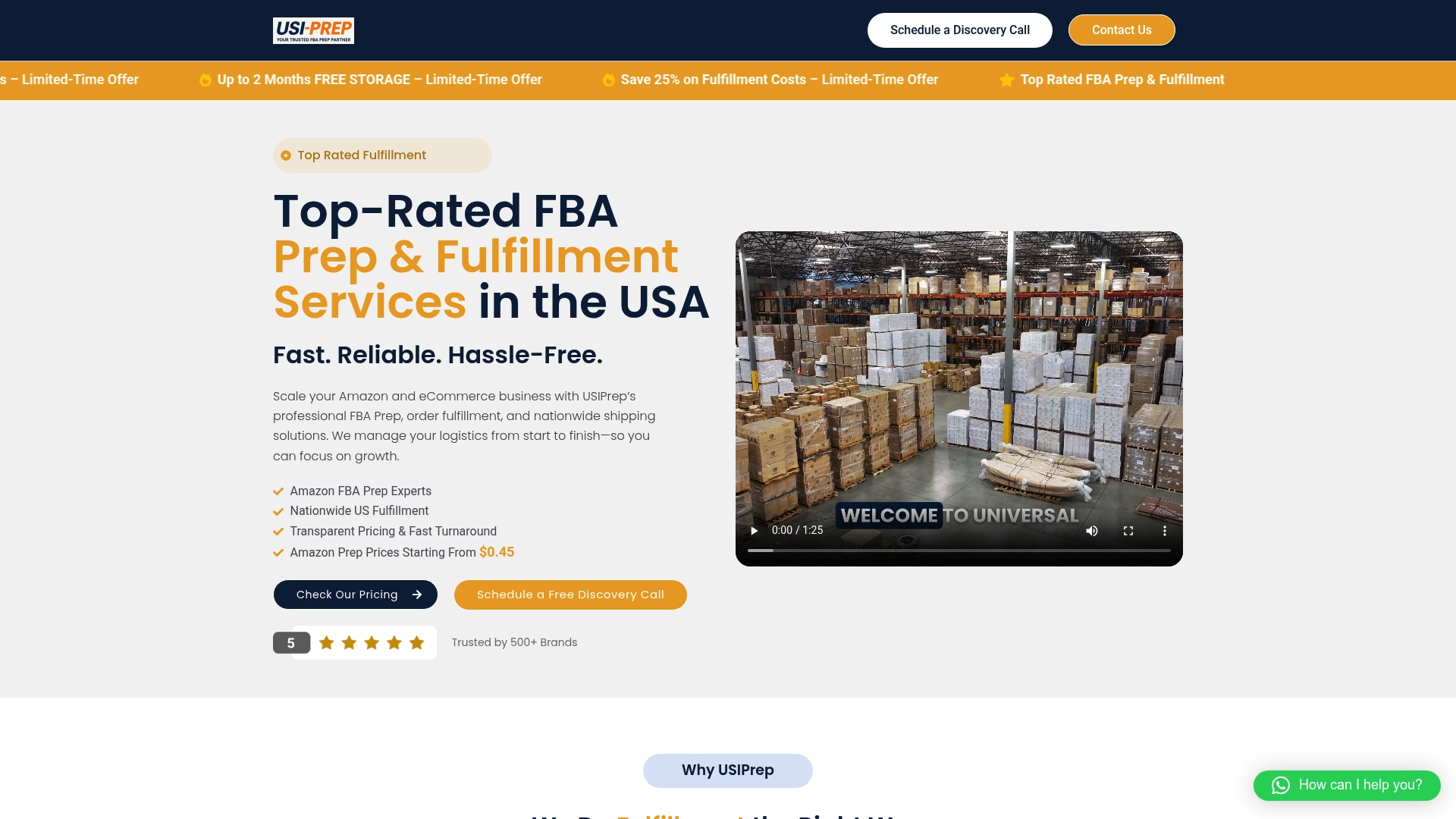
Usiprep was founded by former Amazon sellers who experienced exactly the contract surprises described here. The company built its fulfillment model around the transparency that most 3PL agreements lack, including faster inventory check-ins, clear pricing, and a 98.9% on-time delivery rate.
If you are preparing to sign a fulfillment agreement or evaluating your current provider, the FBA Prep Requirements Checklist 2026 is a practical starting point. It covers the compliance and operational standards your fulfillment partner should already meet. Usiprep also publishes transparent fulfillment pricing so you can compare real costs against what your current contract charges before you commit.
FAQ
What are the most important fulfillment contract terms to watch?
The most critical fulfillment agreement clauses are renewal notice windows, liability caps, hidden fee structures, and SLA remedies. Missing any one of these can result in unexpected costs or an inability to exit a poor-performing provider.
How long do standard 3PL contracts last?
Standard 3PL agreements run 12–24 months and typically require written notice 30–90 days before the end of the term to prevent automatic renewal.
What is the difference between an MSA and an SOW in a fulfillment contract?
The MSA covers legal risk and liability, while the SOW defines operational performance standards like order accuracy and processing times. Both documents require careful review before signing.
How can I avoid hidden fees in a fulfillment agreement?
Request a sample invoice before signing, audit billing monthly against your rate card, and confirm that all pass-through charges like carrier surcharges require itemized documentation. Regular parcel audits catch billing errors that accumulate over time.
What should an SLA include to be enforceable?
An enforceable SLA must include measurable metrics like order accuracy and turnaround time, plus specific penalty clauses or service credits for missed targets. Vague language like “best efforts” provides no real accountability.