
Self-fulfillment means you pick, pack, and ship orders yourself. Third-party logistics, or 3PL, means you hand that work to an outside provider. Knowing how to choose between 3PL and self fulfillment is one of the most consequential decisions you will make as an e-commerce seller. The wrong choice does not just cost money. It shapes your team’s daily workload, your customers’ experience, and your ability to grow. In-house fulfillment works best below 200–300 orders per month, while 3PL fees and minimums make that model less attractive at very low volume. This guide goes beyond simple order-count rules to help you match the right model to your actual operations.
What are the pros and cons of self-fulfillment?
Self-fulfillment gives you total control over the customer experience. You choose the box, the tissue paper, the handwritten note, and the shipping carrier. That control matters most when your brand identity lives inside the package itself.
The financial picture is more complicated. Self-fulfillment looks cheap at first because you avoid 3PL fees. The reality is that hidden fixed costs add up fast. Warehouse management software, packaging equipment, insurance, and management overhead are costs most entrepreneurs underestimate. Those costs can surpass 3PL per-order fees once you cross 500 orders per month.
Situations where self-fulfillment makes sense:
- You ship fewer than 200–300 orders per month
- Your products require custom assembly or fragile handling
- Most of your customers live near your warehouse location
- Your brand experience depends on highly personalized packaging
- You want to learn fulfillment operations before outsourcing them
Situations where self-fulfillment creates problems:
- Order volume spikes during Q4 or promotional events
- You lack dedicated warehouse space and trained staff
- Shipping costs are high because you cannot negotiate carrier rates
- Fulfillment tasks pull your attention away from product and marketing
Pro Tip: Track your true hourly cost of fulfillment, including your own time. Most founders forget to count their own labor. When you do, self-fulfillment often costs more than a 3PL at surprisingly low order volumes.
Scaling self-fulfillment during peak seasons is the hardest part. Hiring temporary workers, renting extra space, and buying more packaging supplies all take time you may not have. That operational pressure is where many sellers first consider switching models.
What are the advantages and drawbacks of using a 3PL provider?
A 3PL provider warehouses your inventory, picks and packs orders, and ships them on your behalf. The core financial advantage is access to negotiated carrier rates that individual shippers cannot get on their own. 3PLs consolidate volume across many clients, which gives them leverage with UPS, FedEx, and regional carriers. That rate advantage alone can offset a significant portion of their fees.

The cost structure of a 3PL is variable, not fixed. You pay per order, per pallet stored, and per unit picked. Typical 3PL minimums run $500–$1,000 per month, with pick-and-pack fees of $2.50–$4.00 per first item and storage fees of $10–$50 per pallet. That structure means your costs rise with volume but fall when volume drops, which is the opposite of running your own warehouse.
Key advantages of using a 3PL:
- Variable cost structure scales with your actual order volume
- Access to carrier pricing unavailable to small individual shippers
- No need to hire, train, or manage warehouse staff
- 3PLs act as a shock absorber during peak periods like Q4 without requiring you to lease extra space
- Dedicated teams track carrier performance and audit shipping invoices
Key drawbacks to plan for:
- Less direct control over daily packaging and fulfillment quality
- Contract terms often require 6–12 month commitments with surcharges during Black Friday and Q4
- You depend on clean data inputs and accurate volume forecasts
- Integration issues between your store platform and the 3PL’s system can cause errors
Pro Tip: Read every line of a 3PL contract before signing. Look specifically for seasonal surcharges, minimum monthly fees, and exit clauses. Hidden fees in fulfillment contracts are the number one source of budget surprises for new 3PL clients.
The biggest misconception about 3PLs is that they eliminate operational complexity. They do not. Complexity shifts to managing data, forecasts, and contract compliance rather than disappearing. You still need to send accurate inventory counts, packaging specs, and demand forecasts. Brands that treat a 3PL as a set-and-forget solution consistently underperform those that stay actively engaged.
How do you evaluate your business needs and choose the right model?
The real question is not “how many orders do I ship?” It is “where do I want fulfillment complexity to live?” That distinction separates brands that choose the right model from those that switch back and forth chasing cost savings.
Use these four criteria to guide your decision:
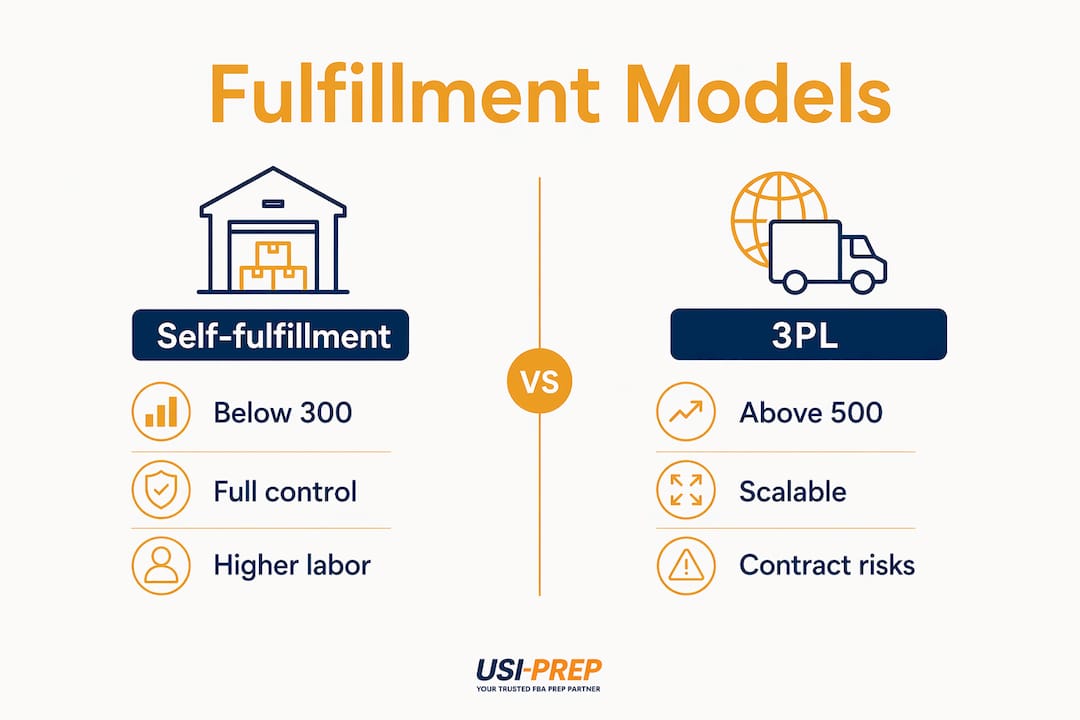
Order volume and SKU complexity. Below 200–300 monthly orders, self-fulfillment usually wins on cost. Above 500 orders per month, 3PL economics typically become favorable. SKU complexity matters too. A catalog of 200 SKUs with size variants is harder to manage in-house than 10 standard products.
Geographic customer distribution. If most of your customers live within 200 miles of your location, local self-fulfillment can outperform a national 3PL on both speed and cost. If your customers are spread across the country, a 3PL with multiple warehouse locations cuts transit times and shipping costs significantly.
Operational maturity. Do you have documented pick-and-pack processes, a warehouse management system, and trained staff? If not, self-fulfillment will consume management bandwidth that should go toward growth.
Hybrid fulfillment. A hybrid model uses a 3PL for high-volume standard SKUs while keeping custom or fragile items in-house. Hybrid fulfillment requires an order management system that routes orders automatically based on SKU, customer location, and inventory levels. Without that routing logic, manual errors will hurt your margins and customer satisfaction.
| Evaluation criterion | Self-fulfillment fit | 3PL fit |
|---|---|---|
| Monthly order volume | Below 300 orders | Above 500 orders |
| SKU complexity | Low, simple catalog | High, many variants |
| Customer geography | Mostly local | Nationally dispersed |
| Peak season capacity | Manageable in-house | Needs outside buffer |
| Brand packaging needs | Highly custom | Standard or flexible |
| Internal operational maturity | High, with systems | Low, early stage |
How do you implement your chosen fulfillment method?
Setting up self-fulfillment
Start with the physical and digital infrastructure before you ship a single order. You need a dedicated space, a barcode scanner, a shipping scale, and carrier accounts with UPS, FedEx, or USPS. A warehouse management system, even a basic one, prevents inventory errors that compound quickly. Document your pick-and-pack process in writing so any new hire can follow it on day one.
- Audit your current space and confirm it can handle your projected 90-day order volume
- Set up carrier accounts and compare rates using a multi-carrier shipping platform
- Choose and implement a warehouse management system before you need it
- Create written standard operating procedures for receiving, picking, packing, and shipping
- Run a test batch of 50 orders and measure error rate, time per order, and cost per shipment
Onboarding a 3PL partner
Research is the most important step. Review the 3PL’s technology integrations, contract terms, and client references before you commit. Check whether their system connects directly to Shopify, WooCommerce, or your sales platform. Understand their fulfillment center features before signing anything.
| Step | Self-fulfillment | 3PL onboarding |
|---|---|---|
| Week 1 | Secure space, order equipment | Sign contract, set up integration |
| Week 2 | Install WMS, set up carriers | Send inventory to 3PL warehouse |
| Week 3 | Write SOPs, train staff | Test order flow end to end |
| Week 4 | Run test batch, measure KPIs | Go live, monitor error rates |
| Ongoing | Review costs monthly | Audit invoices, update forecasts |
Pro Tip: For 3PL onboarding, always run a parallel test period where you fulfill some orders yourself while the 3PL handles others. This catches integration errors before they affect your entire customer base.
For a detailed walkthrough of the outsourcing process, Usiprep’s guide on outsourced order fulfillment covers the full setup sequence with practical timelines.
Common challenges and how to troubleshoot fulfillment issues
Every fulfillment model produces problems. Knowing which problems to expect lets you fix them before they become expensive.
Self-fulfillment challenges:
- Staffing gaps during peak seasons cause delays and errors
- Inconsistent packaging quality when multiple people handle orders
- Inventory discrepancies between your store platform and physical stock
- Burnout when founders handle fulfillment alongside every other business function
3PL challenges:
- Data mismatches between your system and the 3PL’s warehouse management system
- Unexpected fees from seasonal surcharges or minimum shortfalls
- Slow response times when issues arise with specific orders
- Loss of brand control when the 3PL uses generic packaging or makes substitutions
Pro Tip: Schedule a monthly performance review with your 3PL. Review on-time delivery rate, error rate, and cost per order. Bring data to every meeting. Partners who know you track performance consistently deliver better results.
Managing quality control is the central challenge for both models. For self-fulfillment, a simple checklist at the packing station catches most errors. For 3PL relationships, a clear service-level agreement with defined error thresholds gives you a contractual basis for demanding corrections. Understanding your fulfillment cost components in detail makes it easier to spot billing errors and cost creep before they compound.
Seasonality is the stress test for any fulfillment model. 3PLs absorb volume spikes without requiring you to act. Self-fulfillment requires you to plan staffing and space months in advance. If you consistently underestimate Q4 demand, that single data point is a strong argument for outsourcing.
Key Takeaways
The right fulfillment model depends on where you want operational complexity to live, not just how many orders you ship per month.
| Point | Details |
|---|---|
| Volume thresholds matter | Self-fulfillment wins below 300 orders per month; 3PL economics favor above 500. |
| Hidden costs are real | Self-fulfillment fixed costs often exceed 3PL fees once volume grows past 500 orders. |
| 3PLs shift complexity | Outsourcing moves work from warehouse ops to data management and contract oversight. |
| Hybrid models need systems | Automated order routing is required for hybrid fulfillment to work without margin loss. |
| Contract terms are critical | Review 3PL agreements for seasonal surcharges, minimums, and exit clauses before signing. |
The fulfillment decision most sellers get wrong
Most sellers treat the 3PL vs. self-fulfillment decision as a volume problem. They wait until they hit some magic order number and then scramble to switch. That approach costs them months of margin and operational pain.
The real variable is complexity tolerance. I have seen brands with 800 monthly orders thrive with self-fulfillment because they built tight systems and hired one dedicated warehouse person. I have also seen brands at 200 orders collapse under the weight of fulfillment because the founder was doing it alone between product development calls. Volume is a signal, not a verdict.
The hybrid model is underused and underrated. Routing your standard SKUs through a 3PL while keeping your custom or high-touch products in-house is not complicated if you have the right order management system. The mistake is trying to run hybrid fulfillment on spreadsheets. That always ends badly.
My strongest advice: revisit this decision every year. Your customer geography changes. Your SKU mix changes. Your team’s capacity changes. A fulfillment model that was right at $500,000 in annual revenue may be completely wrong at $2 million. Build the habit of reviewing your fulfillment economics annually, not just when something breaks.
— Akbar
Usiprep’s fulfillment solutions for e-commerce sellers
Usiprep was built by former Amazon sellers who experienced unreliable logistics firsthand. That background shapes every part of how Usiprep operates: faster inventory check-ins, transparent pricing, and a 98.9% on-time delivery rate that most sellers never see from generic providers.
Usiprep clients report a 30% reduction in fulfillment costs after switching. If you are preparing to send inventory to Amazon, the FBA prep requirements checklist gives you a clear starting point. For sellers evaluating full-service order fulfillment, Usiprep’s pricing page shows exactly what you pay with no hidden minimums buried in fine print.
FAQ
What order volume makes a 3PL cost-effective?
Most 3PLs become cost-effective at 500 or more orders per month. Below 200–300 monthly orders, self-fulfillment typically costs less once you account for 3PL minimum fees of $500–$1,000 per month.
What is hybrid fulfillment?
Hybrid fulfillment uses a 3PL for high-volume standard products and self-fulfillment for custom or fragile items. It requires an automated order management system to route orders correctly and avoid costly errors.
What hidden costs should I watch for in self-fulfillment?
Warehouse management software, packaging equipment, insurance, and your own labor are the most commonly overlooked costs. These fixed expenses often exceed 3PL per-order fees once volume grows past 500 orders per month.
How do I evaluate a 3PL before signing a contract?
Check for seasonal surcharges, monthly minimums, integration compatibility with your sales platform, and exit clause terms. Most 3PL contracts require 6–12 month commitments, so due diligence before signing protects your budget.
Does outsourcing to a 3PL eliminate operational complexity?
No. Outsourcing shifts complexity from warehouse management to data accuracy, volume forecasting, and contract compliance. Brands that stay actively engaged with their 3PL consistently outperform those that treat it as a hands-off arrangement.