
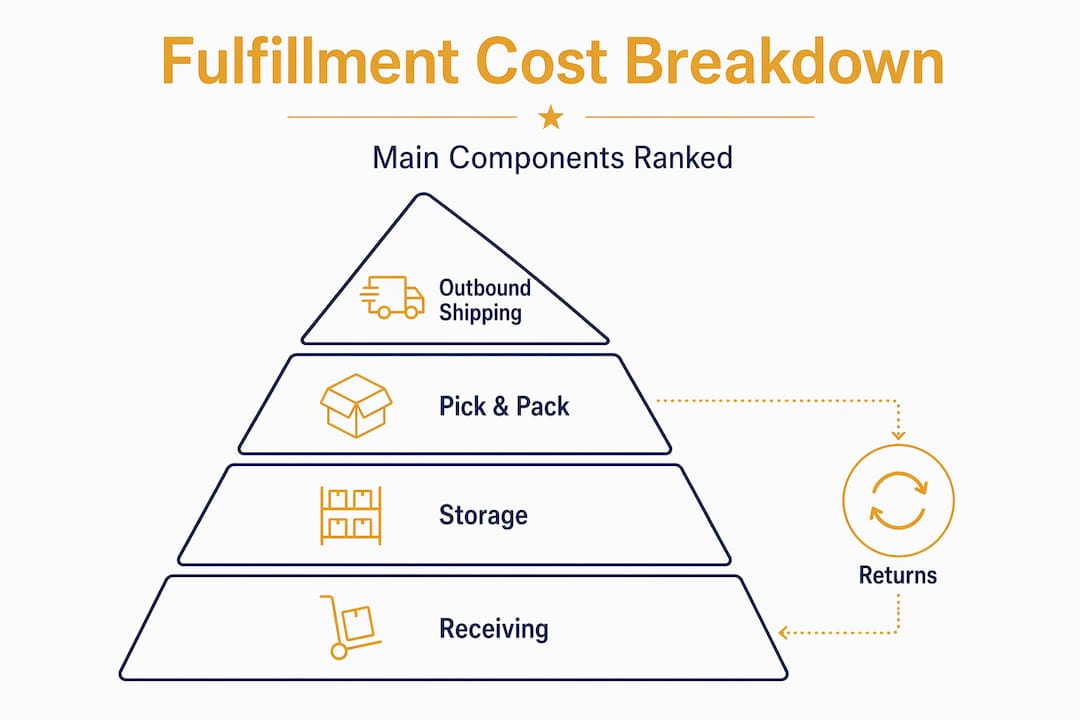
Every e-commerce business owner eventually faces the same shock: fulfillment costs are eating margins they didn’t know they had. Understanding what are fulfillment cost components is the first step to fixing that. Most sellers focus on the obvious line items and miss the ones quietly draining profit. Outbound shipping alone represents 50 to 60% of total fulfillment costs, and that’s before you account for returns, pallet errors, or account management fees. This guide breaks down every major and minor component so you can stop guessing and start making smarter decisions.
Table of Contents
- Key Takeaways
- Core fulfillment cost components explained
- Hidden fulfillment costs most sellers miss
- Fixed, variable, and semi-variable costs
- Practical ways to reduce fulfillment costs
- My take on fulfillment cost analysis
- How Usiprep helps you control fulfillment costs
- FAQ
Key Takeaways
| Point | Details |
|---|---|
| Shipping dominates your costs | Outbound shipping is 50 to 60% of fulfillment expenses, making carrier negotiation your highest-leverage move. |
| Hidden costs are real budget killers | Pallet errors, damage rates, and account management fees add up faster than most sellers expect. |
| Fixed vs. variable clarity matters | Knowing which costs scale with volume and which don’t is the foundation of smart fulfillment budgeting. |
| Returns are underestimated | Reverse logistics adds inspection, restocking, and labor costs that most cost analyses ignore entirely. |
| Transparent pricing saves money | Choosing a fulfillment partner with clear, itemized pricing prevents costly surprises at month end. |
Core fulfillment cost components explained
The fulfillment cost breakdown starts long before a package hits your customer’s door. It begins the moment inventory arrives at a warehouse.
Inbound receiving and processing
When your goods arrive at a fulfillment center, someone has to count them, inspect them, log them, and put them away. That work costs money. Receiving fees are typically charged per pallet, per carton, or per unit depending on the provider. If your shipment arrives disorganized or mislabeled, expect additional handling fees on top of the base rate.
Inventory storage
Storage fees go beyond rent. They include utilities, insurance, equipment maintenance, and compliance costs. You’ll generally pay based on square footage, pallet positions, or cubic footage. Climate-controlled storage for products like electronics or cosmetics carries a surcharge. The longer your inventory sits, the more storage costs compound. This is why slow-moving SKUs are often more expensive than sellers realize.
Pick and pack labor
This is where the physical order fulfillment happens. A warehouse worker (or robot) locates your item, picks it from the shelf, packages it, and labels it for shipping. Pick and pack fees typically range from $2.50 to $4.79 per order, with per-item add-ons for multi-unit orders. Packaging materials average around $1.19 per box, and order inserts run about $0.17 each.
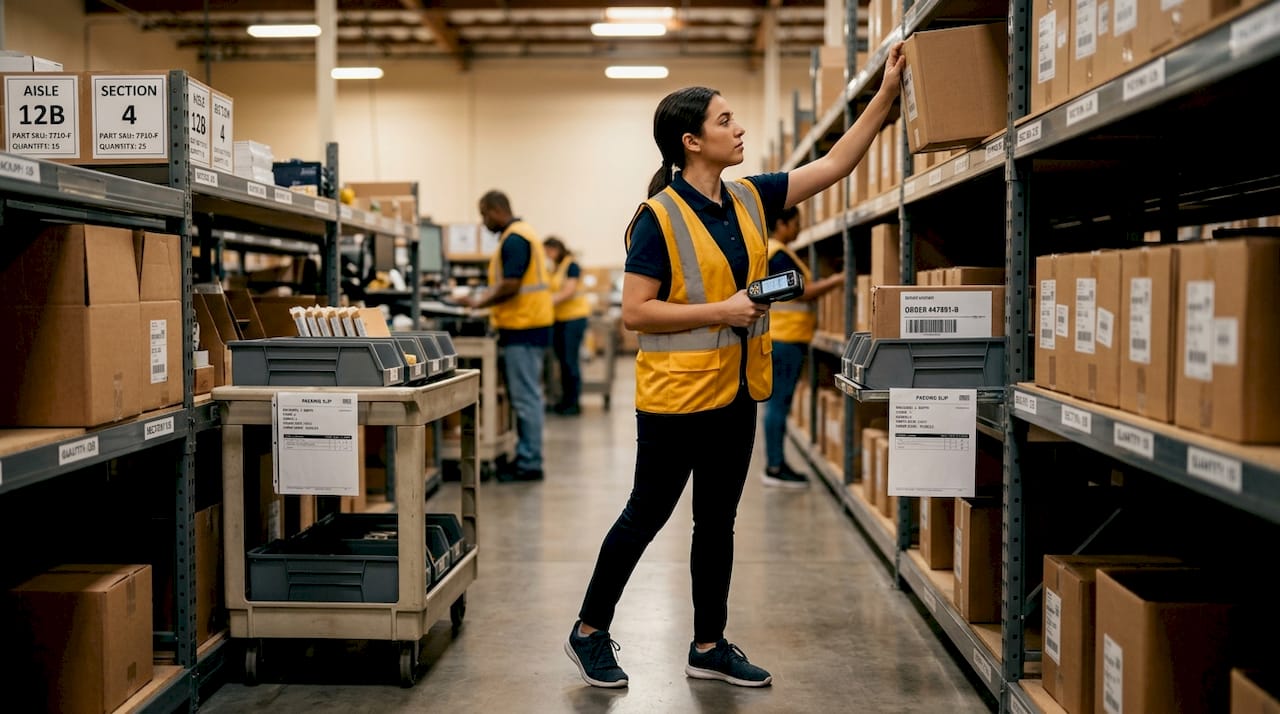
Automation is reshaping this cost center fast. AI-enabled autonomous mobile robots now perform 70 to 80 picks per hour, and many fulfillment providers offer these via a Robots-as-a-Service model that eliminates large upfront capital costs.
Outbound shipping
This is your biggest line item, full stop. Carrier fees depend on package weight, dimensional (DIM) weight, destination zone, and the service level selected. Fuel surcharges add another layer of volatility. In early 2026, fuel surcharges rose 26.7% year-over-year, meaning the cost of moving a package from your warehouse to your customer’s door got meaningfully more expensive with no warning.
DIM weight pricing is a trap many newer sellers fall into. Carriers charge based on whichever is greater: actual weight or dimensional weight. A lightweight but bulky product can cost as much to ship as something twice as heavy.
Returns and reverse logistics
Returns are not just a customer service issue. They are a cost issue. Returns add significant reverse logistics costs including inspection, restocking, and additional handling labor. Processing a return typically takes more time than processing an outbound order because each item must be evaluated individually before it can be resold or disposed of. Most fulfillment cost analyses undercount this expense by a wide margin.
Pro Tip: Track your return rate by SKU, not just overall. A single product with a 25% return rate can quietly destroy the margin on an otherwise healthy catalog.
Hidden fulfillment costs most sellers miss
Understanding fulfillment expenses means looking past the obvious line items. Here are the costs that rarely show up in a seller’s initial budget but consistently appear on their monthly invoices.
-
Pallet calculation errors. Pallet math errors cause rejected shipments, LTL surcharges, and damage risk. If your shipment doesn’t meet carrier or Amazon inbound requirements, you pay to re-ship it. That’s not a one-time mistake. It’s a recurring cost if you don’t fix the root cause.
-
Technology and software overhead. Warehouse management systems, order management platforms, and API integrations all carry licensing or usage fees. These costs are often buried in a fulfillment provider’s overhead and passed to you indirectly through higher per-order rates.
-
Kitting, labeling, and customization fees. If your products require special assembly, custom labeling, gift wrapping, or branded inserts, each of those services carries an additional charge. These are legitimate value-adds, but they need to be in your cost model from day one.
-
Damage rates and shrinkage. Product damaged in storage or transit, and inventory that goes missing, represents real financial loss. Providers vary widely in how they handle liability for these losses. Read the fine print.
-
Account management and call center fees. Account management fees can run around $102 per month, and call center services can cost roughly $1.29 per minute. If your fulfillment partner handles customer inquiries on your behalf, those costs add up quickly, especially during peak seasons.
Pro Tip: Ask any fulfillment provider for a full fee schedule before signing a contract. If they can’t produce one, that’s your answer about how transparent they’ll be once you’re a client.
Fixed, variable, and semi-variable costs
Understanding how costs behave as your order volume changes is critical for scaling without losing control of your margins. Misunderstanding fixed versus variable costs leads to poor scalability decisions and ineffective cost optimization.
Here’s how the three categories break down in fulfillment:
| Cost type | Examples | Behavior |
|---|---|---|
| Fixed | Warehouse lease, salaried staff, software licenses | Stays constant regardless of order volume |
| Variable | Packaging materials, pick and pack labor, outbound shipping | Scales directly with the number of orders processed |
| Semi-variable | Utilities, part-time labor, equipment maintenance | Has a fixed base with a variable component layered on top |
The practical implication: fixed costs hurt you when volume is low because you’re paying for capacity you’re not using. Variable costs hurt you when margins are thin because every order adds cost. The goal is to structure your fulfillment model so that fixed costs are minimized during slow periods and variable costs are negotiated down as volume grows.
A few pitfalls to avoid:
- Treating all fulfillment costs as variable when some are locked in by contract
- Failing to account for semi-variable costs when forecasting peak season expenses
- Underestimating how quickly variable costs compound during a high-volume promotion
Careful pallet planning is one area where getting the fixed-versus-variable distinction right pays off directly. Optimized pallet configurations reduce both per-shipment costs and damage rates, stabilizing your freight cost forecasts.
Practical ways to reduce fulfillment costs
Once you understand the components of fulfillment costs, you can target specific areas for reduction. Here’s where the real leverage is:
-
Negotiate carrier rates. Volume matters in carrier negotiations. If your current fulfillment provider doesn’t pass through negotiated rates, ask why. Some providers mark up carrier rates as a revenue source.
-
Invest in automation where it makes sense. Manual labor costs are being offset by robotics, helping businesses scale fulfillment more efficiently. You don’t need to own the robots. Partnering with a provider that uses them gives you the benefit without the capital expense.
-
Optimize your packaging. Oversized packaging increases DIM weight charges and wastes material. Audit your box sizes against your actual product dimensions. Even a small reduction in average box size can produce meaningful savings at scale.
-
Plan for returns proactively. Build a returns process before you need it. Define what “resellable” means, set inspection standards, and choose a provider that handles returns at a reasonable per-unit cost. Reactive returns management is always more expensive than planned returns management.
-
Choose providers with transparent pricing. Fulfillment cost analysis only works if you have accurate data. Providers that bundle fees or obscure their pricing make it nearly impossible to identify where money is going. Transparent, itemized billing is not just a nice-to-have. It’s a requirement for running a serious operation.
-
Review your storage footprint regularly. Slow-moving inventory is a storage cost that compounds silently. Set a quarterly review cadence for your SKU velocity and liquidate or discount slow movers before storage fees exceed their margin contribution.
My take on fulfillment cost analysis
When I first started working closely with e-commerce brands on their fulfillment operations, the most common mistake I saw wasn’t overspending. It was not knowing where the money was going. Sellers would look at their total fulfillment invoice and treat it as a single number rather than a collection of controllable line items.
The shift that changed everything for most of them was separating fixed from variable costs. Once you know that your warehouse lease is fixed and your pick and pack labor is variable, you start making different decisions. You stop cutting the wrong things during slow periods and you start negotiating the right things during growth phases.
I’ve also seen reverse logistics destroy margins on otherwise profitable businesses. A 15% return rate sounds manageable until you calculate the labor, inspection, and restocking cost on every single unit. That number rarely shows up in a seller’s initial cost model, and it absolutely should.
On automation: I’m genuinely impressed by what robotics is doing to pick rates and accuracy. But I’d caution against assuming technology alone solves cost problems. The providers using automation most effectively are the ones who also have clean processes and transparent pricing. Technology built on top of a disorganized operation just creates faster chaos.
The practical advice I give every brand is this: demand itemized billing, review it monthly, and benchmark every line item against alternatives at least once a year. Fulfillment costs are not fixed facts. They are negotiable, manageable, and reducible if you treat them that way.
— Akbar
How Usiprep helps you control fulfillment costs
Usiprep was built by former Amazon sellers who lived through exactly the cost problems described in this article. They know what a surprise pallet rejection costs. They know what opaque billing does to a brand’s ability to plan. That’s why Usiprep operates on transparent, itemized pricing with no hidden fees and faster inventory check-ins than most traditional 3PLs.
Brands working with Usiprep have seen up to a 30% reduction in fulfillment costs, backed by a 98.9% on-time delivery rate. The combination of advanced technology, clear communication, and a team that understands Amazon FBA requirements from the inside means you get fewer rejected shipments, lower damage rates, and a fulfillment partner that actually helps you scale. If you’re ready to see what transparent fulfillment looks like, explore Usiprep’s FBA prep services and find a cost structure that works for your business.
FAQ
What are the main fulfillment cost components?
The main components include inbound receiving, inventory storage, pick and pack labor, packaging materials, outbound shipping, and returns processing. Outbound shipping typically accounts for 50 to 60% of total fulfillment costs.
How do I calculate fulfillment costs per order?
Add up all fulfillment-related expenses for a period, including storage, labor, shipping, and returns, then divide by the total number of orders shipped. Most providers also offer per-order rate cards that make this calculation easier.
What hidden costs should I watch for in fulfillment?
Pallet calculation errors, account management fees, kitting charges, damage rates, and call center costs are the most commonly overlooked expenses in a fulfillment cost breakdown.
Why does outbound shipping cost so much?
Outbound shipping is driven by package weight, DIM weight, carrier zone, service level, and fuel surcharges. Fuel surcharges rose 26.7% year-over-year in early 2026, making this cost category especially volatile.
How can I reduce my fulfillment costs?
Negotiate carrier rates, optimize packaging dimensions, audit slow-moving inventory, plan for returns in advance, and choose a fulfillment provider with fully transparent pricing and itemized billing.