
A fulfillment fee audit is a systematic review process that verifies every logistics charge against actual services rendered and contracted rates to detect errors, overcharges, and hidden costs. For Amazon FBA sellers and small eCommerce brands, these audits are not optional financial housekeeping. They are the primary defense against a billing system that, by its complexity alone, generates consistent errors. Understanding fulfillment fees starts with knowing that fees vary annually and sometimes mid-year, meaning the rate you agreed to in january may not be the rate you pay in september.
How fulfillment fee audits work: types of fees and common errors
Fulfillment cost audits begin with mapping every fee category on your invoices. The main categories are fulfillment fees, storage fees, inbound receiving fees, carrier surcharges, and referral fees. Each one carries its own error risk.

| Fee Type | What It Covers | Common Error |
|---|---|---|
| Fulfillment fee | Pick, pack, and ship per order | Wrong size tier applied |
| Storage fee | Monthly inventory holding cost | Excess inventory misclassified |
| Inbound receiving | Processing shipments into FBA | Duplicate charges on split shipments |
| Carrier surcharge | Dimensional weight, fuel, residential | Dimensional weight inflated |
| Referral fee | Percentage of sale price by category | Wrong category assigned |
The most damaging error type is dimensional weight misclassification. Amazon may re-measure products and reclassify them into more expensive size tiers, triggering higher fees on every single unit sold. A product that ships as a small standard item can suddenly bill as a large standard item after a remeasurement event you were never notified about.
The second major risk is the “other” fee bucket on 3PL invoices. 3PL invoices often bundle surcharges into an opaque line item that hides dimensional weight adjustments, non-standard packaging fees, and address correction charges. Reviewing at least 90 days of invoices helps surface sporadic hidden fees that inflate your costs without appearing on any single statement.
- Phantom orders: Billed shipments that do not match your actual order count
- Duplicate receiving charges: The same inbound shipment billed twice after a split
- Wrong category referral fees: Products assigned to a higher-commission category
- Undisclosed surcharges: Fuel, residential delivery, and peak season fees buried in “other”
Pro Tip: Pull your Amazon Fee Preview report and your Inventory Adjustments report side by side. Discrepancies between what Amazon projected and what it charged are your starting point for every audit.
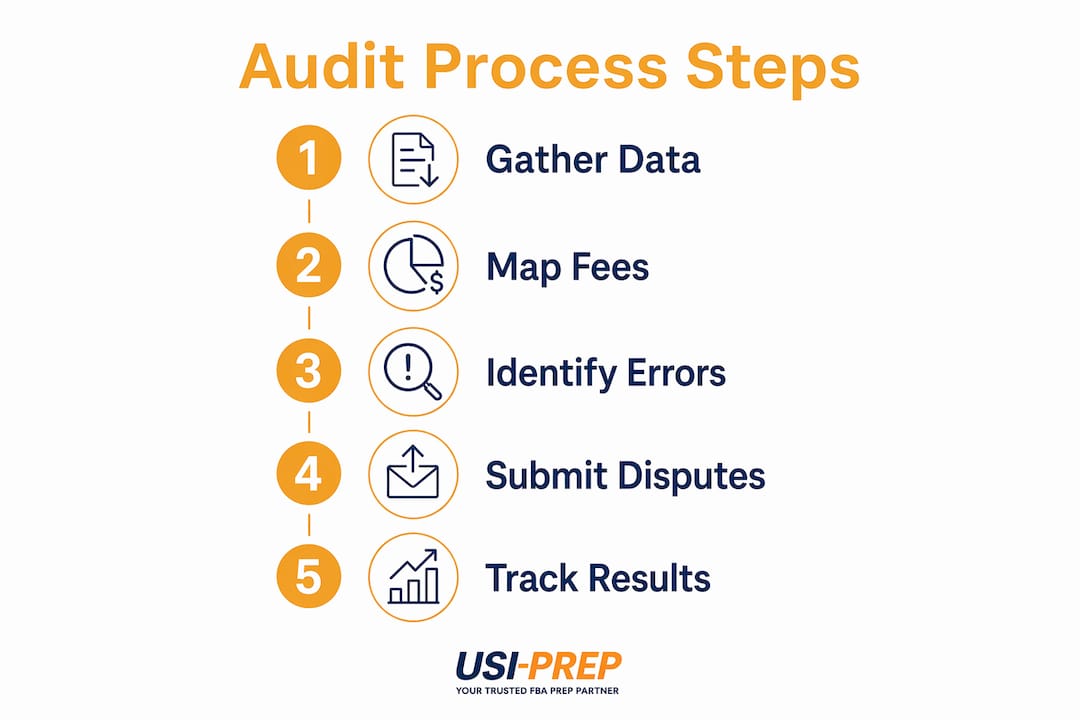
Step-by-step process for auditing your fulfillment fees
The fee audit process follows a clear sequence. Skipping steps creates gaps that let errors slip through.
-
Download your fee reports. In Amazon Seller Central, pull the Fee Preview report, the Payments report, and the Inventory Adjustments report. For 3PL accounts, request itemized invoices broken down by fee type, not summary totals.
-
Build a comparison ledger. Create a spreadsheet with columns for each fee category. Enter the contracted rate, the billed rate, and the quantity billed. Flag any line where billed rate exceeds contracted rate by more than a rounding difference.
-
Check dimensions and weights. Compare your recorded product dimensions and weights against what Amazon or your 3PL billed. Dimensional weight misclassification is the most frequent source of FBA fee overcharges, and it requires physical verification against your own measurements.
-
Reconcile reimbursements. Amazon’s auto-reimbursement system often pays based on retail price, not your actual cost. Providing supplier invoices with cost basis documentation can recover an additional 10–30% beyond the default reimbursement amount.
-
Document every discrepancy. For dimensional weight disputes, photograph the product on a scale next to a tape measure. Photographic evidence showing true dimensions and weight is required to trigger Amazon’s remeasurement process. Screenshot the billed fee alongside your evidence.
-
Submit correction requests. Open a case in Seller Central for each discrepancy. Reference the specific transaction ID, the billed amount, the correct amount, and attach your evidence. For 3PL disputes, send a formal written discrepancy report referencing the contract rate.
-
Track outcomes and verify corrections. After a case closes, confirm the corrected fee appears on your next statement. Many sellers win a dispute but never verify the fix applied going forward.
Pro Tip: Never submit multiple disputes in a single case. Amazon’s support system handles one ASIN or one transaction per ticket. Bundling claims slows resolution and increases the chance of partial denial.
Why regular audits matter and how often to run them
Amazon’s FBA reimbursement claim window is now 60 days, reduced from the previous 18-month window. That change alone makes monthly audits non-negotiable. Miss a 60-day window and the claim is gone permanently.
The financial stakes are concrete. Billing errors appear in 3–5% of total 3PL invoice value. For a brand spending $30,000 monthly on fulfillment, that translates to $10,800–$18,000 in annual losses from uncorrected errors. That figure does not include Amazon FBA overcharges, which compound separately.
Approving invoices without auditing them is an expensive habit because billing errors consistently favor providers, not sellers. The assumption that your 3PL or Amazon will self-correct is not supported by how these systems actually operate.
The benefits of running audits monthly include:
- Catching charge spikes within the 60-day claim window before they expire
- Building a baseline of your true cost per order for contract renegotiation
- Identifying seasonal surcharge patterns before they repeat
- Maintaining clean financial records that support accurate profit margin reporting
- Creating documented leverage when negotiating rate adjustments with your 3PL
Understanding fulfillment cost components across all fee categories gives you the baseline you need to spot deviations quickly. Without that baseline, every invoice looks normal until the losses accumulate.
What tools make fulfillment service audits faster and more accurate
The right tools reduce audit time from days to hours. The wrong approach is reviewing invoices manually without a structured ledger.
Amazon Seller Central provides several reports that are the foundation of any FBA audit. The Fee Preview report shows projected fees before they are charged. The Payments report shows what was actually charged. The Inventory Adjustments report tracks lost, damaged, and reimbursed inventory. Running all three together reveals gaps between what Amazon planned to charge and what it actually collected.
Cost reduction depends on measurement infrastructure, not just negotiation. Tracking KPIs like cost per order, storage cost per SKU, and return rate by product gives you the data to act on audit findings rather than just document them. Monthly dashboards built from these metrics show whether fee corrections are holding or reverting.
For 3PL audits, the core technique is breaking the invoice into categories and comparing each against contract rates and prior periods. A spreadsheet ledger with columns for contracted rate, billed rate, variance, and status handles this well for brands under $100,000 in monthly fulfillment spend. Larger operations benefit from dedicated audit software that automates invoice parsing and flags deviations automatically.
Key tools and resources to use:
- Amazon Seller Central: Fee Preview, Payments, and Inventory Adjustments reports
- Spreadsheet ledger: Google Sheets or Excel with contract rate columns and variance formulas
- Supplier invoices: Required for cost basis reimbursement disputes
- Photo documentation: Scale and tape measure photos for dimensional weight disputes
- Usiprep’s hidden fee guides: The hidden fees in fulfillment contracts resource covers specific contract clauses that generate recurring overcharges
Choosing the right tool depends on your volume. A seller processing 200 orders per month needs a solid spreadsheet and a monthly calendar reminder. A seller processing 5,000 orders per month needs automated reconciliation software to catch errors before they compound across thousands of transactions.
Key Takeaways
Fulfillment fee audits recover real money by catching billing errors that providers do not self-correct, and monthly audits are the only way to stay within Amazon’s 60-day claim window.
| Point | Details |
|---|---|
| Audit monthly without exception | Amazon’s 60-day claim window closes permanently, making monthly review the minimum viable cadence. |
| Dimensional weight errors are the top FBA risk | Amazon remeasures products without notice; verify dimensions physically and dispute with photo evidence. |
| The “other” fee bucket hides real costs | Review 90 days of 3PL invoices to surface sporadic surcharges buried in opaque line items. |
| Auto-reimbursements often underpay | Submit supplier invoices with cost basis to recover 10–30% more than Amazon’s default retail price payout. |
| Measurement infrastructure drives savings | Track cost per order and storage cost per SKU monthly to turn audit findings into renegotiation leverage. |
What I’ve learned from watching sellers leave money on the table
Sellers consistently underestimate how much they lose to fulfillment billing errors. The losses are not dramatic line items. They are $0.40 here, $1.20 there, compounding across thousands of transactions until the annual total is genuinely painful.
The sellers who recover the most are not the ones who audit hardest once a year. They are the ones who build a 90-minute monthly routine and stick to it. Consistency beats intensity in this process. A thorough annual audit misses 11 months of 60-day claim windows. A quick monthly check catches everything in time.
The relationship with your fulfillment provider matters more than most sellers realize. Providers who know you audit regularly are more careful with your account. Transparency works both ways. When you show up with documented discrepancies and contract references, you get faster resolutions than sellers who dispute vaguely.
The hardest part of auditing is not the math. It is gathering the right evidence before the window closes. Most sellers lose disputes not because they were wrong, but because they submitted a claim without the photo documentation or supplier invoice that Amazon requires. Build your evidence file as you receive inventory, not after a dispute opens.
Audit findings are also your best negotiation tool. A 12-month record showing consistent overcharges in a specific fee category gives you concrete grounds to request a rate adjustment or contract revision. That conversation is much easier when you arrive with data rather than frustration.
— Akbar
How Usiprep helps sellers audit and control fulfillment costs
Usiprep was founded by former Amazon sellers who understand exactly where billing errors hide and how much they cost. The company’s FBA prep and fulfillment services are built around complete cost visibility, which means clients have the clean data they need to audit accurately from day one.
Usiprep clients report a 30% reduction in fulfillment costs, and that result comes partly from the audit clarity that transparent pricing creates. If you want a structured starting point, the FBA prep requirements checklist covers the shipment preparation steps that prevent the dimensional weight errors and receiving discrepancies that drive most FBA overcharges. For sellers ready to compare fulfillment options with full fee transparency, the Usiprep pricing page shows exactly what you pay before you commit.
FAQ
What is a fulfillment fee audit?
A fulfillment fee audit is a structured review of all logistics charges billed by Amazon FBA or a third-party logistics provider, compared against contracted rates and actual services to identify overcharges, errors, and hidden fees.
How often should I audit my fulfillment fees?
Monthly audits are the minimum standard. Amazon’s reimbursement claim window is now 60 days, so any longer interval risks missing claims permanently.
What are the most common errors found in FBA fee audits?
Dimensional weight misclassification and wrong size tier assignments are the most frequent FBA errors. For 3PL invoices, phantom orders and fees buried in the “other” category are the primary issues.
Do I need special software to audit fulfillment fees?
Sellers processing fewer than a few hundred orders monthly can audit effectively with Amazon Seller Central reports and a spreadsheet ledger. Higher-volume sellers benefit from dedicated reconciliation software that automates invoice parsing and flags deviations.
Can I dispute Amazon FBA fees successfully without professional help?
Yes, but success depends on submitting the right evidence. Dimensional weight disputes require photographs of the product on a scale next to a tape measure. Reimbursement disputes require supplier invoices showing your actual cost basis, not just the retail price Amazon defaults to.