
A fulfillment SLA, or service level agreement, is a measurable commitment that defines how quickly and accurately orders move through each stage of the fulfillment process, from receipt to delivery. Understanding how fulfillment SLAs work is the difference between a logistics operation that scales and one that bleeds money through late shipments, chargebacks, and lost marketplace standing. Platforms like Amazon and third-party logistics providers such as ShipBob build their entire operational frameworks around SLA compliance. For ecommerce entrepreneurs, these agreements are not paperwork formalities. They are the contractual backbone of every customer promise you make.
What are the critical components of fulfillment SLAs?
A fulfillment SLA covers every operational step between an order being placed and the package leaving the warehouse. The agreement must define scope, performance targets, communication standards, and what happens when things go wrong.
The core operational components include:
- Order processing time: How long the 3PL has to acknowledge and begin picking after an order arrives in the system.
- Pick-and-pack accuracy: The percentage of orders picked and packed without errors. Industry-standard targets typically sit above 99%.
- On-time dispatch: On-time dispatch is defined as orders leaving the warehouse before a precise cut-off time, and the SLA must specify the conditions, exclusions, and measurement criteria.
- Inventory handling: Receiving timelines, check-in accuracy, and storage location protocols.
- Data visibility: Real-time inventory sync and order status updates between the seller’s platform and the 3PL’s warehouse management system.
- Exception management: Predefined procedures for backorders, damaged goods, and carrier delays.
Pro Tip: Require your 3PL to provide a written definition of how each metric is measured. “On-time dispatch” means nothing if the 3PL measures it from when they print the label rather than when the carrier scans the package.
Real-time inventory sync, address validation, and customer notification workflows are not optional add-ons. They are the infrastructure that keeps cancellation rates and return-to-sender rates under control.

How do internal and external fulfillment SLAs differ?
Internal and external SLAs operate at different levels of the fulfillment chain, and confusing the two is one of the most common mistakes ecommerce sellers make when setting up 3PL partnerships.
An internal SLA is an operational target set between you and your fulfillment partner. It governs warehouse-level performance. An external SLA is the promise you make to your customer, typically expressed as a handling time and delivery window on your product listing.
Internal SLAs commonly set a 2-hour pick-and-pack window after order receipt, while external SLAs promise shipment within 1 business day and delivery within 3–5 business days. That gap between internal and external targets is your buffer. If your 3PL misses the internal target, your external promise to the customer is still at risk.
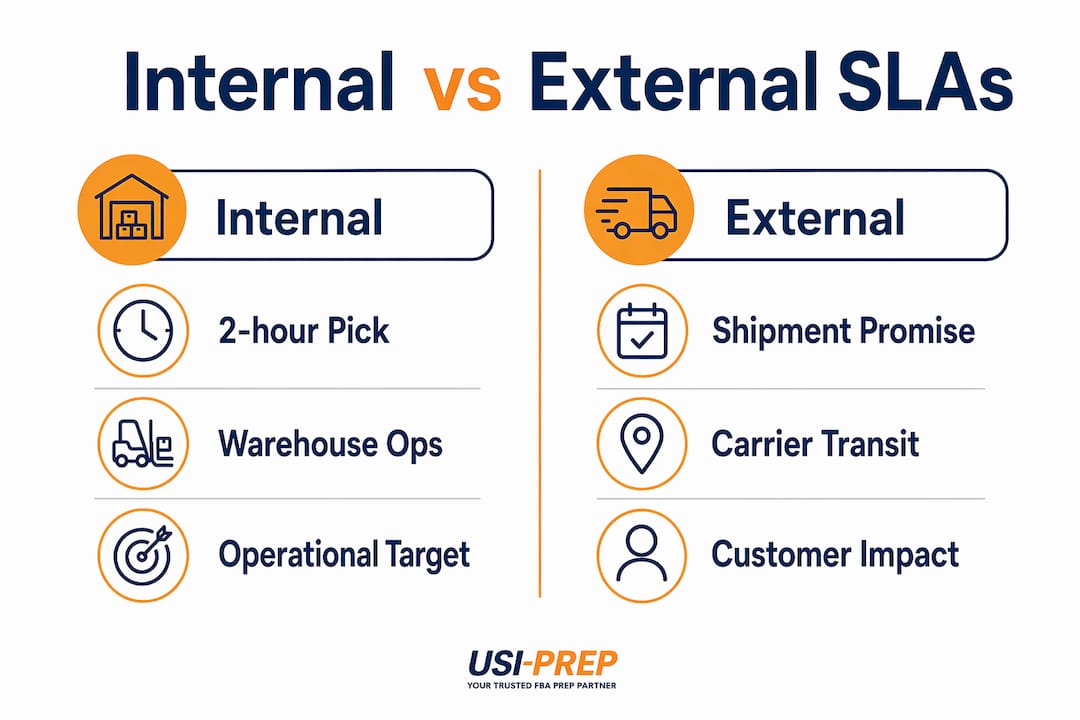
| SLA Type | Typical Target | Who It Governs | Impact if Missed |
|---|---|---|---|
| Internal | 2-hour pick-and-pack | Seller and 3PL | Delayed dispatch, SLA breach |
| External (handling) | 1 business day ship | Seller and customer | Marketplace penalty, negative review |
| External (delivery) | 3–5 business days | Carrier and customer | Refund request, lost trust |
| Carrier zone-specific | Varies by zone | Carrier and 3PL | Delivery promise failure |
Each carrier service level has zone-specific contracted transit times that must be tracked individually. Relying on a generic “3–5 day” range across all zones is a fast path to broken delivery promises in distant shipping zones.
The relationship between internal and external SLAs also shapes your technology requirements. If your internal SLA calls for a 2-hour pick-and-pack window, your warehouse management system needs to push orders to the pick floor automatically. Manual order routing will not meet that target at any meaningful volume.
What are the key metrics and KPIs in fulfillment SLAs?
SLA performance is only as good as the metrics used to measure it. Vague commitments without defined KPIs give 3PLs room to underperform without technically breaching the contract.
The metrics that matter most:
- Late shipment rate: Late shipment rate measures the percentage of orders shipped beyond the promised handling time. Amazon uses this metric directly to evaluate seller account health.
- Order cancellation rate: Orders canceled because of stockouts or processing failures. High cancellation rates signal inventory sync failures.
- Return-to-sender (RTS) rate: Packages that fail delivery and return to the warehouse. Address validation at checkout reduces this significantly.
- Inventory accuracy: The percentage of physical stock that matches the system record. Discrepancies here cause both overselling and missed fulfillment.
- Pick-to-pack cycle time: Measuring pick-to-pack as an end-to-end process is critical. Fragmented metrics can hide true dwell times and cause SLA misalignments that only show up when a shipment is already late.
Tracking these KPIs requires more than a monthly report from your 3PL. You need access to the raw data, not just a summary. Build a requirement for weekly or real-time performance dashboards into your SLA before you sign.
Pro Tip: Ask your 3PL how they calculate late shipment rate. If they exclude weekends, holidays, or “system downtime” from the calculation, your actual performance may look better on paper than it does to your customers.
How does exception handling work in fulfillment SLAs?
Exception handling is the section of a fulfillment SLA that most sellers skip during negotiation and regret during operations. Exceptions are the moments when normal SLA timers should stop, and they need to be defined in writing before they happen.
Common exception scenarios include:
- Damaged inbound inventory: The 3PL receives stock that cannot be fulfilled. The SLA must specify how quickly they notify you, what documentation they provide, and how long they have to quarantine or return the goods.
- Missing inventory: Units that arrive short against the packing list. The SLA should define the investigation timeline and who bears the cost of the discrepancy.
- Carrier pickup failures: The carrier does not collect on schedule. The SLA must clarify whether the 3PL is responsible for rebooking and within what timeframe.
- System outages: Platform or API failures that prevent order transmission. Define the maximum acceptable downtime and the escalation path.
- Peak season surges: Order volumes that exceed agreed capacity. The SLA should include a surge threshold and a protocol for temporary capacity expansion.
Exception protocols must define “pause the clock” scenarios such as damaged or missing inventory, with pre-set resolution timelines. Without these definitions, 3PLs can halt SLA timers without any predefined handling procedure, leaving you with no recourse.
Pro Tip: Require a maximum resolution timeline for every exception category. “We will investigate” is not a commitment. “We will provide a written resolution within 48 hours” is.
Customer communication during exceptions is equally important. Your SLA should specify when and how customers get notified of delays, who sends the notification, and what the reship or refund policy is for orders affected by 3PL-caused exceptions.
How can you negotiate and implement an effective fulfillment SLA?
Negotiating a fulfillment SLA with a 3PL is not just about agreeing on numbers. It is about defining responsibilities explicitly between brand and 3PL, including data access, system integration, and performance reporting frequency.
Key elements to build into your SLA negotiation:
- Explicit ownership mapping: Every task in the fulfillment chain must have a named responsible party. Assumed ownership is where SLAs fail.
- Data access rights: You must have direct access to inventory and order data, not just what the 3PL chooses to share in a report.
- Performance reporting cadence: Weekly scorecards at minimum. Real-time dashboards for high-volume operations.
- Peak season clauses: Strong SLAs contain continuous improvement clauses and peak season adjustment protocols to handle fluctuating order volumes.
- Technology requirements: Webhooks and pre-authorized payment systems speed up order processing by reducing API polling delays and payment holds, tightening SLA windows.
When setting up outsourced fulfillment, the SLA negotiation phase is where you protect yourself from operational failures that will otherwise cost you customers and marketplace standing. Do not treat it as a formality.
Before signing with any fulfillment center, compare the features each center offers against your SLA requirements. Not every 3PL has the technology infrastructure to support real-time data access or automated exception alerts.
Key Takeaways
Fulfillment SLAs work by setting measurable commitments on timing, accuracy, and exception handling that protect both your customer promises and your marketplace standing.
| Point | Details |
|---|---|
| Internal vs. external SLAs | Internal SLAs govern 3PL operations; external SLAs are the promises you make to customers. |
| Exception protocols are non-negotiable | Define “pause the clock” scenarios and resolution timelines before signing any 3PL contract. |
| KPIs need raw data access | Require real-time dashboards, not just monthly summaries, to catch SLA failures early. |
| Peak season clauses protect you | Build surge capacity and continuous improvement requirements into every SLA. |
| Ownership must be explicit | Assumed responsibility is the leading cause of SLA failures, not execution errors. |
Why most SLA failures are ownership problems, not execution problems
The uncomfortable truth I have seen repeatedly in ecommerce logistics is that most SLA failures do not happen because a warehouse team is slow. They happen because nobody agreed in writing on who owned a specific task. A shipment sits for six hours because the 3PL assumed the seller would flag the order as ready. The seller assumed the 3PL’s system would pull it automatically. Both assumptions were wrong, and neither was in the contract.
Many SLA failures arise from unclear ownership and data visibility issues, not just execution inefficiencies. That finding matches exactly what I have seen in practice. The fix is not better warehouse staff. It is a more specific contract.
Exception handling is the second area where sellers consistently leave themselves exposed. Most sellers negotiate the headline metrics, agree on a 99% accuracy target and a 1-day handling time, and then sign without ever discussing what happens when inbound inventory arrives damaged. Six months later, a bad receiving week turns into a week of missed shipments, and the SLA offers no protection because the exception was never defined.
The sellers who get the most out of their 3PL relationships treat the SLA as a living document. They review KPI data weekly, flag trends before they become breaches, and use the continuous improvement clause to push for process changes. That approach builds the kind of operational trust that makes scaling feel manageable rather than chaotic.
— Akbar
Usiprep’s approach to SLA-grade fulfillment
Usiprep was built by former Amazon sellers who experienced firsthand what unreliable fulfillment does to a brand. The company’s 98.9% on-time delivery rate and the 30% reduction in fulfillment costs reported by many of its clients are direct results of the operational standards baked into every partnership.
Usiprep’s pick-and-pack process, inventory check-in speed, and real-time visibility tools are designed to meet the SLA targets this article describes, not just approximate them. If you sell on Amazon and need your prep and shipment process to stay inside tight SLA windows, the FBA prep requirements checklist is the right starting point. For sellers ready to move faster on outbound orders, the FBA shipment checklist walks through every step needed to keep dispatch times on target.
FAQ
What is a fulfillment SLA?
A fulfillment SLA is a written agreement between a seller and a fulfillment provider that defines measurable performance targets for order processing, accuracy, and delivery timing. It covers both internal operational targets and the external promises made to customers.
What is a typical internal SLA for pick-and-pack?
Internal fulfillment SLAs commonly set a 2-hour pick-and-pack window after order receipt. This internal target supports the external promise of same-day or next-business-day shipment.
How is late shipment rate calculated in a fulfillment SLA?
Late shipment rate measures the percentage of orders shipped after the promised handling time window. Marketplaces like Amazon track this metric directly and use it to evaluate seller account health.
What happens when a 3PL misses an SLA target?
The SLA should specify financial penalties, required corrective action plans, or escalation procedures when targets are missed. Without these clauses, a missed SLA has no contractual consequence.
How do I track SLA compliance with my 3PL?
Require real-time or weekly performance dashboards with access to raw order and inventory data. Tracking pick-to-pack as an end-to-end process, rather than in fragments, prevents 3PLs from masking true dwell times in their reporting.