
A fulfillment center is a specialized logistics facility that stores inventory, processes orders, packs shipments, and delivers products directly to customers on behalf of ecommerce businesses. Unlike a general storage unit or a traditional warehouse, a fulfillment center is built for speed and accuracy at the individual order level. Fulfillment centers handle receiving inbound inventory, storage, picking and packing, shipping, and returns management. For small to mid-sized ecommerce sellers, outsourcing these operations to a fulfillment center can mean the difference between scaling confidently and drowning in logistics.
What is a fulfillment center and what does it actually do?
A fulfillment center is the operational engine behind most successful ecommerce brands. When a customer places an order on your Shopify or Amazon store, the fulfillment center receives that order, locates the product in its warehouse, packs it, labels it, and hands it off to a carrier like FedEx, UPS, or USPS. Order fulfillment covers the entire end-to-end process from receiving orders to delivery, with a focus on orchestrating inventory, picking and packing, and shipping logistics to meet customer expectations.
The fulfillment center meaning goes beyond simple storage. These facilities run on warehouse management systems (WMS) that track every SKU in real time, generate pick lists automatically, and sync order data with your sales platforms. The result is faster processing, fewer errors, and customers who receive their orders on time. Fulfillment centers improve speed, accuracy, and customer satisfaction by offloading operational burdens from ecommerce sellers.

How fulfillment centers work: the step-by-step process
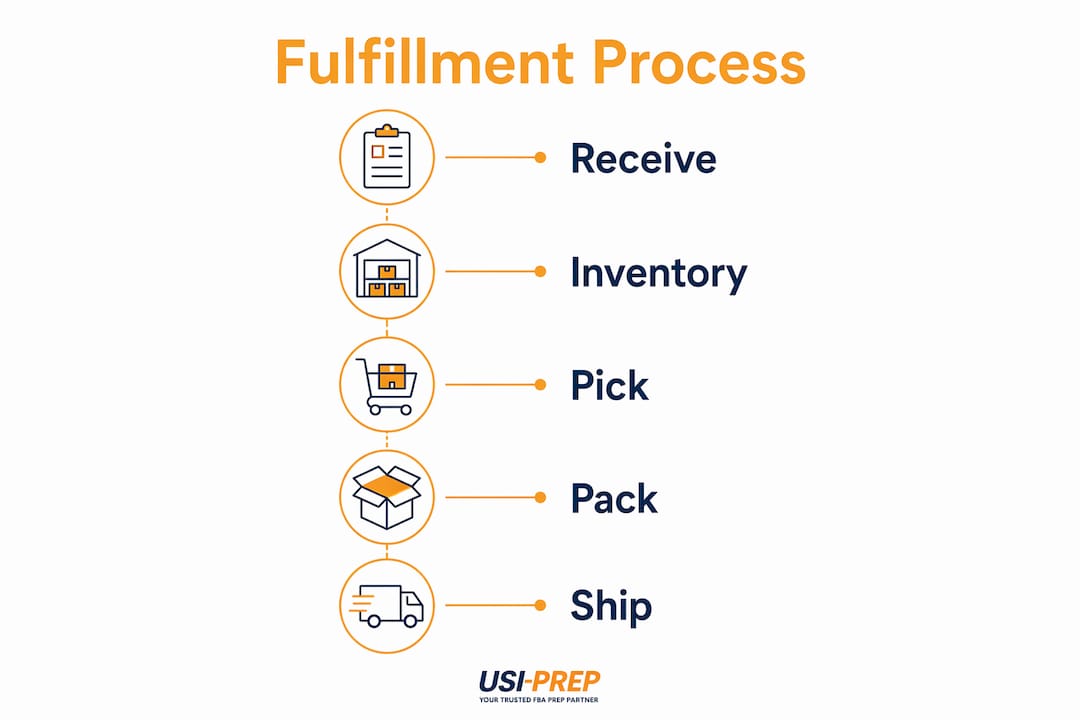
Understanding the operational flow inside a fulfillment center helps you evaluate whether a provider can actually meet your business needs. Here is the standard workflow most third-party logistics (3PL) providers follow:
- Inbound receiving. Your inventory arrives at the fulfillment center. Staff inspect, count, and log each unit into the WMS. Accurate check-in at this stage prevents downstream errors.
- Storage and slotting. Products are assigned bin locations based on size, velocity, and SKU type. Fast-moving items go in accessible zones to cut pick times.
- Order receipt and processing. When a customer places an order, the fulfillment center’s WMS pulls it automatically from your ecommerce platform via API or EDI integration. No manual data entry required.
- Picking. A warehouse associate or automated system retrieves the correct item from its bin location using a pick list generated by the WMS.
- Packing and labeling. The item is packed according to your specifications, a shipping label is generated, and the package is sealed and sorted by carrier.
- Carrier handoff. Typical carriers include FedEx, UPS, USPS, and regional delivery partners. The package enters the carrier network and tracking information is pushed back to your store automatically.
- Returns management. Returned items are received, inspected, and either restocked, quarantined, or disposed of based on your instructions.
Pro Tip: Ask any fulfillment partner how quickly they check in inbound inventory. A provider that takes five to seven days to log your stock is a provider that will cost you sales during peak season.
Fulfillment center vs warehouse vs distribution center
These three terms get used interchangeably, but they describe fundamentally different operations. Choosing the wrong type of facility for your business model is a costly mistake.
| Facility type | Primary function | Order type | Speed | Automation level |
|---|---|---|---|---|
| Fulfillment center | Direct-to-consumer order processing | Individual ecommerce orders | High | High |
| Warehouse | Long-term inventory storage | Bulk shipments | Low | Low to medium |
| Distribution center | Bulk product routing to retailers or hubs | Pallet and case quantities | Medium | Medium |
Fulfillment centers are optimized for fast order execution on high-velocity demand, while warehouses store goods long-term with bulk shipments. A traditional warehouse is the right choice if you need to hold large quantities of product for months before moving them in bulk to retailers. A distribution center sits in the middle, routing pallets to stores or regional hubs rather than shipping individual packages to consumers.
For ecommerce sellers, the fulfillment center is the correct model. Here is why the distinction matters in practice:
- A warehouse charges you for cubic footage over time. A fulfillment center charges you per order processed, per unit stored, and per shipment sent.
- Warehouses rarely integrate with Shopify, WooCommerce, or Amazon Seller Central. Fulfillment centers are built around those integrations.
- Fulfillment centers are specialized for direct-to-consumer shipments with high turnover and automation, which is exactly what ecommerce demands.
If you are a Walmart seller or Amazon FBA seller, you need a partner who understands marketplace compliance, not just storage. The 3PL advantage for sellers becomes clear the moment you compare fulfillment speed and error rates between a generic warehouse and a purpose-built fulfillment center.
How technology powers modern fulfillment centers
Technology is what separates a high-performing fulfillment center from a glorified storage room. The software stack inside a modern fulfillment center handles everything from inventory tracking to customer-facing order status updates.
The core systems include:
- Warehouse Management System (WMS). The WMS is the brain of the operation. It tracks every unit by location, manages pick lists, and controls inbound and outbound workflows in real time.
- ERP and ecommerce platform integration. Fulfillment centers coordinate with ecommerce and ERP platforms through WMS to generate pick lists and provide tracking. Platforms like Shopify, WooCommerce, and NetSuite connect via API so orders flow automatically without manual input.
- EDI transactions. Real implementations use EDI transactions like the “945 Warehouse Shipping Advice” to automate shipment confirmation and inventory synchronization, reducing manual errors. This is standard practice among enterprise-grade 3PL providers.
- Automated pick and pack workflows. Barcode scanning, conveyor systems, and in some facilities robotic picking reduce human error rates dramatically.
- Real-time tracking and customer notifications. Once a package ships, tracking data syncs back to your store and triggers customer notification emails automatically.
Pro Tip: Before signing with any fulfillment partner, ask for a live demo of their WMS. If they cannot show you real-time inventory visibility and order status in under two minutes, that is a red flag.
AI-powered inventory control is also entering the fulfillment space, with predictive restocking algorithms that flag low-stock SKUs before you run out. For growing ecommerce brands, this kind of proactive visibility is no longer a luxury. It is a competitive requirement. Real-time job status matters equally in fulfillment, where customers expect to know exactly where their order is at every stage.
How to choose the right fulfillment center for your business
Choosing a fulfillment center is one of the highest-leverage decisions you will make as an ecommerce seller. The wrong partner creates errors, delays, and customer complaints. The right one lets you focus on growth. Choosing a fulfillment center involves evaluating service capabilities, technology, pricing, location, integration quality, scalability, and support.
Here is what to assess before you commit:
Service capabilities and technology. Does the center support your product type? Fragile goods, oversized items, and hazmat products each require specific handling. Confirm the WMS integrates directly with your sales channels. Review the fulfillment center features that matter most before you sign any contract.
Pricing structure. Fulfillment pricing typically includes receiving fees, storage fees (monthly, per pallet or bin), pick and pack fees per order, and outbound shipping costs. Hidden fees for special projects, returns processing, or account management add up fast. Understand the full fulfillment cost breakdown before comparing providers.
Geographic location. A fulfillment center in Florida, for example, gives you strong coverage for the Southeast and fast delivery to the Caribbean and Latin America. If most of your customers are on the West Coast, a Florida-based center adds transit days and shipping costs. Match the center’s location to your customer concentration.
Integration and communication quality. Fulfillment partners must meet service-level expectations, communicate proactively, and integrate technology effectively to avoid operational problems. Ask how issues are reported, what your SLA looks like, and who your dedicated contact is.
Scalability. A center that handles your current 200 orders per month needs to handle 2,000 orders per month without degrading performance. Ask for references from brands that scaled through the provider. Efficient FBA inventory restocking is one area where scalability gaps show up first.
Contract terms and exit clauses. Many sellers get locked into long-term contracts with minimum volume commitments. Read the termination clause before you sign. A provider confident in their service will offer flexible terms.
Key takeaways
A fulfillment center is the most operationally efficient way for ecommerce sellers to handle order processing, shipping, and returns at scale without building their own logistics infrastructure.
| Point | Details |
|---|---|
| Fulfillment center definition | A specialized facility that stores inventory, processes individual orders, and ships directly to customers. |
| Core workflow | Inbound receiving, storage, order processing, pick and pack, carrier handoff, and returns management. |
| Fulfillment center vs warehouse | Fulfillment centers process individual orders fast; warehouses store bulk inventory long-term. |
| Technology is non-negotiable | WMS, API integrations, and EDI transactions are what separate reliable partners from unreliable ones. |
| Location and cost matter | Match the center’s geography to your customer base and audit all pricing components before committing. |
Why most sellers underestimate what a fulfillment center actually requires
I have worked with enough ecommerce brands to know that most sellers think choosing a fulfillment center is mostly about price per pick. It is not. The brands that struggle after switching to a 3PL almost always made the same mistake: they evaluated the sales pitch instead of the operational reality.
The single most revealing question you can ask a fulfillment partner is how long it takes them to check in inbound inventory. A provider that takes four to six business days to log your stock into their system is telling you everything you need to know about their operational discipline. Fast check-in is not a bonus feature. It is a baseline indicator of how the entire operation runs.
Technology integration is the second area where sellers get burned. A WMS that cannot push real-time tracking to your Shopify store or sync inventory levels automatically is a system that will create manual work for your team and errors for your customers. The FBA inventory check-in practices that top sellers use are built around providers who treat technology as infrastructure, not an add-on.
My honest advice: visit the facility before you sign. Watch a pick and pack cycle happen in real time. Ask to see a live inventory report for an existing client. Any provider worth your business will welcome that scrutiny.
— Akbar
How Usiprep helps ecommerce sellers fulfill orders with confidence
Usiprep was founded by former Amazon sellers who experienced firsthand what unreliable fulfillment does to a growing brand. The result is a fulfillment service built around transparency, speed, and real operational accountability. Usiprep delivers a 98.9% on-time delivery rate and has helped brands cut fulfillment costs by 30% by eliminating the hidden fees and slow check-in times that plague generic 3PL providers. If you are preparing your first FBA shipment or scaling an existing operation, start with the FBA prep requirements checklist to make sure your inventory arrives ready to fulfill. You can also review Usiprep’s fulfillment services to see exactly how the operation works before you commit.
FAQ
What is a fulfillment center in simple terms?
A fulfillment center is a third-party warehouse facility that stores your inventory and handles order processing, packing, and shipping to your customers on your behalf. It is the operational backbone of most ecommerce businesses that have outgrown self-fulfillment.
How is a fulfillment center different from a warehouse?
A warehouse stores bulk inventory long-term with infrequent, large shipments. A fulfillment center processes individual customer orders rapidly, with high automation and direct-to-consumer shipping as its core function.
What does a fulfillment center do with returns?
Fulfillment centers receive returned packages, inspect the condition of each item, and either restock it, quarantine it for review, or dispose of it based on the seller’s instructions. This process is called reverse logistics.
What should I look for in a fulfillment partner?
Evaluate WMS technology, ecommerce platform integrations, inbound check-in speed, pricing transparency, geographic location relative to your customers, and the quality of their customer support and communication.
Is a fulfillment center in Florida a good choice for my business?
A fulfillment center in Florida is a strong choice if your customer base is concentrated in the Southeast, or if you ship internationally to the Caribbean and Latin America. For brands with West Coast-heavy customer distribution, a Florida location adds transit time and cost.