
Fulfillment costs are the single largest variable expense eating into profit margins for small to mid-sized eCommerce businesses. Most sellers underestimate their true fulfillment cost components by 20–30%, treating shipping as a line item rather than a system of compounding charges. A typical domestic order now costs $8–$15 to fulfill once you layer in pick-and-pack labor, packaging, storage, and surcharges. That range can wipe out the entire gross margin on a $30 product. Understanding why fulfillment costs eat margins is the first step toward doing something about it.
Why fulfillment costs eat margins: the full cost breakdown
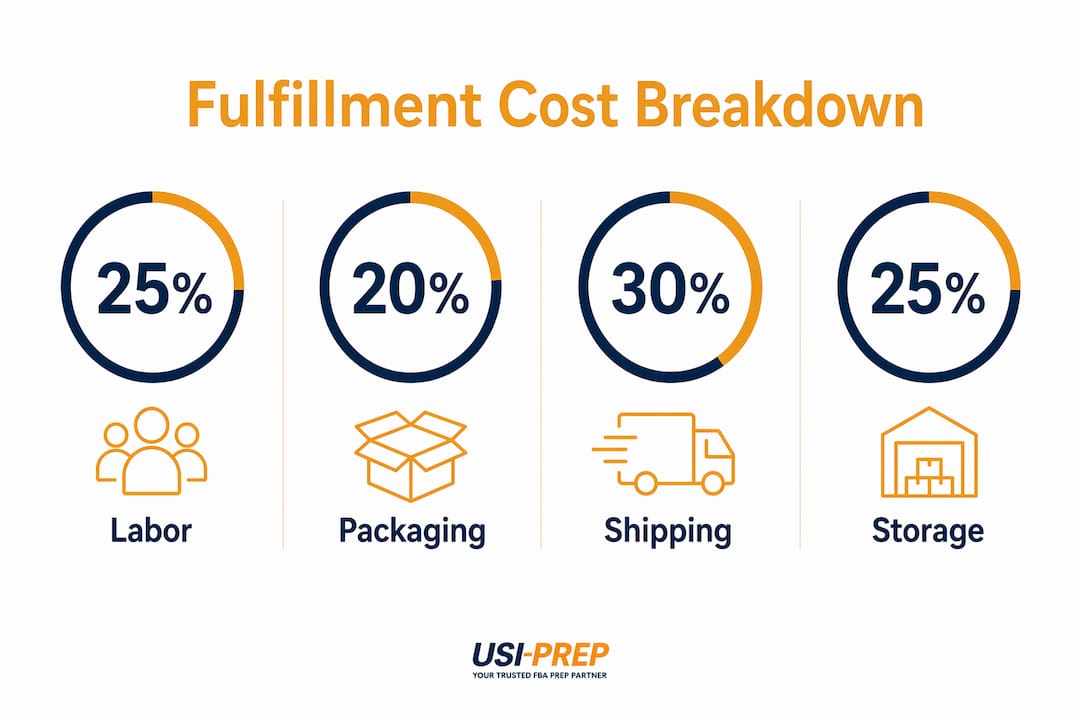
Fulfillment expenses fall into four main buckets: labor, packaging, storage, and shipping. Each one carries its own sub-costs, and they compound fast.
Labor and packaging cover the physical work of receiving inventory, picking items, packing boxes, and printing labels. These costs are relatively predictable, but they are rarely the biggest problem. The real damage comes from shipping and storage.

Shipping costs include a base rate plus a stack of accessorial fees. A standard residential delivery surcharge alone can run $6.50 per parcel. When you add fuel surcharges, address correction fees, and peak-season charges, surcharges total roughly 51% of a typical direct-to-consumer parcel invoice. That means for every $18.80 you spend on shipping, nearly $9.55 goes to fees that have nothing to do with moving the box from point A to point B.
Storage fees hit hardest when inventory sits too long. Most 3PLs charge per pallet or per cubic foot per month, and those rates spike during Q4. Slow-moving SKUs quietly drain margin every month they occupy warehouse space.
| Cost component | Typical share of total fulfillment cost |
|---|---|
| Pick-and-pack labor | 20–30% |
| Packaging materials | 8–12% |
| Warehouse storage | 10–15% |
| Base shipping rate | 25–35% |
| Surcharges and accessorials | 20–30% |
Pro Tip: Run a line-by-line audit of your last three carrier invoices. Most sellers find at least two recurring surcharge types they did not budget for.
How do shipping surcharges and dimensional weight pricing erode margins?
Dimensional weight (DIM weight) billing is the practice of charging based on a package’s volume rather than its actual weight, whichever is greater. For large but light products like apparel, pillows, or foam accessories, DIM weight inflates shipping costs by 2–4 times the actual weight. A pillow that weighs 1.5 pounds but ships in a 14x14x6 box gets billed at a much higher weight. That gap destroys margin on every single shipment.
The problem got worse in 2026. UPS reduced its dimensional weight divisor, and the result was per-package cost increases of 8–22% for mid-market direct-to-consumer brands shipping 10,000–80,000 parcels per month. An 8% cost increase on shipping sounds manageable until you realize shipping already represents 30–40% of your total fulfillment spend. The math compounds quickly.
The fix starts with packaging. Right-sizing cartons and measuring every shipment can reduce DIM-related cost by 15–25%. That is not a rounding error. For a brand shipping 5,000 orders per month at $12 average shipping cost, a 20% reduction saves $12,000 per month.
| Product type | Actual weight | DIM billed weight | Cost difference |
|---|---|---|---|
| Apparel (folded) | 0.8 lbs | 2.4 lbs | +$2.10–$3.50 per parcel |
| Foam pillow | 1.5 lbs | 4.2 lbs | +$3.80–$5.20 per parcel |
| Small electronics | 2.0 lbs | 2.0 lbs | No difference |
| Bulky gift set | 1.2 lbs | 5.8 lbs | +$5.50–$7.00 per parcel |
Pro Tip: Run a 90-day shipment re-rate analysis after any carrier pricing change. Brands that do this catch margin drops within weeks instead of quarters.
Why do 3PL pricing models further compress margins?
The structure of most 3PL contracts creates a conflict of interest that sellers rarely notice until it is too late. Many providers charge a percentage-of-spend fee on freight. That means 3PL revenue rises with your freight costs, giving them no financial reason to help you ship more efficiently. When fuel surcharges spike, your 3PL earns more. When carrier rates increase, your 3PL earns more. You absorb the loss.
Hidden fees compound the problem further. Published rates from 3PLs rarely reflect what you actually pay. Hidden fees add 25–40% on top of headline fulfillment rates once you account for account management charges, peak-season surcharges, integration setup costs, and monthly minimums. A seller who budgets $6 per order for fulfillment often ends up paying $8–$9 once all fees are counted.
Auditing your fulfillment contract for hidden fees is not optional. Look for these specific line items:
- Account management fees: Monthly charges for a dedicated contact, often $200–$500 per month
- Peak surcharges: Temporary rate increases during october through december, sometimes 15–25% above standard rates
- Integration fees: One-time or recurring charges for connecting your store platform to the 3PL’s warehouse management system
- Minimum monthly spend: Clauses that charge you even when order volume drops
- Return processing fees: Per-unit charges for receiving, inspecting, and restocking returned items
Pro Tip: Ask your 3PL for a fully loaded cost-per-order calculation before signing any contract. If they cannot provide one, that is your answer.
What strategies actually reduce fulfillment costs for small eCommerce brands?
Minimizing fulfillment expenses requires a system, not a one-time fix. The brands that protect margins treat fulfillment cost management as an ongoing operational discipline, not a quarterly review.
-
Right-size your packaging stock. Carry three to five box sizes that cover 90% of your SKUs. Shipping a small item in an oversized box is a direct margin tax. Measure every SKU and match it to the smallest box that ships safely.
-
Track all-in cost per order, not just pick-and-pack. Measuring all-in cost per order plus exception costs like returns and address corrections reveals where margin actually leaks. Most sellers only track the headline fulfillment fee and miss the variance costs entirely.
-
Negotiate zone-based shipping rates. Zone mix is one of the biggest drivers of cost per order. If 60% of your customers are on the East Coast and your warehouse is in California, you are paying Zone 7 and Zone 8 rates on most shipments. A second fulfillment location or a 3PL with distributed warehousing cuts zone costs significantly.
-
Set free shipping thresholds that protect contribution margin. Free shipping is a conversion tool, not a gift. Calculate your average order value and set the threshold at a point where the incremental revenue from the larger basket offsets the shipping cost. A threshold set too low subsidizes every order.
-
Run quarterly packaging audits. Carrier billing methodology changes, like the 2026 UPS divisor update, can make previously efficient boxes suddenly expensive. A quarterly audit catches these shifts before they compound across thousands of shipments.
-
Monitor shipping cost volatility as a cash flow issue. Post-shipment billing adjustments from carriers arrive weeks after delivery. Budget a 10–15% buffer above your estimated shipping cost to avoid cash flow surprises that distort your margin picture.
Pro Tip: Decompose your cost-per-order into four levers: zone mix, DIM efficiency, carrier tier, and storage fee tier. Fixing just one lever often yields more savings than renegotiating your entire contract.
Key Takeaways
Fulfillment costs erode eCommerce margins through compounding layers of labor, shipping, surcharges, and hidden 3PL fees that most sellers never fully account for.
| Point | Details |
|---|---|
| True cost per order is higher than expected | Loaded fulfillment costs typically run $8–$15 per order, not the $3–$6 headline rate. |
| Surcharges are the biggest hidden drain | Accessorial fees can make up 51% of a parcel invoice, far exceeding base shipping rates. |
| DIM weight billing multiplies shipping costs | Large, light products get billed at 2–4x actual weight, directly cutting margin per shipment. |
| 3PL pricing structures can work against you | Percentage-of-spend fee models give providers no incentive to reduce your freight costs. |
| Ongoing audits protect margin | Quarterly packaging reviews and 90-day re-rate analyses catch billing changes before they compound. |
The uncomfortable truth about fulfillment cost forecasting
I have worked with enough eCommerce brands to know that most margin problems are not pricing problems. They are forecasting problems. Sellers set their product prices based on a fulfillment cost estimate from six months ago, then watch their margins erode as carrier rates shift, surcharges stack, and 3PL invoices arrive with line items nobody budgeted for.
The 2026 UPS dimensional weight changes are a perfect example. Brands that modeled their shipping costs in late 2025 were working with a different divisor. When the new rates hit, their cost-per-order jumped 8–22% overnight. The sellers who caught it fast were the ones running monthly cost-per-order tracking, not annual P&L reviews.
What I find most underappreciated is the cash flow dimension. Carrier billing adjustments arrive 2–4 weeks after shipment. If you are running tight working capital, those surprise charges hit your account when you least expect them. Fulfillment cost management is not just a margin exercise. It is a liquidity exercise.
The brands that win long-term build operational discipline around three things: packaging efficiency, carrier selection, and contract transparency. They treat their 3PL relationship as a negotiation, not a service subscription. They ask hard questions about fee structures and they re-rate their shipments after every major carrier update. That discipline is what separates brands that scale profitably from those that grow themselves into a cash crisis.
— Akbar
How Usiprep helps eCommerce sellers control fulfillment costs
Usiprep was founded by former Amazon sellers who understood firsthand how fulfillment expenses quietly destroy margins. The company offers FBA prep and order fulfillment services built around transparent pricing, faster inventory check-ins, and full visibility into every cost component.
Usiprep clients report a 30% reduction in fulfillment costs and a 98.9% on-time delivery rate. That performance comes from a process designed to eliminate the hidden fees and DIM weight inefficiencies that most brands accept as unavoidable. Start with the FBA prep requirements checklist to see exactly where your current process is leaking margin, or review Usiprep’s transparent pricing to compare against what you are paying today.
FAQ
What is the average fulfillment cost per eCommerce order in 2026?
Fulfillment costs for a typical domestic eCommerce order range from $8 to $15 when all fees are included. That figure covers pick-and-pack labor, packaging, storage, base shipping, and surcharges.
Why do surcharges make up such a large share of shipping invoices?
Residential delivery fees, fuel surcharges, and peak-season charges stack on top of base rates and can total 51% of a parcel invoice. DTC brands shipping to home addresses pay these fees on nearly every order.
What is dimensional weight billing and why does it matter?
Dimensional weight billing charges based on a package’s volume rather than its actual weight, whichever is higher. For large, light products, this inflates the billed weight by 2–4 times and raises shipping costs on every shipment.
How can I tell if my 3PL is charging hidden fees?
Request a fully loaded cost-per-order breakdown from your provider and compare it to your actual invoices. Hidden fees like account management charges, peak surcharges, and return processing fees often add 25–40% above the published rate.
How often should I audit my fulfillment costs?
Run a packaging audit and shipment re-rate analysis every quarter. Carrier billing methodology changes, like the 2026 UPS divisor update, can shift your cost-per-order significantly between annual reviews.