
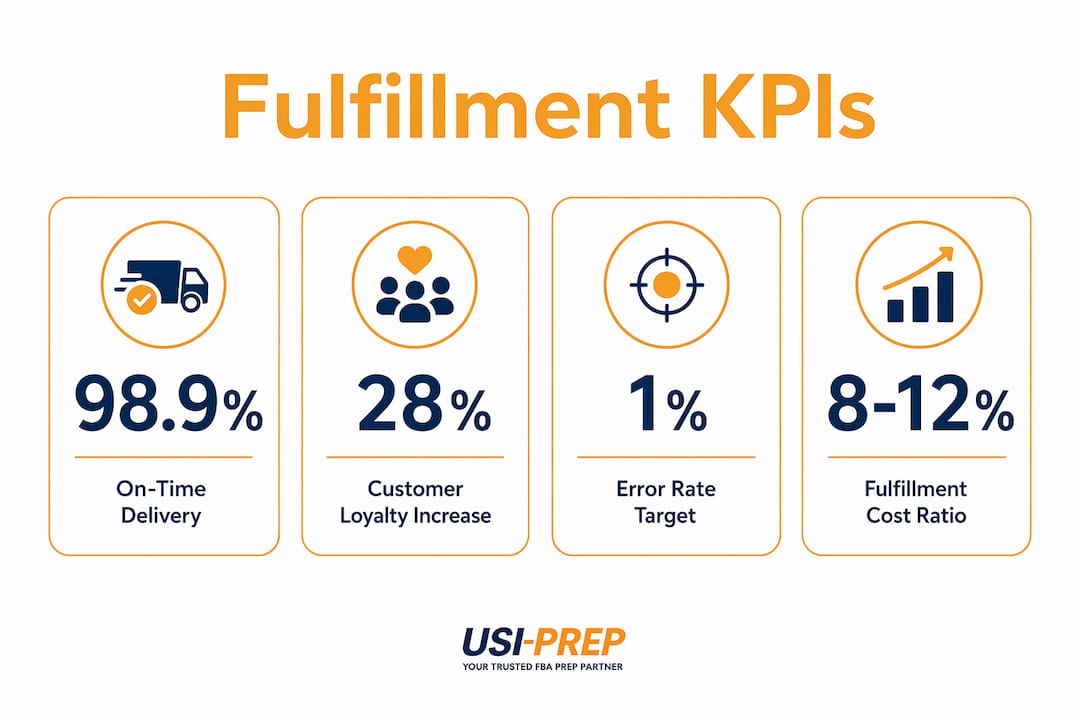
Fulfillment efficiency is defined as the ability to pick, pack, ship, and return orders at the lowest possible cost without sacrificing accuracy. The role of fulfillment efficiency in profits is direct: every dollar wasted in the warehouse is a dollar removed from your margin. Healthy DTC brands target fulfillment costs at 8–12% of net revenue, with apparel verticals often running 13–18% due to returns volume. When fulfillment costs exceed 20% of net revenue, margin erosion becomes severe enough to threaten the business itself. Understanding where those costs come from, and how to control them, is the most direct path to stronger profits.
What is the role of fulfillment efficiency in profits?
Fulfillment operations profitability starts with understanding what you actually spend. Most ecommerce sellers think of fulfillment as a single line item. In reality, it breaks into five distinct cost buckets, each with its own margin impact.
The five major cost components are:
- Labor: Picking, packing, receiving, and returns processing. Labor accounts for 55–70% of total fulfillment costs, and warehouse wages rose 18% between 2022 and 2025. That wage inflation means cost models built before 2022 are likely underestimating your true labor spend.
- Warehousing: Storage fees, bin space, and long-term holding costs. These scale with inventory volume and turnover rate. Slow-moving SKUs quietly inflate this number every month.
- Packaging: Materials, dimensional weight charges, and custom branding add up fast. Oversized packaging triggers carrier surcharges that compound across thousands of orders.
- Shipping: Carrier rates, zone-based pricing, and fuel surcharges. This is the most visible cost, but not always the largest.
- Returns processing: Inspection, sorting, restocking, and sometimes disposal. Returns processing is consistently underestimated, which you will see in detail below.
Each of these components directly affects your contribution margin, which is the revenue left after variable costs. When fulfillment costs climb, contribution margin shrinks. A brand doing $2 million in revenue with 15% fulfillment costs spends $300,000 on fulfillment. Dropping that to 10% saves $100,000 per year without touching product costs or marketing.
Pro Tip: Track fulfillment cost as a percentage of net revenue monthly, not annually. Annual averages hide seasonal spikes that quietly destroy quarterly margins.

Understanding fulfillment cost components at this level of detail is the foundation of any serious margin improvement effort.
How do fulfillment errors affect profits and customer loyalty?
Fulfillment errors are one of the most expensive problems in ecommerce, and most sellers undercount them. Fulfillment errors cause 23% of ecommerce returns due to incorrect items. Each of those returns eliminates the margin on the original order and then adds return shipping, inspection, and reshipping costs on top.
The financial chain of a single error looks like this:
- Original order margin: lost
- Return shipping cost: absorbed by the seller in most cases
- Inspection and reprocessing labor: added cost
- Replacement shipment: full shipping cost again
- Customer service time: overhead cost
That single wrong item can turn a profitable order into a net loss. At scale, even a 1% error rate across 10,000 monthly orders creates 100 error events, each carrying that full cost chain.
The upside of fixing accuracy is equally significant. Order accuracy boosts customer loyalty by 28%. That loyalty translates directly into repeat purchase revenue, which carries no customer acquisition cost. Acquiring a new customer costs five to seven times more than retaining an existing one, so accuracy improvements compound into serious revenue gains over time.
The operational metrics that connect most directly to profitability are order accuracy rate, return rate by SKU, and time to reship. Tracking these weekly gives you early warning before errors become a margin crisis.
Pro Tip: Audit your return reasons monthly. If “wrong item” or “not as described” appears in your top three return reasons, you have a fulfillment accuracy problem, not a product problem. Fix the warehouse process first.
Reducing fulfillment errors is one of the fastest ways to protect margins without spending more on marketing or product development.
What hidden fulfillment costs are silently draining your margins?
Hidden costs are the most dangerous category in fulfillment operations because they do not show up clearly on any single report. They accumulate quietly until a margin audit reveals the damage.
The four most common hidden cost drains are:
-
Billing leakage from warehouse systems. Structural billing leakage can cause 1–3% annual gross revenue loss due to unbilled automated actions. A warehouse management system that does not capture every pick, label, or special handling task leaves money on the table for 3PLs and creates cost gaps you cannot reconcile.
-
Underpriced returns handling. Returns handling is often underpriced by 30–60% in 3PL contracts because inspection, sorting, and restocking require far more labor than standard inbound processing. If your 3PL charges a flat fee per return, you are almost certainly subsidizing their labor cost.
-
Aggregate margin masking. When you report profitability at the brand level, profitable SKUs hide the losses from underperforming ones. A single high-volume product with strong margins can mask three or four SKUs that lose money on every order after fulfillment costs.
-
Contract gaps between WMS, invoices, and actual activity. Reconciling your warehouse management system output against invoices and contract terms is tedious work. Most sellers skip it. That gap is where billing errors, unauthorized charges, and rate creep live.
Per-client P&L reporting illuminates SKU-level performance, preventing aggregated margins from hiding product-level losses. Running a per-SKU profitability report quarterly is not optional if you want accurate margin data.
Pro Tip: Request an itemized fulfillment invoice from your 3PL and compare every line against your contract. Most sellers find at least one billing discrepancy within the first audit. Check hidden fees in fulfillment contracts before signing any new agreement.
How can technology improve fulfillment efficiency and protect margins?
Technology is the most reliable lever for increasing profits through efficient fulfillment at scale. Manual processes have a ceiling. Automated and AI-driven systems do not.
AI-enabled fulfillment reduces carrying costs by 20–30%, lowers supply chain costs up to 10%, and automates reordering, cutting manual work by 60%. Those are not marginal gains. A brand spending $500,000 annually on fulfillment could recover $50,000–$150,000 per year from those improvements alone.
The practical applications break down into three areas:
Route and zone optimization
Distributing inventory across multiple fulfillment locations based on customer geography reduces average shipping zones. Lower zones mean lower carrier costs per order. This single change often delivers the fastest ROI of any fulfillment technology investment.
Automated reordering and inventory positioning
Manual reorder processes create two expensive problems: stockouts that kill revenue and overstock that inflates carrying costs. Automated reordering systems set dynamic thresholds based on sales velocity, lead times, and seasonal patterns. They remove the human delay that causes both problems.
Accuracy technology
Barcode scanning at pick, pack, and ship stages catches errors before they leave the warehouse. The cost of a scanner and the software to run it is a fraction of the cost of a single month of error-driven returns at scale.
The table below shows the cost impact difference between traditional and tech-enabled fulfillment approaches:
| Fulfillment approach | Labor cost exposure | Error rate | Carrying cost | Returns cost accuracy |
|---|---|---|---|---|
| Traditional manual | High, wage-sensitive | 1–3% typical | Full carrying cost | Often underestimated |
| Tech-enabled automated | Reduced by automation | Below 0.5% target | 20–30% lower | Tracked per SKU |
Operational inefficiency is persistent and linked to lower current and future profitability. Businesses that do not invest in fixing fulfillment inefficiencies tend to see the problem compound over time, not resolve itself. The ROI on fulfillment technology is not speculative. It shows up in margin reports within one to two quarters of implementation.
Pro Tip: Start with barcode scanning before investing in full warehouse automation. It is the lowest-cost, highest-impact accuracy improvement available to mid-sized ecommerce sellers.
For a full breakdown of how to apply these strategies, the 2026 ecommerce fulfillment guide covers the operational frameworks in detail.
Key Takeaways
Fulfillment efficiency directly controls ecommerce profit margins, and sellers who treat it as a cost center rather than a profit lever consistently leave money on the table.
| Point | Details |
|---|---|
| Target fulfillment cost ratio | Keep fulfillment costs at 8–12% of net revenue to protect contribution margins. |
| Labor is the largest cost driver | At 55–70% of fulfillment spend, labor management is the highest-leverage cost reduction target. |
| Errors compound into losses | A 23% return rate from wrong items eliminates order margin and adds return processing costs. |
| Hidden costs require active auditing | Billing leakage and underpriced returns handling can drain 1–3% of gross revenue annually. |
| Technology delivers measurable ROI | AI-enabled fulfillment cuts carrying costs by 20–30% and reduces manual reorder work by 60%. |
Why fulfillment is the profit lever most sellers ignore
I have worked with enough ecommerce brands to say this plainly: most sellers treat fulfillment as a fixed cost they cannot control. That belief is the most expensive mistake in ecommerce operations.
Fulfillment is not fixed. Every component, labor rates, packaging choices, carrier zones, returns handling, is a variable you can actively manage. The brands I have seen grow profitably through scaling are the ones that audit fulfillment costs quarterly, track accuracy metrics weekly, and renegotiate 3PL contracts annually. They do not accept the first invoice as final.
The mindset shift that matters most is moving from “what does fulfillment cost?” to “what does each SKU cost to fulfill, and is that order profitable after all costs?” That question forces SKU-level P&L thinking, which is where real margin improvement lives. A brand that discovers three of its ten SKUs lose money after fulfillment costs can either reprice, repackage, or discontinue those products. That decision alone can add several points of margin.
Fixing accuracy, cycle times, and inventory turns drives measurable margin improvements. The data is consistent on this point. Fulfillment is not a back-office function. It is a profit multiplier, and the sellers who treat it that way outperform those who do not.
— Akbar
How Usiprep helps ecommerce sellers protect margins through better fulfillment
Usiprep was built by former Amazon sellers who experienced firsthand what unreliable fulfillment does to margins. The result is a prep and fulfillment service designed around the metrics that actually matter: accuracy, speed, and cost transparency.
Usiprep delivers a 98.9% on-time delivery rate and has helped brands reduce fulfillment costs by 30%. Every client gets full visibility into their inventory and order status, which means no billing surprises and no margin leakage from reconciliation gaps. If you are ready to treat fulfillment as a profit driver, start with the FBA prep requirements checklist to identify where your current process is losing money. You can also review how to speed up your FBA prep to cut labor time and protect your margins at every stage.
FAQ
What percentage of revenue should fulfillment costs be?
Healthy DTC brands target fulfillment costs at 8–12% of net revenue. Apparel brands often run 13–18% due to higher return rates, and costs above 20% signal serious margin erosion.
How do fulfillment errors hurt profits?
Fulfillment errors cause 23% of ecommerce returns from incorrect items, eliminating the original order margin and adding return shipping, inspection, and reshipping costs on top.
What is billing leakage in fulfillment?
Billing leakage occurs when warehouse systems fail to capture every automated action, causing 1–3% annual gross revenue loss through unbilled or unreconciled fulfillment activity.
Does technology actually improve fulfillment profitability?
AI-enabled fulfillment reduces carrying costs by 20–30% and cuts manual reorder work by 60%, delivering measurable margin improvements within one to two quarters of implementation.
How does order accuracy affect customer loyalty?
Order accuracy improvements boost customer loyalty by 28%, which increases repeat purchase revenue and reduces customer acquisition costs over time.