
A fulfillment invoice is an itemized bill from a logistics provider that documents every charge tied to storing, handling, and shipping your products. Understanding how fulfillment invoices work is the first step toward controlling logistics costs and catching billing errors before they compound. For eCommerce entrepreneurs managing third-party logistics (3PL) relationships, these documents are not just receipts. They are the primary tool for auditing what you actually owe versus what you agreed to pay.
What are the main components of a fulfillment invoice?
Fulfillment invoices break down costs into three primary buckets: storage fees, fulfillment and labor fees, and shipping or carrier charges. Each bucket reflects a distinct logistics activity, which makes it easier to identify where costs are rising and why.
Storage fees cover the space your inventory occupies in a warehouse, typically billed by pallet, bin, or cubic foot per month. The longer your inventory sits, the higher this line item grows. Slow-moving SKUs are the most common culprit for inflated storage charges.
Fulfillment and labor fees cover the physical work of picking items from shelves, packing them into boxes, and preparing shipments. These fees scale directly with order volume. A spike in orders during a peak season will produce a proportional spike in this line item.

Shipping and carrier charges are the cost of moving packages from the warehouse to your customers. These vary by carrier, package weight, dimensions, and destination zone. A real-world example illustrates the scale: 40 shipments can generate $180 in fulfillment fees, $612.40 in shipping charges, and $96 in storage fees, totaling $888.40. That breakdown shows how shipping typically dominates the invoice total, often exceeding labor and storage combined.
Beyond these three core categories, invoices may include accessorial fees. These are charges for services outside the standard workflow, such as special packaging, address corrections, or residential delivery surcharges. Many eCommerce entrepreneurs overlook accessorial fees during contract review, which leads to budget surprises later.
| Line Item | What It Covers |
|---|---|
| Storage fees | Warehouse space per pallet, bin, or cubic foot |
| Fulfillment/labor fees | Picking, packing, and shipment preparation |
| Shipping/carrier charges | Carrier cost by weight, zone, and dimensions |
| Accessorial fees | Special handling, address corrections, surcharges |
Pro Tip: Request a sample invoice from any 3PL before signing a contract. Comparing their invoice format against this breakdown will reveal which fees they bundle and which they itemize separately.
How does the fulfillment invoice process align with shipping workflows?
The timing of invoice generation depends directly on how your fulfillment system handles the relationship between shipping and billing. Two distinct workflows exist, and the one your provider uses affects both your cash flow and your accounting accuracy.
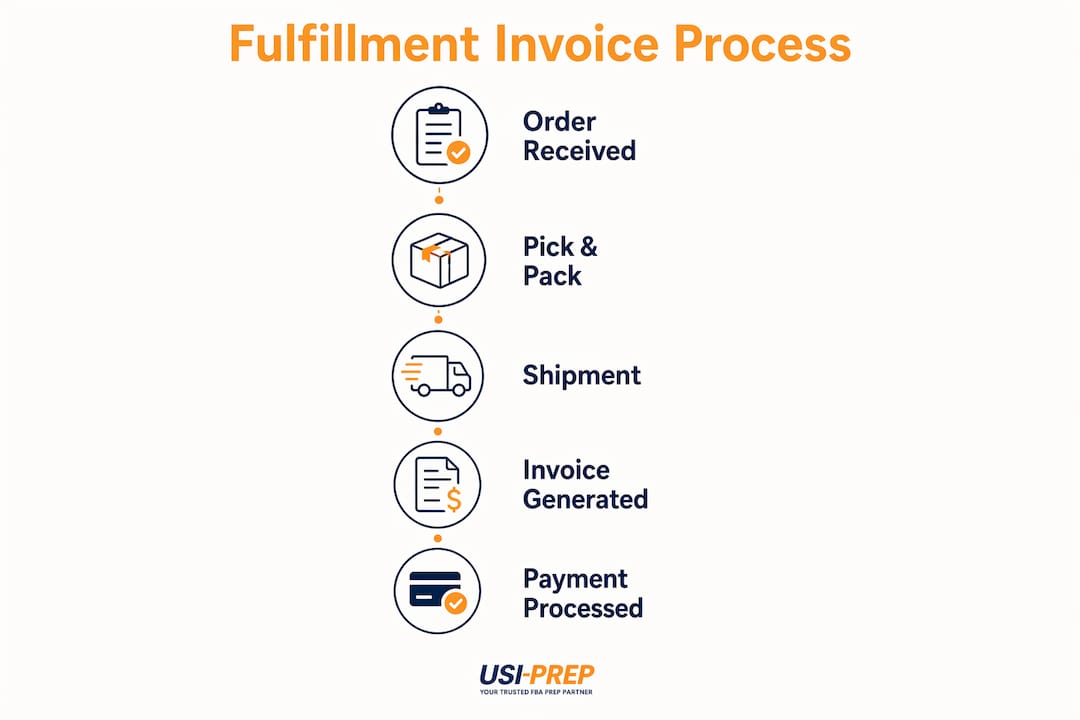
In a combined workflow, fulfillment automatically triggers invoice creation. The moment an order ships, a corresponding invoice is generated for the full order value. This is simple but inflexible. If an order ships in multiple batches, the invoice may not reflect the actual goods delivered.
In a decoupled workflow, fulfillment and billing are separated. ERP systems like NetSuite’s Advanced Shipping feature enable this separation. Billing only occurs for items that have actually shipped, not for the entire order upfront. That distinction matters significantly for growing brands managing large or complex orders.
The steps in a typical decoupled fulfillment invoice process follow this sequence:
- A customer places an order and it enters the warehouse management system (WMS).
- The warehouse picks and packs available items, creating a shipment record.
- The system generates a fulfillment event tied to the shipped items only.
- A billing trigger fires based on the fulfillment event, not the original order.
- An invoice is issued reflecting only the services rendered for that shipment.
- The cycle repeats for any remaining items in a partial shipment.
Partial shipment invoicing improves cash flow by matching billing to actual delivery. You pay for what shipped, not what was ordered. For eCommerce businesses with high order volumes or frequent backorders, this distinction can meaningfully reduce financial exposure.
Pro Tip: Ask your 3PL whether their system supports partial shipment invoicing. If it does not, you may be paying for goods that have not yet left the warehouse.
What challenges arise with international fulfillment invoices?
Cross-border fulfillment introduces a layer of billing complexity that domestic shipping does not. International invoices carry surcharges that rarely appear in the base contract but show up clearly on the invoice.
The most common hidden charge is the international handling fee. These surcharges can reach 15% of the subtotal and shipping costs combined. That percentage can turn a manageable invoice into a significant budget overrun, especially for brands scaling into new markets.
Other charges that inflate international invoices include:
- Pick rate surcharges for orders requiring special handling due to customs requirements
- Packaging fees for materials that meet destination country regulations
- Carrier fuel surcharges that fluctuate with international fuel indexes
- Customs documentation fees for paperwork preparation and compliance
Accessorial fees in international contracts often trigger from operational details that are not obvious in the base agreement. A fee for “special handling” might apply whenever a package exceeds a certain weight, even if your products have always been that weight. Reading the contract’s accessorial fee schedule line by line is the only reliable way to anticipate these charges.
“The most expensive fulfillment invoice mistakes happen before the first shipment. They happen during contract review, when sellers accept vague fee language without asking for a complete accessorial schedule.”
Brands shipping internationally should request a full fee schedule from their 3PL before going live. Comparing that schedule against actual invoice line items after the first billing cycle will reveal any discrepancies immediately.
How to handle invoices and audit fulfillment billing effectively
Effective invoice management starts with one principle: every charge on a fulfillment invoice must be traceable to a warehouse event. If a line item cannot be matched to a specific shipment, storage period, or service, it warrants a dispute.
Aligning invoice data with warehouse logs is the most reliable method for catching billing errors. Errors most commonly stem from manual data entry mistakes or outdated rate cards that were not updated after a contract renegotiation. A rate card mismatch of even a few cents per unit compounds quickly across thousands of orders.
Practical steps for auditing your fulfillment invoices:
- Match shipment records to invoice line items. Every fulfillment fee should correspond to a specific order number and ship date in your WMS.
- Verify storage calculations. Confirm that the cubic footage or pallet count billed matches your actual inventory levels during the billing period.
- Check carrier charges against carrier receipts. Your 3PL should be able to provide carrier tracking data that supports each shipping charge.
- Review rate cards quarterly. Rates change, and providers do not always proactively update billing systems when they do.
- Flag recurring unexplained charges. A charge that appears every billing cycle without a clear description is a red flag worth investigating.
Integrating your WMS with billing software reduces invoice discrepancies and speeds up payment reconciliation. When both systems share the same data in real time, manual errors drop significantly. Platforms that support this integration give you a live view of charges as they accrue, rather than a surprise at the end of the billing cycle.
Pro Tip: Set a calendar reminder to audit your fulfillment invoices within 48 hours of receipt. Disputes are far easier to resolve when the shipment details are still fresh and the 3PL’s team can quickly pull the relevant records.
Understanding your fulfillment cost components before you receive your first invoice gives you a baseline for comparison. Brands that enter 3PL relationships without that baseline often overpay for months before noticing a pattern.
Key Takeaways
A fulfillment invoice is the definitive record of what your logistics provider charged, why they charged it, and whether those charges match your contract terms.
| Point | Details |
|---|---|
| Three core cost buckets | Every fulfillment invoice covers storage, labor, and shipping as distinct line items. |
| Invoice timing matters | Decoupled billing systems like NetSuite’s Advanced Shipping invoice only shipped items, not full orders. |
| International fees add up fast | Cross-border surcharges can reach 15% of subtotal and shipping, requiring contract-level review. |
| Audit every billing cycle | Match each invoice line item to a warehouse event to catch rate card errors before they compound. |
| WMS integration reduces errors | Connecting your warehouse management system to billing software cuts discrepancies and speeds reconciliation. |
Why invoice literacy changed how I think about fulfillment partnerships
The first time I saw a fulfillment invoice with an unexplained “handling adjustment” line item, I assumed it was a standard charge. It was not. That single line item, billed every month, added up to thousands of dollars over a year. The 3PL had applied an outdated rate card after a contract renewal, and no one caught it because no one was comparing invoices to the signed agreement.
That experience reshaped how I evaluate fulfillment partnerships. A provider’s pricing page tells you the base rate. The invoice tells you the truth. Brands that treat fulfillment invoices as routine paperwork are leaving money on the table every billing cycle.
The most underrated skill in eCommerce logistics is knowing how to read a fulfillment invoice the way an accountant reads a balance sheet. Every line item is a question: what triggered this charge, does it match the contract, and does it match the warehouse record? When you can answer all three, you are in control of your logistics costs. When you cannot, your 3PL is.
Clear invoicing also changes how you negotiate. When you can show a provider exactly where their billing diverges from your contract, you negotiate from a position of fact rather than frustration. That shift alone has helped brands I have worked with reduce fulfillment costs meaningfully without changing providers.
— Akbar
Usiprep’s approach to transparent fulfillment billing
Usiprep was founded by former Amazon sellers who experienced firsthand how opaque billing erodes margins. That background shapes every aspect of how Usiprep structures its fulfillment billing: clear line items, no buried surcharges, and full visibility into charges as they accrue.
Usiprep clients report a 30% reduction in fulfillment costs and benefit from a 98.9% on-time delivery rate. If you are ready to move from confusing invoices to billing you can actually verify, the FBA prep requirements checklist is a practical starting point for getting your shipments and costs aligned. For a full picture of what transparent fulfillment services look like in practice, Usiprep’s team is available to walk you through a real invoice comparison.
FAQ
What is a fulfillment invoice?
A fulfillment invoice is an itemized bill from a logistics provider that lists charges for storage, picking and packing, and shipping. It serves as the primary document for verifying that billed charges match contracted rates.
What are the three main costs on a fulfillment invoice?
The three core cost categories are storage fees, fulfillment and labor fees, and shipping or carrier charges. A real example shows these totaling $888.40 across 40 shipments, with shipping making up the largest share.
How does partial shipment invoicing work?
Partial shipment invoicing bills only for items that have actually shipped, not for the entire order at once. ERP systems like NetSuite support this through Advanced Shipping features that decouple fulfillment events from billing triggers.
What hidden fees should I watch for on international fulfillment invoices?
International handling surcharges can reach 15% of the subtotal and shipping costs. Additional charges may include pick rate surcharges, packaging fees, and customs documentation fees that are not always visible in base contract pricing.
How often should I audit my fulfillment invoices?
Audit every invoice within 48 hours of receipt by matching each line item to a warehouse event. Quarterly rate card reviews add a second layer of protection against billing drift caused by outdated pricing in your provider’s system.