
Opening a US seller account for your international business is a defined compliance and registration process centered on Amazon Seller Central, requiring identity verification, tax documentation, and payment configuration before you can sell to American consumers. The platform handles identity verification and tax information as its core onboarding gates, meaning you cannot list a single product until both are complete. Most international entrepreneurs underestimate how much preparation these steps demand before they ever touch a product listing. This guide covers every requirement, account decision, and market entry move you need to make it work in 2026.
What requirements do international sellers need to open a US seller account?
The requirements for a US seller account as a foreign business fall into four categories: identity, financial, tax, and business documentation. Getting all four ready before you start registration cuts your setup time significantly and prevents the mid-process stalls that trip up most overseas sellers.
Identity and contact requirements:
- A valid international phone number capable of receiving SMS or voice calls for two-factor authentication
- A government-issued photo ID (passport is the most universally accepted document)
- Proof of address dated within 90 days, such as a utility bill or bank statement
Financial requirements:
- A bank account capable of receiving USD payouts. Amazon Payoneer and Hyperwallet are accepted intermediaries if your local bank does not support direct USD transfers.
- A valid international credit card for paying Amazon fees
Tax documentation:
- Non-US individuals complete Form W-8BEN to certify foreign status and claim treaty benefits
- Foreign entities (corporations, LLCs registered outside the US) use Form W-8BEN-E
- If you own a US-registered LLC as a foreign national, the correct form depends on how the IRS classifies your entity, which creates a common conflict covered in detail in the tax section below
Business documentation:
- Business registration certificate if selling as a company
- Any relevant import or product compliance certificates depending on your product category
The legal name on every document must match exactly across your ID, bank account, and tax forms. A single discrepancy triggers Amazon’s Know Your Customer review, which can delay your account by weeks.
Pro Tip: Prepare a single folder with digital copies of every document before you visit Seller Central. Amazon’s onboarding session has a time limit, and uploading documents mid-session under pressure leads to errors.

Individual vs. Professional: which account type should you choose?
Amazon Seller Central offers two account structures, and the choice affects your cost base from day one. Individual accounts charge $0.99 per sale, while Professional accounts cost $39.99 per month regardless of sales volume. The math is straightforward: if you sell more than 40 units per month, the Professional account costs less per transaction.
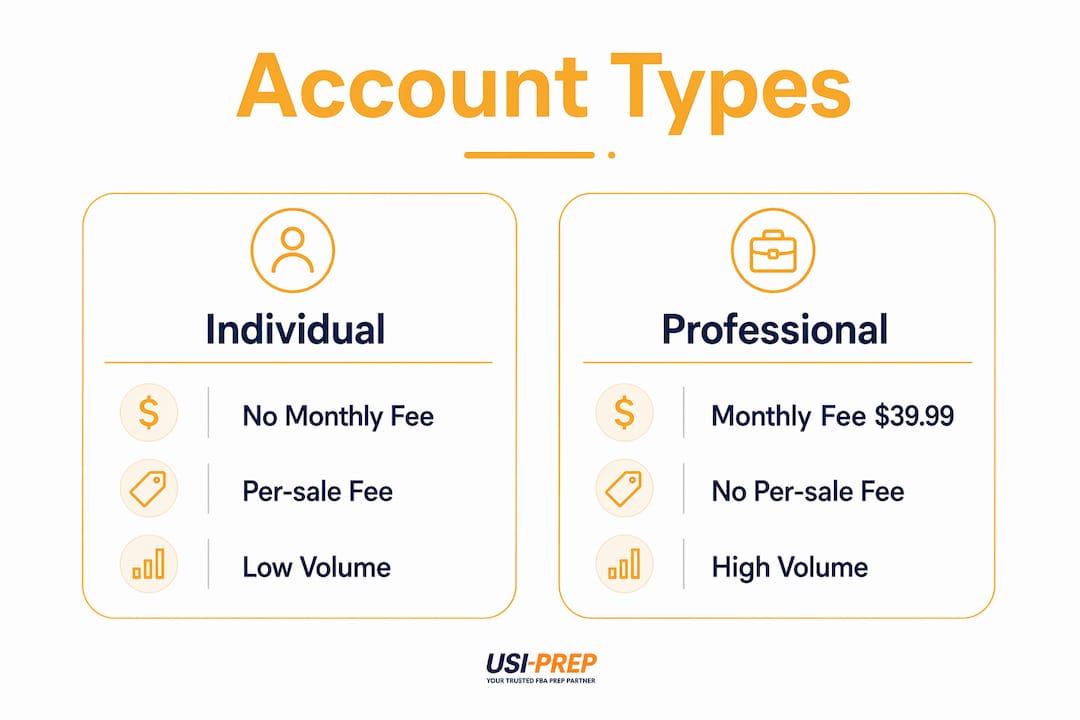
| Feature | Individual account | Professional account |
|---|---|---|
| Monthly fee | $0 | $39.99 |
| Per-sale fee | $0.99 | $0 |
| Access to advertising tools | No | Yes |
| Bulk listing uploads | No | Yes |
| Buy Box eligibility | Limited | Full |
| API access | No | Yes |
For international sellers entering the US market, the Professional account is almost always the right starting point. Buy Box eligibility alone justifies the monthly fee. Without it, your listings appear at a structural disadvantage against established US sellers, regardless of your price. Advertising access through Amazon Sponsored Products is equally critical for new sellers who have no organic ranking history in the US marketplace.
The Individual account makes sense only if you are testing a single product at very low volume before committing to a full market entry. Even then, the feature restrictions make it harder to gather the data you need to make that decision confidently.
How to complete the Amazon tax interview for foreign sellers
The tax interview inside Seller Central is where most international sellers lose time. The system asks you a series of questions to determine which IRS tax form applies to your account, then generates the form for your electronic signature. The process sounds simple. For foreign sellers, it frequently is not.
Here is how to approach it correctly:
-
Determine your entity type before you start. Are you selling as an individual, a foreign corporation, or a US-registered LLC owned by a non-US person? Each triggers a different tax form. Mixing these up mid-interview forces you to restart.
-
Foreign individuals use W-8BEN. This form certifies you are not a US person and may claim reduced withholding rates under a tax treaty between your country and the United States. Complete your legal name exactly as it appears on your passport.
-
Foreign entities use W-8BEN-E. This applies to corporations, partnerships, and LLCs registered outside the US. You will need your entity’s legal name, country of incorporation, and chapter 3 and chapter 4 status classifications.
-
Non-US owners of US LLCs face a specific conflict. Amazon’s system sometimes prompts these sellers to submit a W-9, which is the form for US persons. Non-US owners of US LLCs regularly encounter this conflict because a US LLC is a domestic entity even when its owner is foreign. The correct form depends on whether the LLC is treated as a disregarded entity or a corporation for US tax purposes. Consult a US tax professional before completing this step if your structure falls into this category.
-
Keep your legal name consistent throughout. Changing tax details mid-onboarding triggers re-verification and a new tax interview, adding days or weeks to your timeline.
One additional note on reporting: the Form 1099-K threshold applies to US tax reporting, but you are required to report all income regardless of whether Amazon issues the form. Do not treat the threshold as a floor for your own compliance obligations.
Pro Tip: Treat the tax interview as a legal document process, not a technical setup task. Screenshot every screen before you submit. If Amazon’s system generates an error or misclassifies your form, your screenshots become your evidence when contacting Seller Support.
What are the key steps to verify and configure your account?
Most delays for international sellers occur during verification and payment setup, not during listing creation. Completing these steps correctly the first time is the single biggest factor in how fast you get to market.
-
Complete phone verification first. Amazon sends a PIN to your registered number. Use a number you can access immediately. If you use a VoIP number, confirm it accepts SMS from US carriers before registration.
-
Submit identity documents in the correct format. Passport scans must be clear, unedited, and show all four corners of the document. Amazon rejects cropped or compressed images.
-
Enter bank account details for USD payouts. If you use Payoneer or a similar service, enter the virtual US bank account details it provides. Confirm the account name matches your Seller Central legal name exactly.
-
Configure shipping and returns settings. International sellers often skip this step during setup and face order cancellations later. Set your default shipping regions, transit times, and return address. A US-based return address, even a third-party fulfillment address, significantly improves your conversion rate with American buyers.
-
Complete your seller profile. Add a store name, logo, and business description. Amazon’s algorithm factors profile completeness into search ranking, and buyers check seller profiles before purchasing from unfamiliar international brands.
For FBA sellers, understanding how Amazon FBA check-in works before you ship your first inventory batch prevents costly receiving delays at fulfillment centers.
How to approach market entry and scale through Amazon US
Account setup is the foundation. Market entry is where your revenue actually starts. Amazon’s Sell Globally feature sequences this process in a specific order: verify your account, list products, ship inventory, then activate growth programs. Skipping steps in this sequence creates operational gaps that are expensive to fix retroactively.
Listing and pricing for US consumers:
- Price in USD and research competitive pricing using Amazon’s own data tools before launch
- Write product titles and bullet points for US search behavior, which differs from European or Asian markets in keyword structure and buyer language
- Use Amazon’s Brand Registry if you own a trademark. It unlocks A+ Content, which increases conversion rates measurably for new sellers without US brand recognition
Inventory and shipping strategy:
- FBA (Fulfillment by Amazon) removes the logistics burden for international sellers and makes your listings Prime-eligible from day one
- Use a US-based FBA prep center to receive, inspect, and label your inventory before it enters Amazon’s fulfillment network. This is where Usiprep adds direct value for overseas sellers.
- Review the FBA prep requirements checklist before your first shipment to avoid rejection at Amazon’s receiving docks
Growth programs to activate after launch:
- Sponsored Products ads for immediate visibility in search results
- Amazon Vine for early reviews on new product listings
- Lightning Deals and coupons to drive conversion during your launch period
For sellers planning to expand beyond the US, Amazon’s regional account policies separate North America and Europe into distinct unified account systems. Plan your multi-region structure before you set up your first account to avoid re-registration complications later.
Key takeaways
Successfully opening a US seller account as an international business requires completing Amazon Seller Central’s compliance, tax, and verification steps in the correct sequence before any product listing or market entry activity begins.
| Point | Details |
|---|---|
| Document consistency is non-negotiable | Legal names must match across ID, bank account, and tax forms to pass KYC checks. |
| Tax form selection depends on entity structure | Foreign individuals use W-8BEN; foreign entities use W-8BEN-E; US LLC owners need professional guidance. |
| Professional account is the default choice | Buy Box eligibility and advertising access justify the $39.99 monthly fee for any serious market entry. |
| Verification delays are preventable | Submitting clear, correctly formatted documents the first time eliminates the most common onboarding bottleneck. |
| Market entry follows a fixed sequence | Compliance and listings come before shipping and growth programs, per Amazon’s Sell Globally framework. |
Why the tax interview deserves more respect than most sellers give it
I have watched dozens of international sellers burn two to four weeks on account suspensions that trace back to a single decision made in five minutes: the tax interview. They rush through it, pick the wrong form, and then spend weeks in Seller Support trying to correct a document that Amazon’s system does not easily allow you to amend.
The uncomfortable truth is that Amazon’s onboarding is primarily a compliance workflow dressed up as a product setup process. The product catalog, the listings, the advertising tools. Those come later and they are genuinely intuitive. But the compliance layer underneath, the KYC checks, the tax classification, the entity verification, that layer was built for US sellers and adapted imperfectly for international ones.
My advice: treat your entity structure and tax setup as a separate project that runs parallel to your technical account creation. Decide your legal structure before you touch Seller Central. If you are a non-US owner of a US LLC, get a US tax professional to confirm your IRS classification in writing before you start the tax interview. That one step eliminates the single most common cause of international seller account delays.
The sellers who enter the US market fastest are not the ones who move quickest through setup. They are the ones who prepare the most thoroughly before they start.
— Akbar
How Usiprep helps international sellers hit the ground running
Getting your Amazon seller account approved is step one. Getting your inventory into Amazon’s fulfillment network correctly is where most international sellers encounter their next major obstacle. Usiprep was founded by former Amazon sellers who know exactly where those friction points are. The team handles FBA prep and fulfillment for overseas brands entering the US market, with a 98.9% on-time delivery rate and a track record of reducing fulfillment costs by 30% for clients. From labeling and bundling to shipment creation and check-in, Usiprep gives you full visibility at every stage. Start with the FBA prep requirements checklist to confirm your inventory is ready before it ships.
FAQ
What documents do I need to open a US seller account?
You need a government-issued photo ID, proof of address, a bank account capable of receiving USD, a valid credit card, and the appropriate IRS tax form (W-8BEN for foreign individuals, W-8BEN-E for foreign entities). Business registration documents are required if you are selling as a company.
Can a non-US resident open an Amazon seller account?
Yes. Amazon Seller Central accepts registrations from sellers in most countries worldwide. You do not need a US address or US bank account, as Amazon accepts payment intermediaries like Payoneer for USD payouts.
Which tax form should a foreign seller submit in Amazon’s tax interview?
Foreign individuals submit Form W-8BEN, and foreign business entities submit Form W-8BEN-E. Non-US owners of US-registered LLCs face a more complex classification that depends on how the IRS treats the entity, and professional tax advice is recommended before completing the interview.
How long does Amazon seller account verification take for international sellers?
Verification typically takes 24 to 72 hours when all documents are submitted correctly and names match across all records. Discrepancies or unclear document scans can extend the process to several weeks.
Do I need FBA to sell on Amazon US as an international seller?
FBA is not mandatory, but it makes your listings Prime-eligible and removes the complexity of shipping individual orders from overseas. Most international sellers use FBA combined with a US-based prep center to manage inventory efficiently before it enters Amazon’s fulfillment network.