
Amazon FBA storage fees are monthly charges calculated on the cubic feet your inventory occupies inside fulfillment centers, plus additional surcharges triggered by inventory age, excess stock, and low supply levels. Most sellers who focus only on the base rate discover too late that surcharges erode margins by 10 to 15% beyond what Amazon’s own calculator shows. Understanding how Amazon storage fees work means knowing the base rate formula, the surcharge triggers, the billing calendar, and the specific levers you can pull to keep costs under control. This guide covers all of it.
How Amazon calculates base monthly storage fees
Amazon’s base monthly storage fee is a per-cubic-foot charge applied to the average daily volume your inventory occupies during a calendar month. The rate is not flat year-round. Standard-size products cost $0.78 per cubic foot from January through September, then jump to $2.40 per cubic foot from October through December. That is a 207% increase for the same physical space, applied to every unit sitting in a fulfillment center during Q4.
How the cubic foot calculation works
Amazon converts your packaged product dimensions into cubic feet using this formula: Length × Width × Height ÷ 1,728. That result is your per-unit cubic footage. Amazon then multiplies that figure by the number of units stored and by the applicable monthly rate. A product in a 12×10×8 inch box occupies 0.67 cubic feet. At the off-peak rate, that unit costs roughly $0.52 per month in storage fees. During peak season, that same unit costs $1.61 per month. Scale that across 500 units and you are looking at $260 versus $805 for identical inventory.

Oversize products follow the same cubic-foot formula but carry different rate tiers. Amazon classifies products as standard-size or oversize based on packaged weight and dimensions, and the oversize rates are higher across both seasons. Sellers who ship products in unnecessarily large boxes pay more than they need to. Tighter packaging directly reduces your cubic footage and your monthly bill.
Pro Tip: Review your FBA packaging requirements before each shipment. Reducing a box by even one inch on each dimension can meaningfully cut your cubic footage and compound into real savings across thousands of units.
The seasonal rate structure means that early September shipments carry real risk if your product moves slowly. Inventory that arrives in late September and sits unsold crosses into October still in the warehouse, immediately subject to the higher Q4 rate. Timing your replenishments around actual sales velocity is not optional. It is the single most direct way to control your base storage cost.
What surcharges stack on top of base fees?
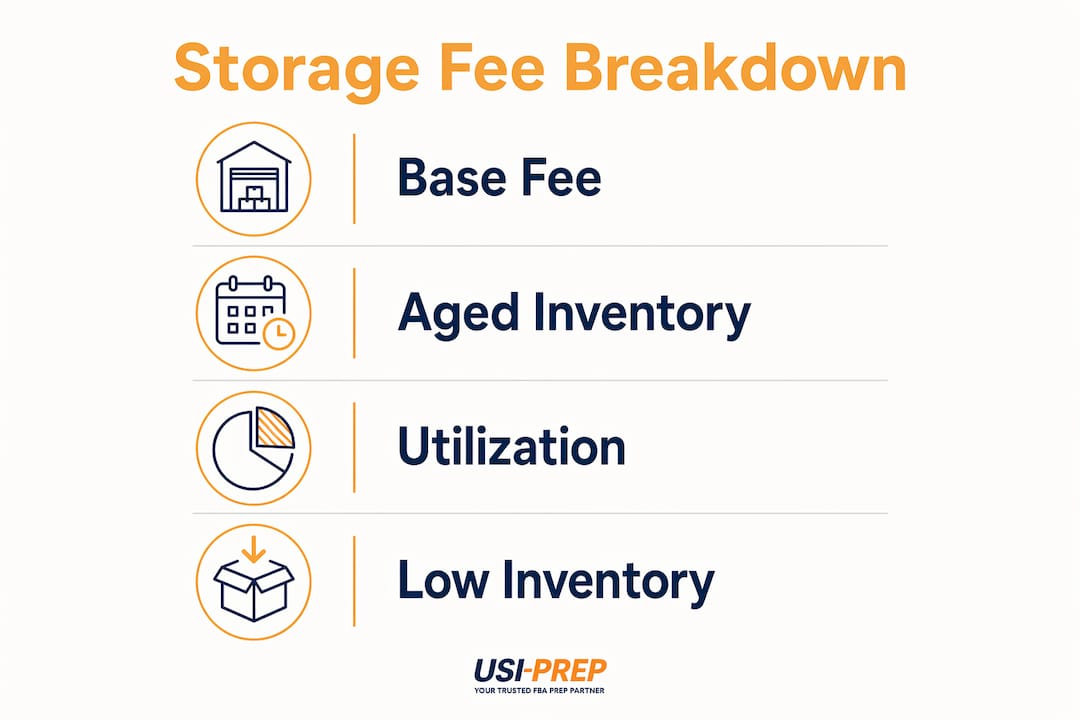
Beyond the base monthly rate, Amazon applies three major surcharges that can turn a manageable storage bill into a serious margin problem. Each one has a different trigger, but all three compound on top of your base fee.
Aged Inventory Surcharge
The Aged Inventory Surcharge (formerly called the Long-Term Storage Fee) begins once a unit has been in a fulfillment center for more than 180 days. The rate starts at $0.50 per cubic foot for units stored 181 to 210 days and escalates to $6.90 per cubic foot for units stored beyond 365 days, or $0.15 per unit, whichever is greater. At $6.90 per cubic foot, a single slow-moving product can generate more in storage fees per month than it earns in profit.
Storage Utilization Surcharge
This surcharge targets sellers who hold excess inventory relative to their sales velocity. When your weeks of cover (the number of weeks your current inventory would last at your current sales rate) exceeds 22 weeks, Amazon applies an additional charge. The Storage Utilization Surcharge ranges from $0.44 to $1.88 per cubic foot depending on whether your weeks of cover falls in the 22 to 52 week range or beyond. This fee penalizes bulk-buying strategies that look efficient on a per-unit cost basis but ignore the carrying cost of slow-moving stock.
Low Inventory Level Fee
Amazon also charges sellers whose stock falls too low relative to historical demand. This fee is designed to discourage chronic understocking that degrades Prime delivery performance. It applies when your days of supply drops below a defined threshold, and it functions as a counterweight to the utilization surcharge. You can be penalized for holding too much and for holding too little.
| Surcharge | Trigger | Rate range |
|---|---|---|
| Aged Inventory Surcharge | 181+ days in fulfillment center | $0.50 to $6.90 per cubic foot |
| Storage Utilization Surcharge | 22+ weeks of cover | $0.44 to $1.88 per cubic foot |
| Low Inventory Level Fee | Below minimum days of supply | Variable by product category |
Pro Tip: Set a recurring calendar reminder for the 13th of every month. That gives you two days to identify and act on units approaching the 180-day threshold before Amazon’s assessment date hits.
When does Amazon charge and post storage fees?
Amazon calculates monthly storage fees based on the average daily inventory volume across the entire calendar month. The fee is not based on a single snapshot. It is the average of every day’s inventory count multiplied by the applicable cubic-foot rate. This means that removing inventory mid-month still reduces your bill for that month, even if the units were present for the first half.
Here is how the billing cycle actually works:
- Month-end calculation. Amazon tallies your average daily inventory for the month and computes the base storage fee.
- Mid-following-month posting. Fees post to seller accounts during the billing cycle following the storage month, typically around the 15th of the next month.
- Aged inventory assessment. The Aged Inventory Surcharge is assessed separately, also around the 15th of each month, based on which units crossed the 180-day or 365-day thresholds.
- Reconciliation in Seller Central. You can verify charges using the FBA Monthly Storage Fees report and the Inventory Age report inside Seller Central. Cross-reference both before disputing any charge.
The practical implication is that removing inventory before the 15th prevents the aged inventory surcharge from applying to units that are about to cross a threshold. A removal order submitted on the 12th of the month can save you from a surcharge that would otherwise compound for months. Fee awareness without calendar discipline is worthless.
Sellers operating across multiple Amazon marketplaces should note that billing cycles and assessment dates can vary by region. The US marketplace follows the schedule above, but European and Asian marketplaces have their own fee structures and posting schedules. Always verify within the specific Seller Central account for each marketplace.
How to minimize storage fees on Amazon
Reducing Amazon FBA storage costs is not about finding a loophole. It is about managing inventory as a flow problem rather than a static stocking decision. These tactics address the specific fee triggers covered above.
- Track weeks of cover weekly. The weeks of cover metric is the single number that controls your exposure to the Storage Utilization Surcharge. Keep it below 22 weeks for all SKUs, and you avoid that surcharge entirely. Use Seller Central’s Inventory Performance Dashboard or a third-party tool like Skubana or Inventory Planner to monitor this in real time.
- Cap Q4 inventory at six weeks of demand. Sellers who hold no more than six weeks of demand in FBA during peak season avoid the worst of the $2.40 per cubic foot rate on slow-moving units. Ship in smaller, more frequent batches rather than one large Q4 send.
- Audit inventory before the 15th every month. Units approaching 180 days need a decision: run a promotion, create a removal order, or enroll in Amazon’s Liquidations program. Avoiding the aged inventory surcharge is almost always cheaper than paying it.
- Use Amazon Warehousing and Distribution (AWD) or a third-party logistics provider for overflow stock. AWD offers lower storage rates for bulk inventory held outside the fulfillment network, with replenishment to FBA on demand. A 3PL like Usiprep can hold surplus inventory at lower cost and ship to FBA in timed batches, keeping your FBA weeks of cover in range.
- Reduce packaging dimensions wherever possible. Tighter boxes mean lower cubic footage, lower base fees, and lower surcharges. Review your FBA prep errors regularly to catch oversized packaging before it ships.
| Strategy | Fee it targets | Difficulty |
|---|---|---|
| Cap Q4 stock at 6 weeks of demand | Base fee (peak season) | Medium |
| Monthly audit before the 15th | Aged Inventory Surcharge | Low |
| Keep weeks of cover below 22 | Storage Utilization Surcharge | Medium |
| Use AWD or 3PL for overflow | Base fee and utilization | Medium |
| Reduce packaging dimensions | Base fee (all seasons) | Low |
Pro Tip: Build your storage fee estimate by adding a 10 to 15% buffer on top of Amazon’s calculator output. That buffer accounts for surcharges, fuel adjustments, and timing gaps that the calculator does not capture.
Key takeaways
Amazon storage fees compound across base rates, aged inventory surcharges, utilization penalties, and low inventory fees, making proactive inventory flow management the only reliable way to control costs.
| Point | Details |
|---|---|
| Base fee formula | Cubic feet per unit × units stored × monthly rate ($0.78 or $2.40 depending on season). |
| Q4 rate spike | Standard-size fees jump 207% in October, making slow-moving Q4 inventory extremely costly. |
| Surcharges stack | Aged inventory, utilization, and low inventory fees all add to base fees and can spike monthly bills. |
| Billing calendar | Fees post mid-month following the storage month; aged fees assessed around the 15th. |
| Key action | Audit inventory before the 15th monthly and keep weeks of cover below 22 to avoid surcharges. |
Storage fees are a flow problem, not a line item
I have worked with enough Amazon sellers to know that the ones who get burned by storage fees are almost never the ones who misread the rate card. They are the ones who treat storage as a fixed cost of doing business rather than a variable they actively manage.
The most common mistake I see is the bulk Q4 shipment. A seller sees a great per-unit price on a large order, ships 3,000 units into FBA in September, and then watches sales come in at 200 units a week. By November, they have 1,400 units sitting at $2.40 per cubic foot with weeks of cover pushing past 30. The utilization surcharge kicks in on top of the peak rate, and suddenly the “savings” from the bulk order are gone.
The sellers who consistently control their storage costs do three things differently. They check weeks of cover every week, not every quarter. They set hard calendar alerts for the 13th of each month to review aging inventory. And they treat their 3PL or AWD account as a buffer layer, not a last resort. Integrating hidden fulfillment fees into your unit economics from day one changes how you make every buying and shipping decision.
Storage fees are not a penalty for bad luck. They are a signal that inventory is moving slower than you planned. The fee is Amazon’s way of charging you for that gap. Fix the gap, and the fee takes care of itself.
— Akbar
Cut storage fees with Usiprep’s FBA prep services

Usiprep was founded by former Amazon sellers who understand exactly how prep delays and oversized packaging translate into higher storage fees. When inventory sits at a prep center longer than it should, it arrives at FBA later, ages faster, and costs more. Usiprep’s FBA prep and fulfillment services are built to move inventory through the prep process quickly, with a 98.9% on-time delivery rate and a 30% reduction in fulfillment costs for many brands. Start with the FBA prep checklist to make sure every shipment is compliant and sized correctly before it reaches Amazon. For sellers ready to speed up their entire prep cycle, the FBA prep process guide walks through every step.
FAQ
How are Amazon FBA storage fees calculated?
Amazon calculates storage fees by converting your packaged product dimensions to cubic feet (Length × Width × Height ÷ 1,728), multiplying by units stored, and applying the monthly rate. The rate is $0.78 per cubic foot from January through September and $2.40 per cubic foot from October through December for standard-size products.
When does Amazon charge storage fees?
Monthly storage fees are based on average daily inventory volume and post to seller accounts mid-month following the storage month. Aged Inventory Surcharges are assessed separately around the 15th of each month.
What triggers the Aged Inventory Surcharge?
The Aged Inventory Surcharge applies once a unit has been stored in an Amazon fulfillment center for more than 180 days. Rates start at $0.50 per cubic foot and escalate to $6.90 per cubic foot for units stored beyond 365 days.
What is the Storage Utilization Surcharge?
The Storage Utilization Surcharge applies when your weeks of cover exceeds 22 weeks, meaning you hold more than 22 weeks of supply relative to your sales velocity. The surcharge ranges from $0.44 to $1.88 per cubic foot on top of your base monthly fee.
How can I avoid Amazon storage fees during Q4?
Cap your Q4 FBA inventory at no more than six weeks of projected demand to limit exposure to the $2.40 per cubic foot peak rate. Use Amazon AWD or a third-party logistics provider to hold overflow stock outside the FBA network and replenish in smaller, timed batches.