
FBA compliance is the set of packaging, labeling, and prep standards Amazon requires before inventory enters a fulfillment center, and ignoring those standards now costs sellers more than ever. Since January 2026, Amazon ended all in-house prep services, shifting full responsibility onto sellers and introducing a new penalty structure that hits margins hard. Understanding why FBA compliance matters is no longer optional. It is the difference between inventory that sells and inventory that sits rejected at a dock.
Why FBA compliance matters more than ever in 2026
FBA compliance covers every physical requirement Amazon places on inbound inventory: FNSKU labeling, polybagging, bubble wrap, suffocation warning labels, and correct barcode placement. Each requirement exists to protect Amazon’s fulfillment speed. When a unit arrives without a scannable label or in packaging that fails inspection, the entire shipment can stall.
The 2026 policy change made this far more consequential. Amazon ended all prep services as of January 1, 2026, replacing them with an Inbound Defect Fee starting at $0.60 per unit, with certain violations exceeding $1.00 per unit. Before 2026, Amazon would often fix minor prep issues for a fee. That option no longer exists. Non-compliant shipments now face outright rejection or punitive charges rather than corrective prep.
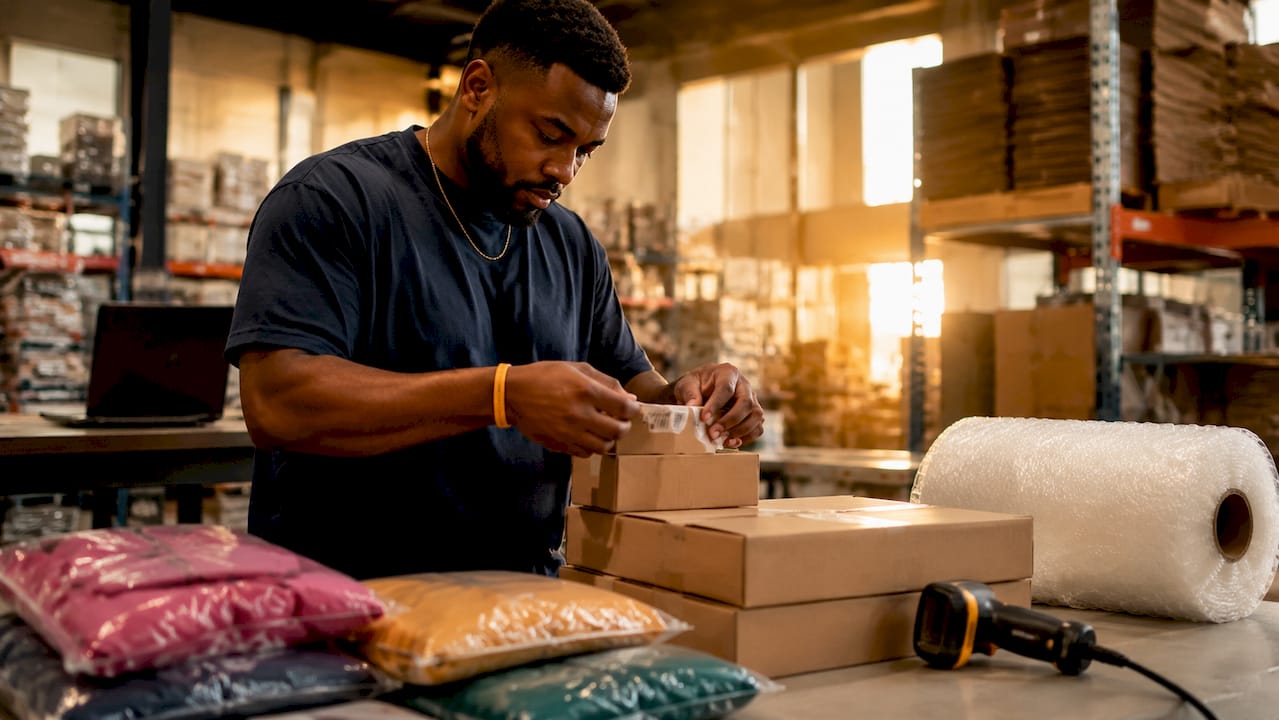
The labeling requirements alone demand precision. FNSKU labels must be scannable, properly sized, and placed flat on the product or packaging, fully covering any manufacturer barcodes. A label that is slightly crooked, printed at the wrong resolution, or placed over a seam can trigger a scanning error at the fulfillment center. That single error can delay an entire pallet.
The scale of the problem is already visible in the data. Over 17% of inbound FBA shipments faced packaging issues in 2025, causing an average 2.3-day delay and increased handling fees. That figure represents millions of units held up before the 2026 rules even took full effect. The compliance bar has only risen since.
Pro Tip: Review the FBA packaging requirements for 2026 before your next shipment. A single overlooked polybagging rule can flag an entire container.
Here is a quick breakdown of the core compliance categories every seller must address:
- FNSKU labeling: Covers every sellable unit, printed at the correct size, placed flat and scannable
- Polybagging: Required for soft goods, loose sets, and items with exposed parts. Bags must meet thickness requirements and include suffocation warnings for openings over 5 inches
- Bubble wrap and fragile prep: Required for glass, ceramics, and fragile electronics
- Bundling and set prep: Multi-unit sets must be labeled “Sold as Set” and packaged together
- Carton labeling: Each shipping carton needs a compliant FBA shipment label placed correctly on the outside
How non-compliance hits your finances and operations
The financial impact of non-compliance compounds quickly. Sellers shipping 1,000 units per month with a 5% error rate now face $50 or more in unplanned fees, compared to roughly $10 before 2026. That is a fivefold increase in penalty costs from the same error rate, and it does not include the downstream disruptions.
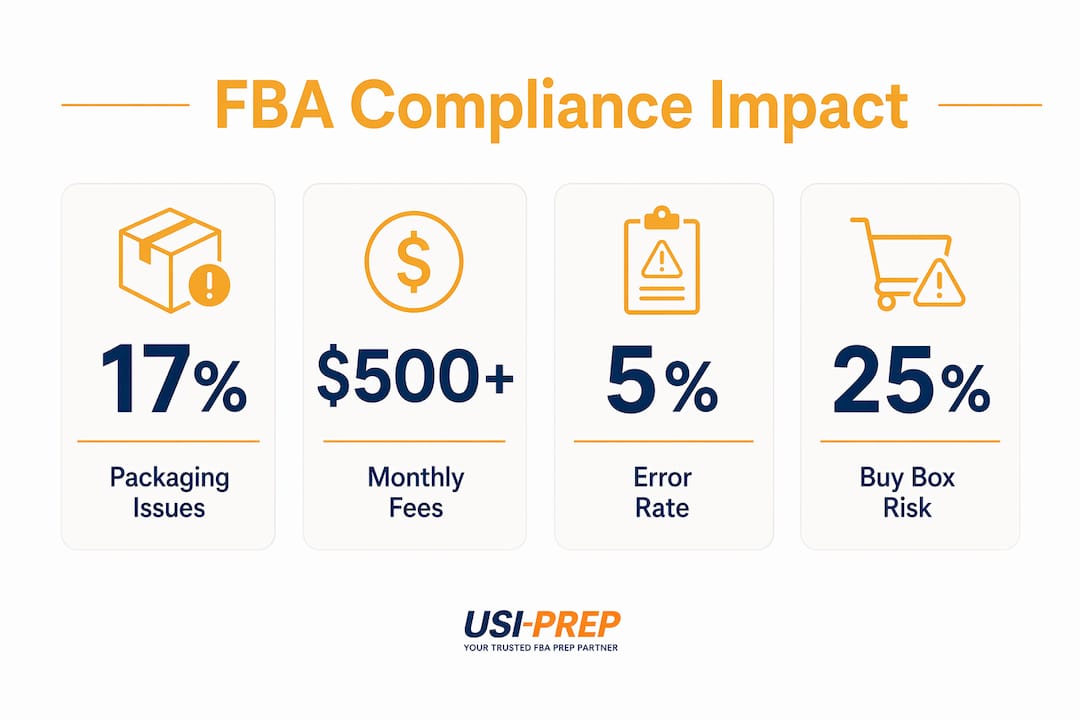
Beyond the direct fees, non-compliance triggers a cascade of secondary costs. Stranded inventory, appointment rescheduling, and return-to-sender logistics increase total landed cost by 10 to 15%. A shipment rejected at the fulfillment center does not just cost the Inbound Defect Fee. It costs the return freight, the storage fees while the inventory waits, the reprocessing labor, and the lost sales velocity during the delay.
The table below shows how the consequences have shifted between pre-2026 and post-2026 policy:
| Scenario | Pre-2026 outcome | Post-2026 outcome |
|---|---|---|
| Missing FNSKU label | Amazon applies label for a fee | Shipment rejected or Inbound Defect Fee charged |
| Improper polybagging | Amazon repackages for a fee | Unit refused or $0.60+ per unit fee applied |
| Incorrect carton label | Shipment delayed, corrected on-site | Appointment canceled, return-to-sender possible |
| Bundling error | Amazon separates and relabels | Seller bears full cost of reprocessing |
| 5% error rate on 1,000 units | ~$10 in fees | $50+ in fees plus operational disruption |
Account health is also at risk. Repeated compliance failures raise your defect rate in Seller Central, which affects your eligibility for promotions, Prime placement, and in severe cases, can trigger account review. The FBA check-in process at fulfillment centers is automated and unforgiving. There is no customer service rep reviewing your shipment for context.
Pro Tip: Monitor your Inbound Performance dashboard in Seller Central weekly. Amazon flags problem shipment types by ASIN, so you can identify which products are generating repeat violations before they accumulate into account-level penalties.
What are the best prep options for staying compliant?
The most effective strategy for FBA compliance is moving prep upstream, meaning completing all labeling and packaging before inventory leaves the factory or origin country. Full FBA-spec inspections at factories reduce defects and delays more reliably than any downstream fix. The logic is simple: catching a labeling error in Shenzhen costs a fraction of catching it in a New Jersey fulfillment center.
The data supports this approach. Moving prep to the factory level reduced shipment rejections from 12% to under 2% and saved over $5,000 in penalty and delay costs across early shipments. That is not a marginal improvement. It is a structural change in how compliant inventory gets built.
Sellers have three realistic options for where prep happens:
- Factory-level prep in China: The manufacturer or a local 3PL applies FNSKU labels, polybagging, and carton labels before the goods ship. Lower cost per unit, but requires tight quality control instructions and verification photos before the container closes.
- US-based 3PL prep centers: Inventory ships to a third-party warehouse in the US, where prep is completed before forwarding to Amazon. Higher per-unit cost but more control over quality and easier to catch errors before they reach the fulfillment center.
- Integrated forwarder prep services: Some freight forwarders now offer prep as part of their logistics package. This consolidates vendors but requires confirming the forwarder’s prep standards match Amazon’s exact specifications.
The cost and control tradeoffs look like this:
| Prep method | Cost per unit | Rejection risk | Best for |
|---|---|---|---|
| Factory-level prep | Low ($0.10 to $0.30) | Low with strong QC | High-volume, repeat SKUs |
| US 3PL prep center | Medium ($0.50 to $1.50) | Very low | New products, complex prep |
| Integrated forwarder prep | Medium ($0.40 to $1.00) | Low to medium | Sellers consolidating vendors |
| DIY at home or warehouse | Variable | High | Very low volume only |
Pro Tip: When using factory-level prep, send a physical sample of the correctly prepped unit to your supplier before the production run. A photo reference reduces misinterpretation of label placement and polybagging specs far better than written instructions alone.
Reviewing the polybagging requirements and sticker placement rules before briefing any prep partner is a non-negotiable step. Suppliers and 3PLs vary widely in their familiarity with Amazon’s exact standards.
How compliance unlocks growth, not just protection
FBA compliance is not only a defensive measure. It is a prerequisite for accessing Amazon’s most valuable growth programs. Access to programs like FBA New Selection is directly tied to maintaining high operational standards, and those programs offer up to a 10% sales rebate and free storage for qualifying new ASINs. Sellers with compliance problems are excluded from these benefits entirely.
High compliance also correlates with stronger Buy Box performance. Amazon’s algorithm factors in fulfillment reliability when determining which seller wins the Buy Box on a shared listing. A seller with a clean inbound performance record has a structural advantage over one with repeated defect flags, even if their price is identical.
“Successful sellers integrate FBA prep as part of their quality control process, improving supply chain reliability and reducing hidden costs.” — Unicargo, Amazon FBA Prep Requirements 2026
The long-term operational benefit is equally significant. Sellers who build compliance into their supply chain as a standard workflow, rather than a last-minute checklist, eliminate the emergency relabeling and repacking that inflate unit costs by 10 to 15%. Over a year of shipments, that margin recovery compounds into a meaningful cost advantage over competitors who treat compliance as an afterthought.
Pro Tip: Use the FBA New Selection program as a compliance audit trigger. If a new ASIN fails to qualify, trace back through the prep checklist to identify which requirement is causing the disqualification.
My take: compliance is a supply chain function, not a checklist
The real cost of treating compliance as an afterthought
I have watched sellers lose weeks of sales velocity because a supplier printed FNSKU labels at the wrong DPI. I have seen a 500-unit shipment get returned to sender because one carton label was placed on the wrong panel of the box. These are not edge cases. They are the predictable result of treating compliance as something you verify at the end of the process instead of building into the beginning.
The 2026 policy shift removed the safety net. Amazon is no longer a forgiving partner that fixes your prep mistakes for a small fee. It is a logistics machine that rejects non-conforming inputs. Sellers who adapted early by moving prep upstream and building quality checks into their supplier relationships are operating at a lower cost per unit than they were two years ago. Sellers who did not are paying the Inbound Defect Fee on every shipment and wondering why their margins keep shrinking.
My honest recommendation: treat FBA compliance the same way you treat product quality. Build the spec into the purchase order. Verify it before the container closes. Do not leave it to chance at the fulfillment center. The sellers scaling fastest on Amazon right now are not the ones with the lowest prices. They are the ones whose inventory moves from factory to Prime-eligible listing without a single rejection.
— Akbar
Get your FBA prep right before your next shipment
Usiprep was founded by former Amazon sellers who know exactly what a rejected shipment costs in fees, delays, and lost ranking. The team handles FNSKU labeling, polybagging, carton prep, and quality checks with a 98.9% on-time delivery rate and a track record of cutting fulfillment costs by 30% for growing brands. If you are preparing for your next inbound shipment and want to avoid the Inbound Defect Fee entirely, start with the 2026 prep requirements checklist Usiprep built specifically for sellers navigating the new rules. For sellers looking to move faster without sacrificing accuracy, the guide on speeding up your FBA prep walks through exactly how to do it.
Key takeaways
FBA compliance directly determines whether your inventory reaches Amazon’s fulfillment centers, sells at full velocity, and qualifies for growth programs, making it a core supply chain function rather than an administrative task.
| Point | Details |
|---|---|
| 2026 policy ended Amazon’s prep services | Sellers must complete all prep before shipment or face Inbound Defect Fees starting at $0.60 per unit. |
| Non-compliance raises total landed cost | Stranded inventory, return freight, and reprocessing increase total landed cost by 10 to 15% per violation. |
| Upstream prep cuts rejection rates dramatically | Moving prep to the factory level reduced rejections from 12% to under 2% and saved $5,000+ in penalties. |
| Compliance unlocks Amazon growth programs | FBA New Selection and Buy Box eligibility both require clean inbound performance records. |
| VAT compliance is an overlooked risk | Amazon’s multi-warehouse inventory distribution can trigger multi-jurisdiction VAT obligations sellers miss. |
FAQ
What is the Inbound Defect Fee and when does it apply?
The Inbound Defect Fee is a per-unit charge Amazon introduced in January 2026 for shipments that arrive without meeting prep and labeling requirements. It starts at $0.60 per unit and can exceed $1.00 per unit depending on the violation type.
What prep requirements do FBA sellers need to meet?
FBA sellers must apply FNSKU labels to every unit, polybag eligible products, add suffocation warnings where required, bubble wrap fragile items, and label each shipping carton correctly. Detailed specs for each requirement are available in Amazon’s Seller Central and in the 2026 prep checklist.
How does non-compliance affect my Amazon seller account?
Repeated compliance failures raise your inbound defect rate in Seller Central, which can reduce your Buy Box eligibility, disqualify you from programs like FBA New Selection, and in serious cases trigger account review or suspension.
Is it cheaper to prep inventory in China or the US?
Factory-level prep in China typically costs $0.10 to $0.30 per unit, compared to $0.50 to $1.50 at a US-based 3PL prep center. The lower cost at origin makes factory prep the better choice for high-volume, repeat SKUs when quality control instructions are precise and verified before the container closes.
Does FBA compliance include tax obligations?
Yes. Amazon distributes FBA inventory across multiple warehouses automatically, which can trigger VAT registration requirements in multiple jurisdictions. Sellers should audit their inventory placement in Seller Central monthly to identify any new tax exposure created by Amazon’s distribution decisions.