
Outsourcing your Amazon prep center workflow means handing off product labeling, packaging, inspection, and shipment preparation to a third-party logistics provider who handles every step before your inventory reaches an Amazon fulfillment center. For small to medium-sized eCommerce sellers, this shift delivers a measurable 2–5% EBITDA improvement by cutting labor overhead and avoiding costly compliance penalties. The tasks involved, including FNSKU labeling, polybagging, kitting, and cartonization, are time-intensive and error-prone when managed in-house. Getting this right in 2026 means understanding both the workflow mechanics and the technology that makes outsourced prep faster and more reliable than ever.
What you need before outsourcing your Amazon prep center workflow
Before you redirect a single supplier shipment, you need to prepare a specific set of documents and system configurations. Skipping this step is the most common reason sellers experience delays in their first 30 days with a prep center. The good news: standard onboarding takes roughly 30 minutes when you have the right materials ready.
Here is what you need to gather before onboarding:
- SKU spreadsheet: Include ASINs, product dimensions, weight, and prep specifications for every item you plan to send. The more precise this document, the fewer back-and-forth corrections you will deal with later.
- Supplier redirect SOPs: Write clear instructions telling your manufacturer or distributor to ship directly to the prep center’s address instead of your warehouse. Include contact names, reference numbers, and expected shipment windows.
- Custom prep instructions: Upload detailed labeling and packaging requirements for each SKU. This includes polybag thickness, bundle configurations, and any category-specific rules Amazon enforces.
- Shipment plan templates: If your prep center creates shipments in Seller Central on your behalf, they need API access or login credentials scoped to inventory management only.
- Dashboard or portal access: Most professional prep centers provide a client portal for real-time shipment tracking. Set this up before your first inbound arrives.
Accurate, documented prep instructions are the hidden margin lever that protects you from unexpected Amazon penalties or chargebacks. Sellers who skip this step often discover the problem only after receiving a defect notice or a short-paid invoice.
Pro Tip: Document your SLAs in writing before your first shipment. A 48 to 72 hour receipt-to-shipment-creation window is a reasonable standard. Anything longer signals a capacity or communication problem worth addressing upfront.
How the outsourced prep workflow runs from inbound to FBA check-in
A well-run outsourced prep operation follows a predictable sequence. Understanding each phase helps you monitor performance, catch errors early, and hold your provider accountable.
-
Inbound receiving: The prep center receives your supplier’s shipment, counts cartons, and documents any visible damage. Professional centers conduct AQL inspections on the first three purchase orders, checking 10% of units for defects. Once quality trends stabilize, that rate scales down to 3 to 5%.
-
FNSKU labeling: Labels must be placed on flat surfaces with no seams or curves and must be scannable within one second. Any deviation from Amazon’s placement rules triggers a check-in rejection at the fulfillment center.
-
Polybagging and packaging: Polybags require a minimum 1.5 mil thickness and must display a suffocation warning for bags over a certain size. Your prep instructions should specify this explicitly for every applicable SKU.
-
Kitting and bundling: If you sell multi-packs or product bundles, the prep center assembles these according to your specs. This step requires precise instructions because bundle errors are difficult to reverse once items are in transit.
-
Cartonization: The prep center packs units into master cartons optimized for Amazon’s FBA fee tiers. Getting carton dimensions right reduces oversize fees and speeds up check-in at the fulfillment center.
-
Shipment creation in Seller Central: Your prep center creates the FBA shipment plan, prints box labels, and books the carrier. You can review the FBA shipment creation process to understand exactly what this step involves.
-
Real-time status monitoring: A quality prep center provides photo confirmation at key stages, including receiving, labeling, and packing. You should be able to log into a dashboard and see current status without sending an email.
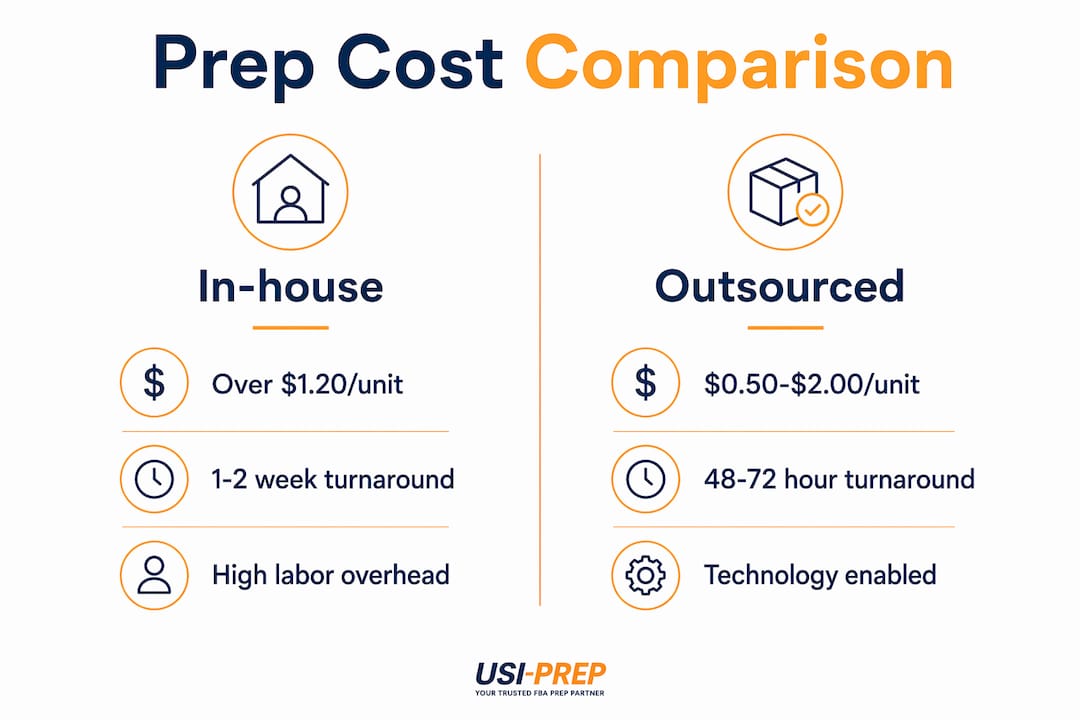
Here is a direct comparison of in-house versus outsourced prep performance:
| Metric | In-house prep | Outsourced prep |
|---|---|---|
| Cost per unit | Over $1.20 | $0.50 to $2.00 (volume-dependent) |
| Turnaround time | 1 to 2 weeks | 2 to 5 days |
| Compliance accuracy | Variable | 99% with specialized centers |
| Labor hours saved weekly | 0 | 20 to 30 hours |
| Gross margin (typical) | 18 to 20% | Up to 25% |
In-house prep costs can exceed $1.20 per unit with a one to two week turnaround. Outsourcing to a specialized provider cuts that turnaround to two to five days while hitting 99% compliance accuracy. That gap compounds quickly at volume.
Pro Tip: Ask your prep center to send photo confirmation at receiving and post-labeling stages. This creates an audit trail that protects you if Amazon raises a check-in discrepancy.
Common mistakes that erode margins in outsourced prep operations
Most margin problems in outsourced prep trace back to one root cause: vague instructions. Sellers assume prep centers will infer the right approach from context. They rarely do.
The most frequent errors and how to address them:
- Incomplete prep specs: Many sellers underestimate the detail required, including polybag thickness, exact label placement coordinates, and packaging material type. A spec sheet that says “polybag required” without specifying 1.5 mil thickness will produce inconsistent results.
- Skipping AQL inspections: Sellers who waive early-order inspections to save time often absorb the cost later through Amazon returns, negative reviews, or account health warnings. The AQL protocol exists precisely to catch supplier quality drift before it reaches customers.
- Undefined SLAs: Without a written agreement on turnaround times, prep centers prioritize based on their own capacity. A documented 48 to 72 hour SLA for receipt to shipment creation is the industry standard and should be non-negotiable.
- Ignoring 2026 Amazon label placement rules: Amazon updated its FNSKU placement requirements, and prep centers that do not stay current will generate check-in rejections. Verify your provider checks compliance daily.
- No shared dashboard: Managing a prep center relationship over email alone creates blind spots. Insist on a portal that shows inbound status, prep progress, and shipment creation in real time.
Specialized 3PL prep centers that check FNSKU placement, packaging standards, and carton labeling daily reduce labeling suspensions and improve inventory turnaround from weeks to days.
Pro Tip: Schedule a monthly workflow audit with your prep center. Review error rates, SLA adherence, and any Amazon check-in discrepancies. Treat this like a vendor performance review, not a casual check-in.
How technology makes outsourced Amazon prep workflows faster and more reliable
The operational gap between average and excellent prep centers comes down to technology. Providers still relying on spreadsheets and email threads introduce delays that compound across hundreds of shipments per month.

The most significant advancement in prep center technology is event-driven architecture using the Amazon SP-API with webhook notifications. This approach cuts API calls by 90% and reduces inventory sync latency from 24 hours to under 15 minutes. For sellers managing multiple SKUs across several suppliers, that difference means catching a receiving error the same day instead of discovering it a week later when stock is already depleted.
A tech-enabled prep center gives you three concrete advantages. First, real-time inbound and prep status through a dashboard that syncs directly with your Seller Central account. Second, automated reorder notifications triggered by inventory thresholds rather than manual checks. Third, shipment tracking that updates without requiring you to contact the prep center for status.
Technology integrations reduce manual overhead and errors, freeing sellers to focus on sourcing and growth rather than operational firefighting. Tools like Extensiv and workflow automation platforms can connect your prep center’s system to your inventory management software, creating a single source of truth across the supply chain.
Pro Tip: Before signing with a prep center, ask specifically whether they use SP-API webhooks or polling. Polling-based systems check for updates on a fixed schedule and can lag by hours. Webhook-based systems push updates the moment a status changes.
Key takeaways
Outsourcing your Amazon prep center workflow delivers measurable margin gains only when you pair it with precise prep instructions, documented SLAs, and a tech-enabled provider.
| Point | Details |
|---|---|
| Prep before you outsource | Submit a complete SKU spreadsheet, supplier redirect SOPs, and custom prep instructions before your first inbound. |
| Enforce written SLAs | A 48 to 72 hour receipt-to-shipment window is the standard. Document it and hold your provider to it. |
| Use AQL inspections early | Inspect 10% of units on the first three orders, then scale to 3 to 5% once quality is confirmed. |
| Choose tech-enabled providers | SP-API webhook integration cuts sync latency from 24 hours to under 15 minutes. |
| Monitor margins monthly | Compare in-house versus outsourced cost per unit quarterly to confirm the EBITDA improvement holds. |
Why I think most SMB sellers wait too long to outsource prep
Most sellers I talk to treat outsourcing prep as something they will do once they hit a certain revenue threshold. That logic is backwards. The sellers who benefit most from outsourcing are not the ones already running at scale. They are the ones who outsource early enough to avoid building the wrong internal habits.
When you prep in-house, you develop workarounds. You tolerate a labeling process that takes twice as long as it should because it is “good enough.” You skip AQL inspections because you trust your supplier. You manage shipment creation manually because you have not had time to set up the API connection. Each of these decisions feels reasonable in isolation. Together, they create a ceiling on how fast you can grow.
The control argument is real but overrated. Yes, outsourcing means delegating. But delegation with precise instructions and a shared dashboard gives you more visibility than most in-house operations actually have. The sellers who struggle with outsourcing are the ones who hand off vague instructions and then blame the prep center when results are inconsistent.
The smarter frame is to treat your prep center as a technical partner, not a vendor. That means investing time upfront in documentation, onboarding, and SLA negotiation. It means reviewing performance data monthly and pushing back when standards slip. Done right, outsourcing prep is not a loss of control. It is a transfer of execution to people who do this all day, every day, while you focus on the decisions only you can make.
— Akbar
How Usiprep helps you run a tighter Amazon prep operation
Usiprep was built by former Amazon sellers who experienced firsthand what unreliable prep looks like from the seller’s side. The result is a prep and fulfillment service designed around transparency, speed, and compliance accuracy. Clients see a 30% reduction in fulfillment costs and a 98.9% on-time delivery rate, backed by real-time dashboard visibility at every stage of the prep process. If you are ready to move from manual prep to a fully managed workflow, start with the FBA prep requirements checklist for 2026 to confirm your specs are current. Then explore Usiprep’s full service offering to see how onboarding works and what your cost per unit looks like at your current volume.
FAQ
What does outsourcing Amazon prep center workflow actually include?
Outsourcing your Amazon prep center workflow covers receiving, FNSKU labeling, polybagging, kitting, cartonization, and FBA shipment creation. The prep center handles every step between your supplier’s factory and Amazon’s fulfillment center.
How long does onboarding with a prep center take?
Standard onboarding takes approximately 30 minutes and involves submitting a SKU spreadsheet, redirecting supplier shipments, uploading custom prep instructions, and configuring dashboard access.
What is a realistic cost per unit for outsourced Amazon prep?
Outsourced prep typically costs between $0.50 and $2.00 per unit depending on volume and complexity. In-house prep often exceeds $1.20 per unit once labor, space, and equipment costs are factored in.
How do I avoid compliance errors when outsourcing prep?
Provide exact prep specs for every SKU, including polybag thickness, label placement coordinates, and bundle configurations. Verify your prep center checks FNSKU placement and carton labeling against current Amazon requirements daily.
What technology should a good prep center use?
Look for SP-API webhook integration, which reduces inventory sync latency from 24 hours to under 15 minutes, plus a client dashboard that shows real-time inbound, prep, and shipment status without requiring manual status requests.