
The Walmart Marketplace fulfillment requirements list is the complete set of product, packaging, shipping, and business standards every seller must meet to use Walmart Fulfillment Services (WFS) and sell on the marketplace without penalties. Missing even one requirement triggers delays, unplanned fees, or outright account rejection. This guide breaks down every major requirement category so small and mid-sized eCommerce sellers can move fast, stay compliant, and access Walmart’s fast delivery network from day one.
1. What are the product eligibility and dimension criteria for WFS?
Walmart Fulfillment Services only accepts non-perishable, non-hazardous products shipped from within the United States. That single rule eliminates a wide range of product categories before you even look at size or weight.
Standard item limits:
- Maximum weight: 150 lbs
- Maximum single dimension (length): 96 inches
- Maximum combined measurement (length + girth): 130 inches
- Must be non-perishable and require no temperature control
Big and bulky item limits:
- Maximum weight: 500 lbs
- Freight shipping is required for items in this category
- Walmart routes bulky items through a separate logistics process
Prohibited and restricted categories include:
- Alcohol and tobacco products
- Perishable food and beverages
- Hazardous materials (flammables, corrosives, pressurized containers)
- Live animals and plants
- Products requiring refrigeration or freezing
Knowing these limits before you list a product saves you from shipping inventory that WFS will reject at the door. Check every SKU against these thresholds before building your catalog.
2. Key seller business requirements and documentation

Only registered U.S. legal entities with Employer Identification Numbers (EINs) qualify to sell on Walmart Marketplace. Sole proprietors who only have a Social Security Number are not accepted. That is a hard cutoff, not a gray area.
Required documents for seller onboarding:
- EIN issued by the IRS
- W-9 tax form
- Valid government-issued photo ID
- Business license (where applicable by state)
- US bank account or credit card for billing
Accepted legal entity types:
- LLC (Limited Liability Company)
- C-Corporation
- S-Corporation
- Partnership (with EIN)
Walmart’s 2026 verification process uses AI to cross-check every document you submit. Slight variations in legal name formatting across your IRS records, bank statements, and marketplace application commonly trigger fraud risk flags and delay approval. The name on your W-9 must match your bank account exactly, character by character.
Pro Tip: Build a compliance dossier before you apply. Gather your EIN letter, W-9, government ID, and a recent bank statement, then verify that the legal business name is spelled identically across all four documents. One mismatched abbreviation can stall your application for weeks.
An established eCommerce track record also improves your approval odds. Walmart reviews your sales history on other platforms as part of its seller quality assessment. If you are new to selling online, consider building a track record on another marketplace first. For international sellers, opening a US seller account requires additional steps around entity formation and EIN registration.
3. How to prepare and ship inventory to WFS correctly
Creating an active shipping plan in Walmart Seller Center is mandatory before you send a single unit to a fulfillment center. Sending inventory without an approved plan results in delayed or rejected stock check-in. That delay costs you sales days and ties up capital in transit.
Step-by-step shipping preparation:
- Log in to Seller Center and create a new inbound shipment plan.
- Select the products and quantities you plan to send.
- Print and apply WFS-compliant labels with scannable barcodes to every unit.
- Package items according to WFS standards (poly bags, bubble wrap, box strength requirements).
- Schedule your delivery appointment at the designated WFS receiving center.
- For bulky items over 150 lbs, arrange freight shipping through an approved carrier.
- Confirm shipment details in Seller Center and mark the plan as active before the truck leaves.
Labeling is where most sellers make costly mistakes. Items lacking proper labels or packaging/Shipping%20to%20WFS/WFS-prep-services) incur a $0.20 per unit unplanned prep fee and up to a 10 business day delay. That fee sounds small, but across a 5,000-unit shipment it adds up to $1,000 in avoidable costs.
Pro Tip: Audit a sample of 20–30 units from every shipment before it leaves your warehouse. Check that every barcode scans cleanly, every poly bag is sealed, and every box meets the minimum weight-bearing standard. Catching one bad pallet before it ships beats paying prep fees and waiting 10 days for your inventory to go live.
WFS Prep Services are available if you prefer Walmart to handle labeling and packaging at the fulfillment center. That option adds cost and can create bottlenecks during peak seasons. Sellers who prep inventory faster on their own side consistently see shorter check-in times and lower per-unit costs.
4. Setting up returns, billing, and account configuration
A US-based return address/Getting%20started%20with%20WFS/WFS-seller-onboarding-setup) configured in your WFS settings is required from day one. Without it, unsellable or damaged returns have nowhere to go, which leads to inventory loss and account health violations. This is one of the most overlooked steps in the WFS onboarding process.
Critical account configuration checklist:
- Set a valid US return address in WFS settings before your first shipment arrives
- Define return rules for each product category (restockable vs. unsellable)
- Connect a US bank account or credit card for WFS fee billing
- Verify your billing method (verification takes 2–3 business days per Walmart’s process)
- Switch your fulfillment type to WFS in Seller Center for each eligible listing
Billing account verification/Getting%20started%20with%20WFS/WFS-seller-onboarding-setup) takes 2–3 business days. Failing to complete it before your inventory arrives at the fulfillment center can interrupt WFS availability for your listings. Set up billing the same day you submit your seller application, not after approval.
Return rules also affect your bottom line directly. Sellers who configure clear, category-specific return rules recover more sellable inventory and reduce the volume of units that get written off as losses. Treat the return address setup as a revenue protection step, not just a compliance checkbox.
5. Seller-fulfilled vs. Walmart Fulfillment Services: which is right for you?
Seller-fulfilled and WFS orders differ across every major operational dimension. The right choice depends on your margins, your warehouse capacity, and how much delivery speed matters to your customers.
| Factor | Seller-Fulfilled | Walmart Fulfillment Services (WFS) |
|---|---|---|
| Inventory storage | Seller’s own warehouse | Walmart fulfillment centers |
| Picking and packing | Seller manages | Walmart manages |
| Shipping responsibility | Seller arranges carriers | Walmart handles all shipping |
| Customer service | Seller handles returns and inquiries | Walmart handles post-shipment support |
| TwoDay delivery badge | Requires seller to meet strict speed standards | Automatically qualifies listings |
| Search ranking impact | Lower visibility without speed badge | Higher visibility with TwoDay badge |
| Operational control | Full control over process | Limited control, Walmart sets standards |
| US warehouse required | Yes, seller must have US-based storage | No, Walmart stores your inventory |
The TwoDay delivery badge is the clearest competitive advantage WFS offers. Listings with that badge rank higher in Walmart’s search results and convert at a higher rate. Seller-fulfilled sellers can earn the badge too, but they must consistently meet Walmart’s delivery speed and on-time rate thresholds, which requires a well-run US warehouse operation.
Cost is the other major variable. WFS charges storage and fulfillment fees that eat into margins on low-price products. Seller-fulfilled keeps those fees off your books but adds warehouse rent, labor, and carrier costs. Understanding your fulfillment cost components before choosing a method prevents margin surprises later.
Pro Tip: Run a per-unit cost comparison for your top 10 SKUs before committing to WFS. Include WFS storage fees, fulfillment fees, and inbound shipping costs. Compare that total to your current self-fulfillment cost per unit. The math often surprises sellers who assumed WFS would be more expensive.
Key takeaways
Meeting Walmart Marketplace fulfillment requirements demands exact documentation, correct product eligibility, compliant packaging, and proper account setup before your first unit ships.
| Point | Details |
|---|---|
| Product eligibility is strict | Standard items must weigh under 150 lbs; prohibited categories include alcohol, perishables, and hazardous materials. |
| Documentation must match exactly | Your EIN, W-9, and bank records must show the identical legal business name to pass AI verification. |
| Shipping plans are mandatory | Always create and activate a shipping plan in Seller Center before sending inventory to WFS centers. |
| Return address setup protects revenue | Configure a US-based return address on day one to prevent inventory loss from unsellable returns. |
| WFS unlocks the TwoDay badge | Using WFS automatically qualifies your listings for Walmart’s TwoDay delivery badge, improving search ranking. |
What I have learned from watching sellers get this wrong
Most sellers who fail the Walmart Marketplace application or get hit with WFS fees are not making big mistakes. They are making small, fixable ones that compound. A business name with “LLC” on the IRS letter but without it on the bank account. A return address left blank because setup felt like a later problem. A shipment sent before the shipping plan was activated because someone assumed the system would catch up.
The data consistency issue is the one I see trip up sellers most often. Walmart’s AI verification does not give partial credit. It flags mismatches and holds the application. Sellers then spend weeks trying to figure out why they were rejected, when the answer is a single missing period in a business name. Build the compliance dossier first. Apply second.
The unplanned prep fee is the other silent killer. A $0.20 per unit fee sounds trivial until you are shipping 10,000 units a month and 15% of them have label issues. That is $300 in fees you could have avoided with a 20-minute pre-shipment audit. The WFS prep services/Shipping%20to%20WFS/WFS-prep-services) option exists for a reason, but leaning on it as a crutch adds cost and slows check-in during peak periods.
My honest advice: treat every fulfillment requirement as a competitive advantage, not a burden. Sellers who get this right ship faster, rank higher, and lose less inventory to returns. The ones who cut corners pay for it in fees, delays, and suppressed listings. The requirements are not arbitrary. They exist because Walmart’s customers expect a consistent experience, and your compliance is what delivers it.
— Akbar
How Usiprep helps you meet Walmart’s fulfillment standards
Staying compliant with Walmart’s packaging, labeling, and shipping requirements takes consistent execution across every shipment. Usiprep was founded by former Amazon sellers who understand exactly what happens when prep work falls short. The result is a fulfillment operation built around faster inventory check-ins, lower per-unit costs, and complete visibility at every stage.
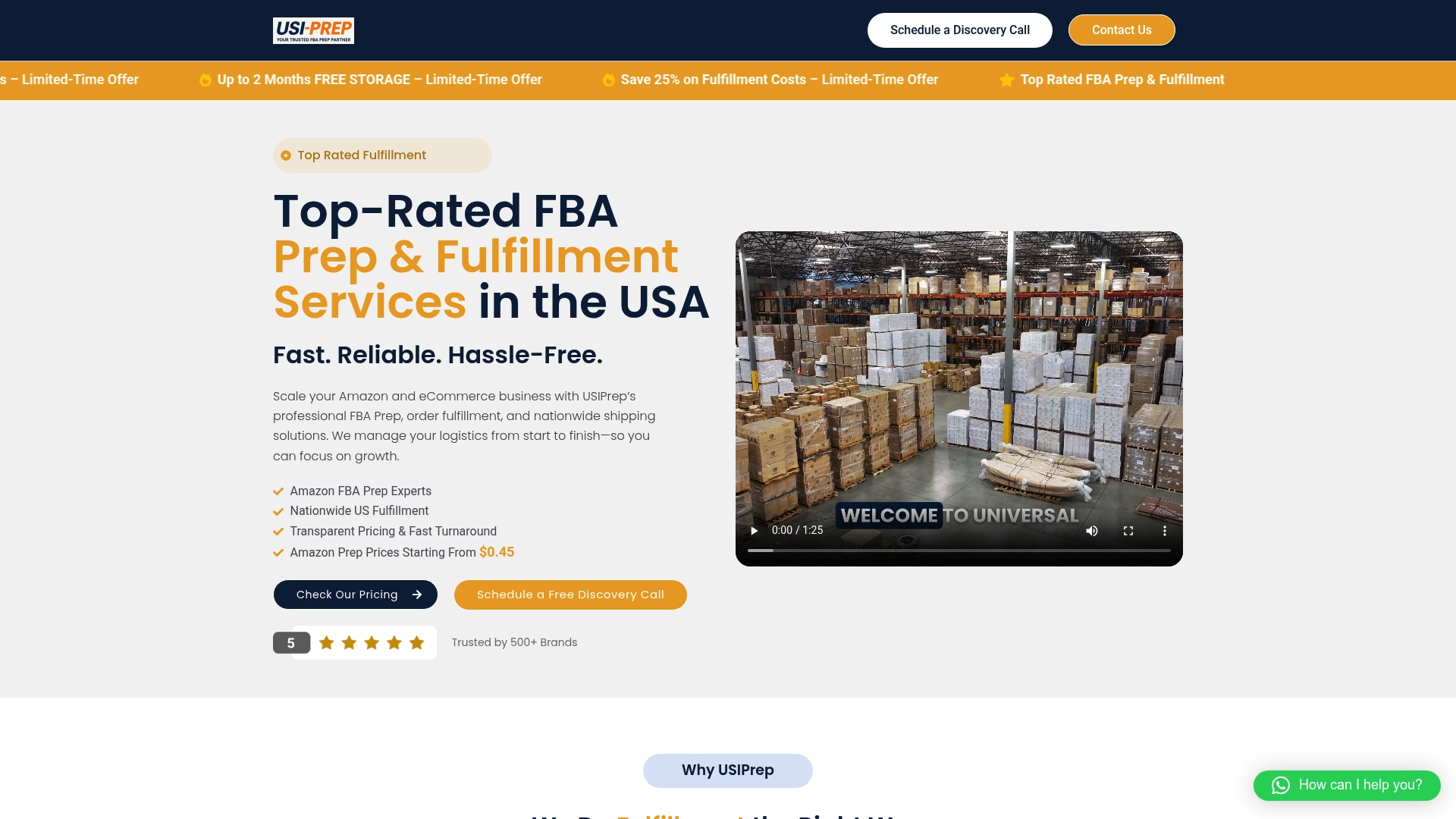
Usiprep clients report a 30% reduction in fulfillment costs and a 98.9% on-time delivery rate. Whether you are prepping your first WFS shipment or managing high-volume restocks, Usiprep’s team handles labeling, packaging, and compliance checks so your inventory arrives ready to sell. Start with the prep requirements checklist to see exactly what your next shipment needs before it leaves your hands.
FAQ
What products does Walmart Fulfillment Services not accept?
WFS does not accept perishable food, alcohol, tobacco, hazardous materials, live animals, or any product requiring temperature control. All accepted items must be non-perishable and ship from within the United States.
Can a sole proprietor sell on Walmart Marketplace?
No. Walmart requires a registered US legal entity with an EIN. Sole proprietors who only have a Social Security Number are not eligible to apply for a Walmart Marketplace seller account.
What happens if I send inventory without a shipping plan?
Sending inventory to a WFS center without an active shipping plan in Seller Center results in delayed or rejected check-in. Always create and activate your shipping plan before your shipment departs.
How long does WFS billing verification take?
Billing account verification takes 2–3 business days. Set up your US bank account or credit card immediately after your seller application is submitted to avoid any interruption to WFS availability.
Does using WFS automatically qualify my listings for the TwoDay badge?
Yes. WFS listings automatically qualify for Walmart’s TwoDay delivery badge, which improves search ranking and conversion rates compared to standard seller-fulfilled listings without the badge.