
Live shopping fulfillment is the process that synchronizes live video product demonstrations with real-time inventory tracking, instant in-stream checkout, and rapid order processing to deliver products accurately after a live commerce event. Known in the industry as live commerce fulfillment, this discipline sits at the intersection of broadcasting, inventory management, and logistics. Platforms like TikTok Shop and tools like Stripe have made the live shopping process accessible to brands of every size. Understanding how live shopping fulfillment works is the difference between a profitable stream and a customer service crisis caused by oversells, delayed shipments, or catalog mismatches.
How does the live shopping fulfillment process work?
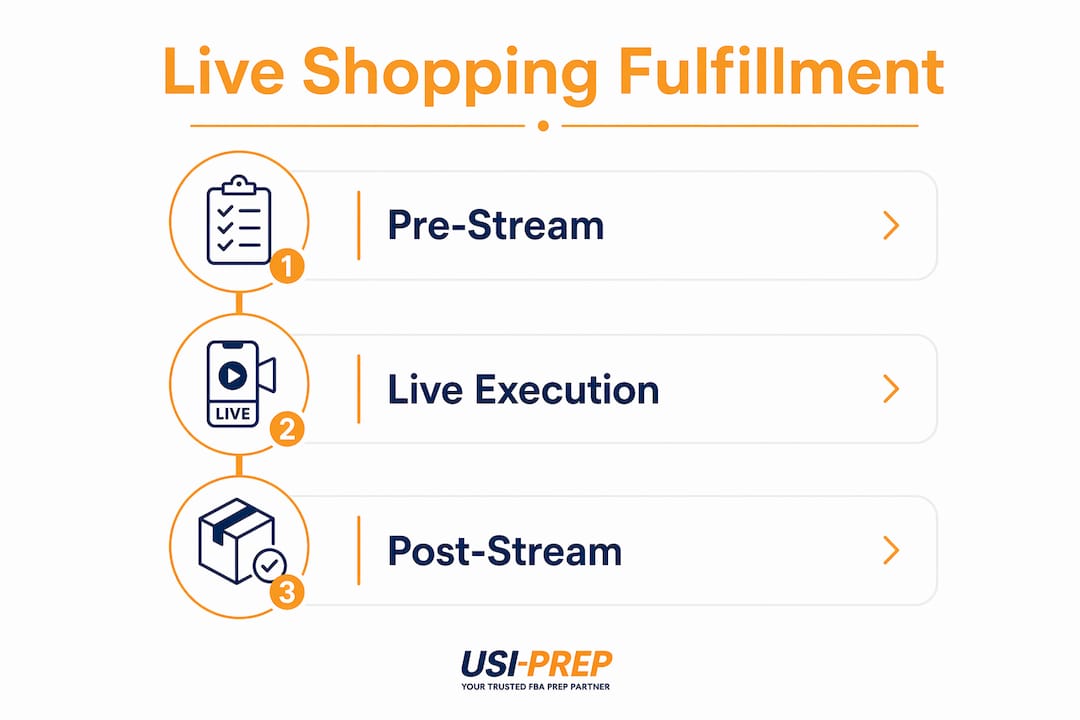
Live commerce fulfillment runs in three distinct phases: pre-stream staging, live execution, and post-stream recovery. Think of it as a mini factory with timed handoffs at every stage. Miss one handoff and the entire line backs up.
Phase 1: Pre-stream staging
Before the camera goes live, your warehouse must be ready. This means verifying inventory counts, mapping every SKU to its product listing, and physically staging units in labeled bins by variant. Pre-stream operational readiness includes preparing backup units and rehearsing host scripts for exceptions like low stock or shipping delays. That last step is underrated. A host who knows exactly what to say when a size sells out keeps viewers engaged instead of confused.
Staging inventory by SKU in specific bins eliminates packing errors during the live sale, especially for drops and bundled products with multiple configurations. A brand selling three colorways of a jacket needs three clearly separated bins, not a single pile sorted on the fly.
Phase 2: Live execution with real-time stock control
During the stream, the fulfillment system must process purchases in milliseconds. Live commerce compresses the purchase journey into a single session with hosts, chat interaction, and in-stream purchase buttons, syncing catalog and inventory in real time. That compression creates enormous pressure on your stock management layer.

The standard technical solution is a reservation token. When a viewer taps to buy, the system issues a per-SKU reservation token with a short expiry, typically 90 seconds, to decrement stock and prevent overselling under real-time latency constraints. If the viewer does not complete payment within that window, the unit returns to available inventory automatically.
Pro Tip: Set your reservation token expiry no longer than 90 seconds. Longer windows lock up inventory and create artificial stockouts that frustrate viewers who cannot add items to their cart.
Phase 3: Post-stream recovery
Once the stream ends, the work shifts to fulfillment execution. Orders must flow automatically from the live platform into your order management system (OMS) or warehouse management system (WMS). Event-driven order-to-fulfillment handoffs via webhooks and APIs replace manual order processing and maintain shipping SLAs. After dispatch, tracking updates must flow back to customers promptly.
Post-stream also means managing returns, processing refunds, and following up on any orders flagged during the live event. Brands that treat post-stream as an afterthought consistently see higher chargeback rates and lower repeat purchase numbers.
What technology stack enables live commerce fulfillment?
Live shopping platform success depends on flawless real-time integration across video, product catalog, audience interaction, inventory, and payment flows. Missing any single layer causes fulfillment breakdown. Here is what that stack looks like in practice:
- Inventory sync layer: A bidirectional connection between your live platform and your OMS or WMS. Stock counts update in real time as reservations and purchases occur. Without this, your host announces a product as available while your warehouse has already shipped the last unit.
- Reservation engine: Redis-backed atomic counters are the standard implementation for high-traffic streams. They process simultaneous purchase requests without race conditions that cause oversells.
- Payment processing: Integrated processors like Stripe or Adyen handle in-stream checkout without redirecting viewers to an external page. Keeping payment inside the stream reduces cart abandonment significantly.
- Webhook-driven order handoff: The moment a payment confirms, a webhook fires to your WMS, triggering pick, pack, and ship workflows automatically. Manual steps at this stage create bottlenecks that compound across hundreds of simultaneous orders.
- Tracking feedback loop: Shipping carrier APIs push tracking numbers back into the platform so customers receive updates without contacting support.
High-traffic live streams require a two-layer stock control system: a fast per-session SKU reservation to prevent simultaneous oversells, plus a slower OMS confirmation post-payment to finalize the stock decrement. The first layer is about speed. The second layer is about accuracy.
Pro Tip: Audit your tech stack before every major live event. A single misconfigured webhook can delay hundreds of orders. Test the full order-to-dispatch flow with a dummy SKU 24 hours before the stream.
Brand-managed vs. platform-operated fulfillment: which model fits your brand?
Brands running live commerce have two primary fulfillment models to choose from. Each carries different implications for control, cost, and scale.
TikTok’s Fulfilled by TikTok (FBT) operates US fulfillment centers where approved seller inventory is stored and live stream orders are picked, packed, and shipped, with returns handled by TikTok. FBT uses AI-powered automation and real-time tracking inside the TikTok ecosystem. For brands already selling heavily on TikTok Shop, FBT removes the logistics burden entirely.
Brand-managed fulfillment, by contrast, routes orders through your own warehouse or a third-party logistics provider (3PL). You control inventory placement, packing standards, and carrier selection. That control comes with responsibility for integration, staffing, and SLA compliance.
| Feature | Brand-managed fulfillment | Platform-operated (e.g., FBT) |
|---|---|---|
| Inventory control | Full control over stock and prep | Inventory held at platform’s facility |
| Integration complexity | High — requires OMS/WMS sync | Low — built into platform |
| Fulfillment speed | Depends on your 3PL or warehouse | Optimized by platform’s automation |
| Cost structure | Variable — based on your 3PL rates | Platform fees plus storage costs |
| Returns handling | Managed by your team or 3PL | Handled by the platform |
| Scalability | Scales with your infrastructure | Scales with platform capacity |
| Best for | Brands with existing logistics ops | Brands new to live commerce logistics |
The right choice depends on your current infrastructure. Brands with established fulfillment center operations and strong WMS integrations often retain more margin through brand-managed fulfillment. Brands launching their first live commerce channel frequently benefit from FBT’s lower operational overhead.
What operational practices prevent live selling fulfillment failures?
Fulfillment failures in live commerce come from desynchronized systems rather than physical logistics limitations. Stripe frames the core risk as catalog, inventory, and checkout falling out of sync, not warehouse capability. That insight should shape how you build your pre-show checklist.
The most effective operational practices for live selling fulfillment are:
- Conduct a full inventory audit 48 hours before the stream. Count every unit by SKU and variant. Reconcile your WMS count against physical stock. Discrepancies discovered during a live stream cannot be fixed on air.
- Stage backup units for your top-selling SKUs. If your hero product sells out in the first ten minutes, your host needs a pivot. Backup units and a prepared script keep the stream moving.
- Automate order tagging, shipping label printing, and inventory updates. Automation of repetitive tasks reduces errors and frees your stream team to focus on customer interaction rather than manual data entry.
- Assign a dedicated fulfillment monitor during the stream. This person watches order volume, flags anomalies, and communicates directly with the warehouse. Do not leave this role to someone also managing chat or hosting.
- Build a post-stream recovery checklist. This covers returns intake, refund processing, customer follow-up emails, and a final inventory reconciliation. Brands that run this process within 24 hours of the stream close the loop before problems escalate.
Viewing fulfillment as a sequence of timed handoffs — streaming pacing, packing automation, customer support escalation — is the key to scaling live shopping without increasing errors. Speed matters, but sequence matters more.
Pro Tip: Use your inventory restocking data from previous live events to set buffer stock levels. If a SKU sold 200 units in your last stream, stage 220 units for the next one.
Key takeaways
Live shopping fulfillment succeeds when synchronized inventory, automated order handoffs, and staged pre-show preparation work together as a single, timed operation.
| Point | Details |
|---|---|
| Three-phase process | Pre-stream staging, live execution, and post-stream recovery each require distinct workflows. |
| Reservation tokens prevent oversells | A 90-second per-SKU token locks inventory at purchase intent, not at payment confirmation. |
| Automation over manual steps | Automating order tagging, label printing, and inventory updates eliminates the most common error sources. |
| Model selection matters | Brand-managed fulfillment offers control; platform-operated models like FBT offer speed and simplicity. |
| Sync failures cause most problems | Desynchronized catalog, inventory, and checkout systems cause more failures than warehouse limitations. |
Where most brands get live shopping fulfillment wrong
I have reviewed enough live commerce operations to say this clearly: the bottleneck is almost never the warehouse. It is the process design upstream of the warehouse.
Brands invest in great hosts, high-production streams, and aggressive promotions. Then they route orders through a manual spreadsheet or a disconnected OMS that requires someone to copy-paste order data into a shipping platform. That single manual step, repeated across 500 orders in 30 minutes, is where the operation collapses.
The lean manufacturing insight applied to live commerce is correct. Failures come from non-standardized workflows and manual steps, not from team effort. I have seen brands with small warehouse teams outperform larger competitors simply because they automated the handoff between checkout and dispatch.
Real-time inventory sync is not a nice-to-have feature. It is the foundation of the entire live shopping process. A brand that updates stock manually every 15 minutes during a live stream will oversell. It is a mathematical certainty at any meaningful order volume.
My recommendation: before your next live event, map every step from viewer purchase to package scan at the carrier. Identify every manual touchpoint. Eliminate as many as possible before the stream goes live. The brands that do this consistently build the repeat customer trust that makes live commerce a sustainable channel, not a one-time spike.
— Akbar
How Usiprep supports your live shopping logistics
Running a successful live shopping operation requires inventory that is prepped, counted, and staged before the stream starts. Usiprep was built by former Amazon sellers who understand exactly what happens when fulfillment breaks down during a high-volume sales event.
Usiprep delivers faster inventory check-ins, accurate FBA prep, and complete visibility across your logistics process, with a 98.9% on-time delivery rate and a 30% reduction in fulfillment costs for many brands. Whether you need a reliable partner for pre-stream inventory staging or a full FBA prep requirements checklist to tighten your workflow, Usiprep has the infrastructure to support your live commerce growth. Visit Usiprep to see how the team can help you scale without operational bottlenecks.
FAQ
What is live shopping fulfillment?
Live shopping fulfillment is the end-to-end process of managing inventory, checkout, and order dispatch during and after a live commerce event. It requires real-time synchronization between the live platform, inventory systems, and warehouse operations.
How do brands prevent overselling during a live stream?
Brands prevent overselling by implementing per-SKU reservation tokens that lock inventory at the moment a viewer initiates a purchase. These tokens typically expire within 90 seconds if payment is not completed, returning the unit to available stock automatically.
What is Fulfilled by TikTok (FBT)?
Fulfilled by TikTok is TikTok Shop’s end-to-end fulfillment solution where seller inventory is stored in TikTok’s US fulfillment centers and orders from live streams are picked, packed, shipped, and returned through TikTok’s logistics network.
Why do most live commerce fulfillment failures happen?
Most live commerce fulfillment failures result from desynchronized inventory, catalog, and checkout systems rather than warehouse limitations. When stock counts do not update in real time, overselling and order errors become unavoidable at scale.
How does order handoff work after a live stream purchase?
After a viewer completes payment, an automated webhook fires to the brand’s OMS or WMS, triggering pick, pack, and ship workflows without manual intervention. The carrier then pushes tracking data back to the platform so customers receive updates automatically.