
A U.S. based fulfillment center is defined as a domestic third-party logistics facility that receives, stores, and ships eCommerce orders on behalf of online sellers. The benefits of a U.S. based fulfillment center are measurable and immediate: brands that shift from a single warehouse to a distributed domestic network reduce shipping costs by 28%–34% on average. For eCommerce sellers competing on price and speed, that margin difference is the gap between growth and stagnation. Usiprep, founded by former Amazon sellers, reports a 98.9% on-time delivery rate and a 30% reduction in fulfillment costs for the brands it serves.
1. How U.S. based fulfillment centers reduce shipping costs
Shipping costs are the single largest variable expense in eCommerce logistics, and domestic fulfillment centers attack them directly through zone reduction. Carriers like UPS and FedEx price ground shipments by zone, and the zone cost differential between Zone 2 and Zone 7 reached $8.40 per package in Q2 2026, up from $6.20 in 2024. That $8.40 gap compounds fast when you ship thousands of orders monthly.
Zone-skipping is the practice of placing inventory closer to your buyers so most shipments travel through low zones. A distributed two-node network covering the East and West coasts covers 85% of the U.S. population within zones 1–3 for ground carriers. That single structural change eliminates the majority of long-haul zone charges without requiring any change to your product or pricing.
The savings are not theoretical. A kitchenware brand reduced its shipping cost per order from $9.42 to $7.18 in two billing cycles after adding a second fulfillment node. That 23.8% reduction came entirely from zone improvement, not carrier renegotiation.
Pro Tip: Map your last 90 days of orders by zip code before choosing a fulfillment node location. Your data will show exactly where a second node cuts the most zone drag.
| Fulfillment Setup | Avg. Shipping Zone | Est. Cost per Package |
|---|---|---|
| Single node (Midwest) | Zone 5–7 | $14.20–$17.80 |
| Two-node (East + West) | Zone 1–3 | $6.80–$9.40 |
| Three-node (national) | Zone 1–2 | $5.50–$7.20 |
2. Faster delivery times through regional placement
Speed is now a purchase decision factor, not a bonus. Zone-skipping fulfillment models improve average delivery time by 1.2 days and push the share of shipments delivered within 3 business days from 52% to 78%. That 26-point jump in on-time delivery directly affects repeat purchase rates and review scores.
Regional U.S. fulfillment centers positioned near dense customer bases make same-day and next-day delivery cost-effective at scale, without requiring expensive urban micro-fulfillment facilities. Brands gain access to FedEx SameDay, UPS Express Saver, and regional last-mile carriers that move packages faster through shorter routes.
The practical outcomes for sellers are significant:
- Shipments delivered within 3 business days increase from 52% to 78% with distributed inventory
- Average delivery time improves by 1.2–1.8 days depending on network configuration
- Same-day and next-day options become available without premium facility costs
- Customer satisfaction scores rise as delivery promises become consistently achievable
- Return rates drop when customers receive orders before they lose interest or buy elsewhere
Understanding fulfillment cost components helps sellers see how faster delivery and lower shipping costs work together rather than against each other.
3. Operational efficiency and scalability
Outsourcing to a U.S. based fulfillment center converts fixed costs to variable costs. Instead of paying for warehouse leases, staff, and equipment regardless of order volume, you pay per shipment. That structure protects cash flow during slow seasons and scales without friction during peak periods.
Third-party U.S. fulfillment centers also provide technology integration that improves replenishment accuracy and shipping precision. Inventory management software synced with fulfillment center systems reduces stockouts, prevents overselling, and automates reorder triggers. For growing brands, that automation replaces a full-time operations hire.
Key operational benefits of domestic fulfillment outsourcing include:
- Variable cost structure that scales with order volume, not headcount
- Shared technology infrastructure amortized across multiple clients
- Automated inventory replenishment tied to real-time stock levels
- Pick-and-pack accuracy improvements through barcode scanning and system checks
- Freed internal resources that redirect to marketing, product development, and customer service
Pro Tip: Multi-node fulfillment becomes cost-effective when you cross 200–300 orders per day. Below that threshold, a single well-placed node often delivers better unit economics than splitting inventory.
4. Key features to compare in U.S. fulfillment centers
Not all U.S. fulfillment centers deliver the same results. The features you evaluate before signing a contract determine whether you capture the cost and speed advantages or simply trade one set of problems for another. A detailed feature comparison covers the specifics, but the categories below frame the decision.
| Feature Category | What to Look For | Common Trade-off |
|---|---|---|
| Location and zone coverage | Proximity to top customer zip codes | Urban locations cost more per sq. ft. |
| Carrier partnerships | FedEx, UPS, USPS, regional carriers | Fewer carriers means less rate flexibility |
| Software integration | API connections to Shopify, WooCommerce, etc. | Proprietary systems limit future switching |
| Value-added services | Kitting, FBA prep, returns processing | Specialty services add per-unit fees |
| Shipping volume aggregation | Facility ships thousands of packages monthly | Smaller facilities lack carrier rate leverage |
Urban fulfillment centers offer shorter last-mile routes but carry higher rent and labor costs. Suburban nodes near major metros often hit the sweet spot: lower overhead with fast access to dense population centers. The right answer depends on where your buyers actually live, not where warehouse rent is cheapest.
Efficient fulfillment centers aggregate regional shipment volumes to negotiate independently with FedEx and UPS representatives. A facility shipping tens of thousands of packages monthly secures rates that a single brand shipping 300 orders per day cannot access alone. That rate leverage is one of the most underappreciated advantages of working with an established U.S. fulfillment partner.
5. Which eCommerce businesses benefit most
The domestic fulfillment advantage is real, but it is not uniform across all seller types. Matching your business profile to the right fulfillment structure determines whether you see strong ROI or marginal improvement.
Sellers who benefit most from U.S. based fulfillment centers:
- Brands shipping 200+ orders per day gain the most from multi-node networks. Below that volume, the fixed costs of splitting inventory often outweigh zone savings.
- Sellers with geographically concentrated buyers see faster ROI. If 60% of your orders ship to the Northeast, a single East Coast node cuts costs immediately.
- Brands with regional sales concentration achieve ROI within 6 months on a two-node setup, based on the 23.8% average shipping cost reduction observed in similar deployments.
- FBA sellers benefit from U.S. prep centers that handle labeling, bundling, and compliance before inventory enters Amazon’s network, reducing costly Amazon processing fees.
One pitfall catches many sellers off guard. Warehouse rent savings in low-cost states like Ohio or Indiana can be fully erased by zone penalties when shipping to West Coast customers. Shipping from the Midwest to California adds $2.80–$4.10 more per package compared to a local West Coast node. Cheap rent does not equal low fulfillment cost.
Smaller sellers shipping under 100 orders per day often do better with a single strategically placed node than with a distributed network. The goal is zone reduction, not node count. One well-placed center near your buyer concentration delivers most of the benefit at a fraction of the complexity.
Key Takeaways
A U.S. based fulfillment center reduces shipping costs, accelerates delivery times, and converts fixed logistics overhead into variable costs that scale with your order volume.
| Point | Details |
|---|---|
| Zone reduction drives savings | Distributed U.S. nodes cut per-package costs by 28%–34% by keeping shipments in low zones. |
| Delivery speed improves measurably | Regional placement increases on-time delivery within 3 days from 52% to 78%. |
| Multi-node ROI requires volume | Splitting inventory pays off consistently above 200–300 orders per day. |
| Location choice matters more than rent | Cheap warehouse states can cost more overall due to zone penalties on distant shipments. |
| Outsourcing converts cost structure | Third-party fulfillment turns fixed warehouse costs into variable per-shipment expenses. |
What I’ve learned from watching brands get this wrong
The most common mistake I see eCommerce brands make is choosing a fulfillment center based on the lowest storage rate. It feels logical. Warehouse rent is a visible line item. Shipping zone charges are buried in carrier invoices and easy to overlook until they compound into a margin crisis.
The brands that get U.S. fulfillment right treat location as the primary variable, not price. They pull their order data, map buyer geography, and then find a node that puts inventory inside Zone 2 or 3 for the majority of their customers. That one decision typically delivers more savings than any negotiation over pick-and-pack fees.
The second thing I’ve learned is that fulfillment strategy needs to be revisited as you grow. A single node that worked perfectly at 150 orders per day becomes a liability at 400 orders per day when your buyer base has spread nationally. The brands that stay ahead of this review their zone distribution quarterly and add nodes when the data justifies it, not when the pain becomes obvious.
Technology is the third lever most sellers underuse. Inventory management software connected to your fulfillment center gives you real-time visibility into stock levels, replenishment needs, and shipping performance. That visibility is what separates brands that scale cleanly from those that hit fulfillment bottlenecks every peak season.
— Akbar
How Usiprep helps eCommerce sellers capture fulfillment advantages
Usiprep was built by former Amazon sellers who experienced unreliable logistics firsthand. The company offers FBA prep and order fulfillment services designed specifically for eCommerce brands that need faster inventory check-ins, transparent pricing, and consistent on-time performance.
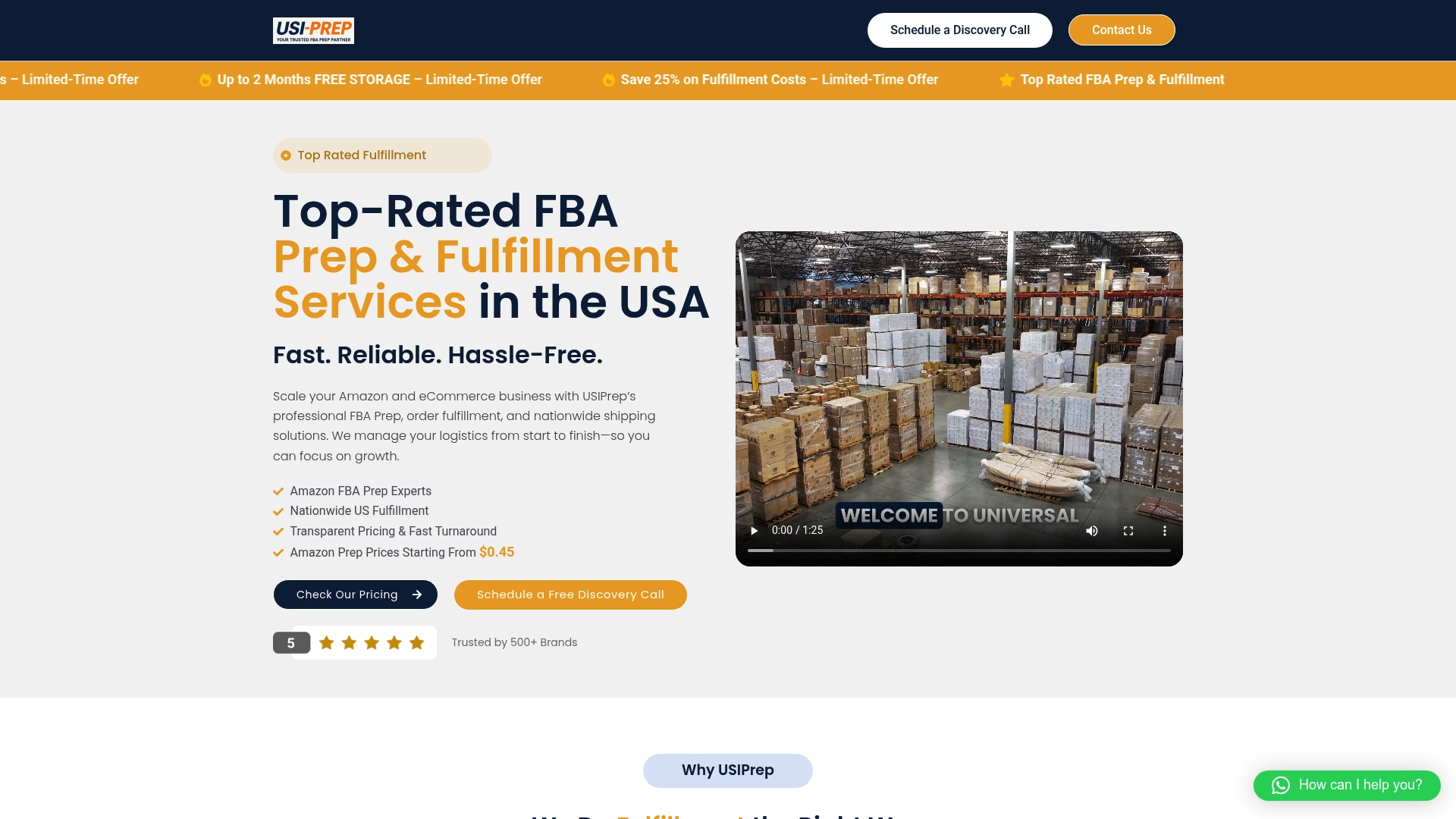
Usiprep’s 98.9% on-time delivery rate and 30% cost reduction results come from the same distributed fulfillment principles covered in this article. Sellers looking to reduce zone charges, speed up delivery, and free their teams from operational complexity can review Usiprep’s fulfillment cost breakdown to see exactly where savings come from. For sellers already using Amazon, the FBA prep requirements checklist is a practical starting point for getting inventory into the network faster and with fewer errors.
FAQ
What are the main benefits of a U.S. based fulfillment center?
U.S. based fulfillment centers reduce shipping costs by 28%–34% through zone reduction, improve delivery times by 1.2–1.8 days, and convert fixed warehouse overhead into variable per-shipment costs that scale with order volume.
How many orders per day do I need to justify a multi-node fulfillment network?
Multi-node fulfillment becomes cost-effective at 200–300 orders per day, where carrier savings from zone reduction outweigh the fixed operational costs of splitting inventory across locations.
Can a cheap warehouse location in a low-cost state hurt my fulfillment costs?
Yes. Shipping from a Midwest warehouse to West Coast customers adds $2.80–$4.10 more per package compared to a local West Coast node, which can fully erase any rent savings from a cheaper state.
How quickly can a second fulfillment node pay for itself?
Brands with regional order concentrations typically see ROI on a two-node setup within 6 months, based on an average 23.8% reduction in shipping cost per order after adding a second domestic node.
What technology features should I look for in a U.S. fulfillment center?
Look for API integrations with your eCommerce platform, real-time inventory visibility, automated replenishment triggers, and barcode-based pick-and-pack accuracy. These features reduce stockouts and shipping errors without adding headcount.