
Outsourcing FBA prep means handing your Amazon product preparation and fulfillment tasks to specialist third-party logistics providers, and the benefits of outsourcing FBA prep are measurable from day one. Certified prep centers reduce manual prep errors by 40 to 60% compared to in-house teams, cutting costly Amazon chargebacks before they hit your account. Amazon ended its own U.S. FBA Prep Services on January 1, 2026, making third-party prep centers the default path for most sellers. For e-commerce entrepreneurs managing growing SKU catalogs, the case for outsourcing has never been stronger.
1. Benefits of outsourcing FBA prep: the cost savings case
The most direct advantage of FBA prep outsourcing is cost reduction, and it works on multiple levels simultaneously. In-house prep requires fixed overhead: warehouse leases, equipment, HR management, and full-time or part-time labor regardless of order volume. A certified 3PL spreads those costs across dozens of clients, which is why per-unit outsourcing fees are often lower at scale than the true loaded cost of in-house labor.
Error-related fees are the hidden cost most sellers underestimate. Amazon charges removal fees averaging $0.50 to $1.50 per unit for non-compliant inventory, and those fees compound fast at volume. Outsourced prep centers maintain error rates below 0.5%, compared to 5 to 10% for typical in-house operations. That gap translates directly into fewer chargebacks, fewer stranded units, and a healthier inventory performance index.
Flexible warehouse space is another lever. You pay for the cubic footage and labor hours you actually use, not a fixed lease you’re locked into year-round.
Pro Tip: Request a per-unit cost breakdown from any 3PL you evaluate. Compare it against your true in-house cost, including labor burden, benefits, and error-related fees, not just hourly wages.

| Cost Category | In-House | Outsourced 3PL |
|---|---|---|
| Labor | Fixed salary + benefits | Per-unit variable fee |
| Warehouse | Long-term lease | Flexible, usage-based |
| Error/chargeback fees | 5–10% error rate exposure | Under 0.5% error rate |
| Compliance updates | Internal training cost | Included in service |
2. Operational efficiency gains that free up your team
Specialized prep centers process receiving, inspection, labeling, and shipping faster than most in-house setups because that is their only job. Where an internal team might split attention between prep, customer service, and purchasing, a dedicated 3PL runs a single optimized workflow. The result is faster inventory check-in times and fewer bottlenecks before your products go live on Amazon.
Outsourcing logistics functions lets sellers redirect internal staff toward product development and marketing rather than manual fulfillment. That shift compounds over time. Every hour your team spends on labeling is an hour not spent on ad optimization, supplier negotiations, or new product launches.
Complex SKUs benefit most from this arrangement. Bundling, fragile item handling, poly-bagging, and multi-piece sets all require trained staff and quality control checkpoints. A capable prep center handles these with documented processes, not improvised solutions.
Pro Tip: Track how many hours per week your team spends on prep-related tasks. Multiply by fully loaded hourly cost. That number is your baseline for evaluating any 3PL quote.
3. How outsourcing improves Amazon compliance
Maintaining compliance with Amazon’s packaging and labeling guidelines is genuinely complex. Requirements shift frequently, and a single non-compliant shipment can trigger inbound rejections, inventory holds, or account health warnings. Outsourcing transfers this compliance burden to experts who track every update as part of their core service.
Certified prep centers train their staff on current Amazon requirements as a standard operating procedure, not a reactive scramble. When Amazon updates its poly-bag requirements or changes label placement rules, a good 3PL adjusts before your next shipment arrives. You can review the current standards using a resource like the 2026 prep checklist to understand what your prep partner should be handling on your behalf.
Lower error rates also protect your organic ranking and ad performance. Stranded inventory and inbound delays reduce your available stock, which suppresses the Buy Box and limits your advertising reach during critical sales windows.
- Prep centers monitor Amazon policy updates in real time.
- Compliant labeling and packaging reduce inbound rejection rates.
- Fewer stranded units mean better inventory performance index scores.
- Consistent prep quality supports ad campaigns by keeping stock available.
- Documented QA processes create an audit trail if Amazon disputes arise.
| Compliance Risk | In-House Exposure | Outsourced Mitigation |
|---|---|---|
| Label placement errors | High without dedicated QA | Systematic pre-ship inspection |
| Packaging non-compliance | Requires constant retraining | 3PL tracks updates automatically |
| Inbound shipment rejections | Delays restock by days or weeks | Under 0.5% error rate reduces rejections |
| Account health penalties | Accumulate without visibility | Expert partners prevent root causes |
4. Inventory control and real-time visibility
One of the most underrated outsourcing fulfillment benefits is what it does for inventory visibility. Many sellers who prep in-house describe a “black hole” problem: inventory ships out and disappears into Amazon’s system with no reliable status updates until it either appears in stock or triggers a problem. Modern 3PLs sync directly with Seller Central and inventory management tools to close that gap.
Technology-enabled prep centers provide real-time check-in confirmations, unit counts, and shipment status updates. This visibility lets you make smarter replenishment decisions, avoid stockouts during peak periods, and catch discrepancies before they become disputes. Sellers using integrated 3PL systems report significantly fewer cases of lost or miscounted inbound inventory. You can explore how this works in practice through FBA inventory check-in best practices.
Automated integrations between your inventory system and your prep provider also prevent the manual data entry errors that cause mismatches between what you shipped and what Amazon received.
5. Scalability without operational drag
Scaling an in-house prep operation requires hiring, training, and managing more people, plus securing additional warehouse space, often before you know whether the volume increase is permanent. That lag creates either a bottleneck or wasted overhead. Outsourcing removes that constraint entirely.
A capable 3PL absorbs volume spikes, whether from a Prime Day surge, a viral product, or a seasonal catalog push, without requiring you to change your internal headcount. Outsourcing is preferable for sellers with variable seasonal volume, complex packaging needs, or fragile multi-piece SKUs. The prep center’s infrastructure is already in place; you simply increase your shipment frequency.
This scalability also applies downward. If a product line slows, you reduce volume without carrying idle labor costs. That flexibility is nearly impossible to replicate in-house without significant operational risk.
6. In-house vs. outsourced FBA prep: which fits your business?
In-house prep makes sense for sellers with simple, stable SKU catalogs and predictable low volume. If you ship the same 10 products every week with no bundling or fragile handling requirements, the math can favor keeping prep internal. Full operational control is a real benefit for some sellers, particularly those with proprietary packaging or brand-specific requirements.
The FBA prep service advantages of outsourcing grow sharply as complexity and volume increase. The cost-effectiveness of FBA outsourcing becomes clear once you factor in error rates, compliance management, and the opportunity cost of your team’s time.
Pro Tip: If you are managing more than 500 units per month or your SKU catalog includes bundles, fragile items, or seasonal spikes, run a formal cost comparison before assuming in-house is cheaper.
| Factor | In-House Prep | Outsourced 3PL |
|---|---|---|
| SKU complexity | Best for simple, stable catalogs | Handles bundles, fragile, multi-piece |
| Volume flexibility | Fixed capacity | Scales up or down on demand |
| Compliance management | Internal responsibility | Handled by certified experts |
| Technology integration | Requires custom setup | Built-in Seller Central sync |
| Cost structure | Fixed overhead | Variable per-unit pricing |
7. What to look for in an FBA prep outsourcing partner
Choosing the right 3PL determines whether you capture the advantages of FBA prep outsourcing or simply trade one set of problems for another. Evaluating a partner requires assessing competence, capacity, commitment, cost transparency, and technology compatibility before signing anything.
Start with certification and experience. A prep center that has processed Amazon inbound shipments at scale knows the edge cases: how Amazon handles specific ASIN types, what triggers inbound performance alerts, and how to document exceptions. Ask for error rate data and references from sellers with similar catalog profiles.
Technology integration is non-negotiable for growing sellers. Your prep partner should connect directly with Seller Central and your inventory management platform, whether that is Linnworks, SkuVault, or a custom ERP. Manual data handoffs create the exact errors you are paying to eliminate. Review the features to compare before committing to any provider.
Pricing transparency matters as much as the headline rate. Request a full fee schedule covering receiving, storage, labeling, poly-bagging, bundling, and returns. Hidden fees in 3PL contracts are common and erode the cost savings that made outsourcing attractive in the first place.
Pro Tip: Run a paid pilot shipment of 100 to 200 units before committing to a long-term contract. Evaluate check-in speed, communication quality, and error rate on that test batch before scaling.
- Verify Amazon certification and current compliance training protocols.
- Confirm direct API integration with Seller Central and your inventory tools.
- Request documented SLAs for receiving time, error rates, and issue resolution.
- Assess warehouse capacity for your peak season volume, not just average volume.
- Check responsiveness: how fast does the team reply to questions or flag problems?
Key takeaways
Outsourcing FBA prep to a certified 3PL reduces costs, errors, and compliance risk while freeing your team to focus on growth rather than manual fulfillment.
| Point | Details |
|---|---|
| Error rate reduction | Certified 3PLs maintain error rates below 0.5% versus 5 to 10% for in-house teams. |
| Cost structure advantage | Per-unit 3PL pricing beats fixed overhead at scale, especially with error fees factored in. |
| Compliance protection | Expert prep centers track Amazon policy updates automatically, reducing inbound rejections. |
| Scalability | Outsourced partners absorb volume spikes without requiring you to hire or expand warehouse space. |
| Partner selection | Evaluate technology integration, pricing transparency, and error rate data before committing. |
Why I think most sellers wait too long to outsource
I have watched dozens of growing Amazon brands make the same mistake: they hold onto in-house prep well past the point where it stops making sense. The reasoning is always the same. They want control. They think outsourcing means losing visibility. They assume their error rate is fine because they have not calculated it carefully.
The reality, based on what I have seen, is that most brands cause more damage by moving in-house prematurely than by outsourcing to a capable prep partner. The moment your catalog includes bundles, fragile items, or seasonal surges, in-house prep becomes a liability, not an asset. You are spending management energy on a function that a specialist can execute more accurately and at lower cost.
Outsourcing is not loss of control. It is strategic delegation: your product vision, your brand standards, and your growth decisions stay in-house, while execution goes to people whose entire infrastructure is built for it. The sellers I have seen scale most cleanly are the ones who outsourced before they needed to, not after a costly compliance incident forced their hand.
The right prep partner functions as an extension of your operation, not a vendor you manage. That distinction matters enormously when you are running ad campaigns that depend on consistent stock availability and clean inbound performance metrics.
— Akbar
How Usiprep helps sellers capture every outsourcing benefit
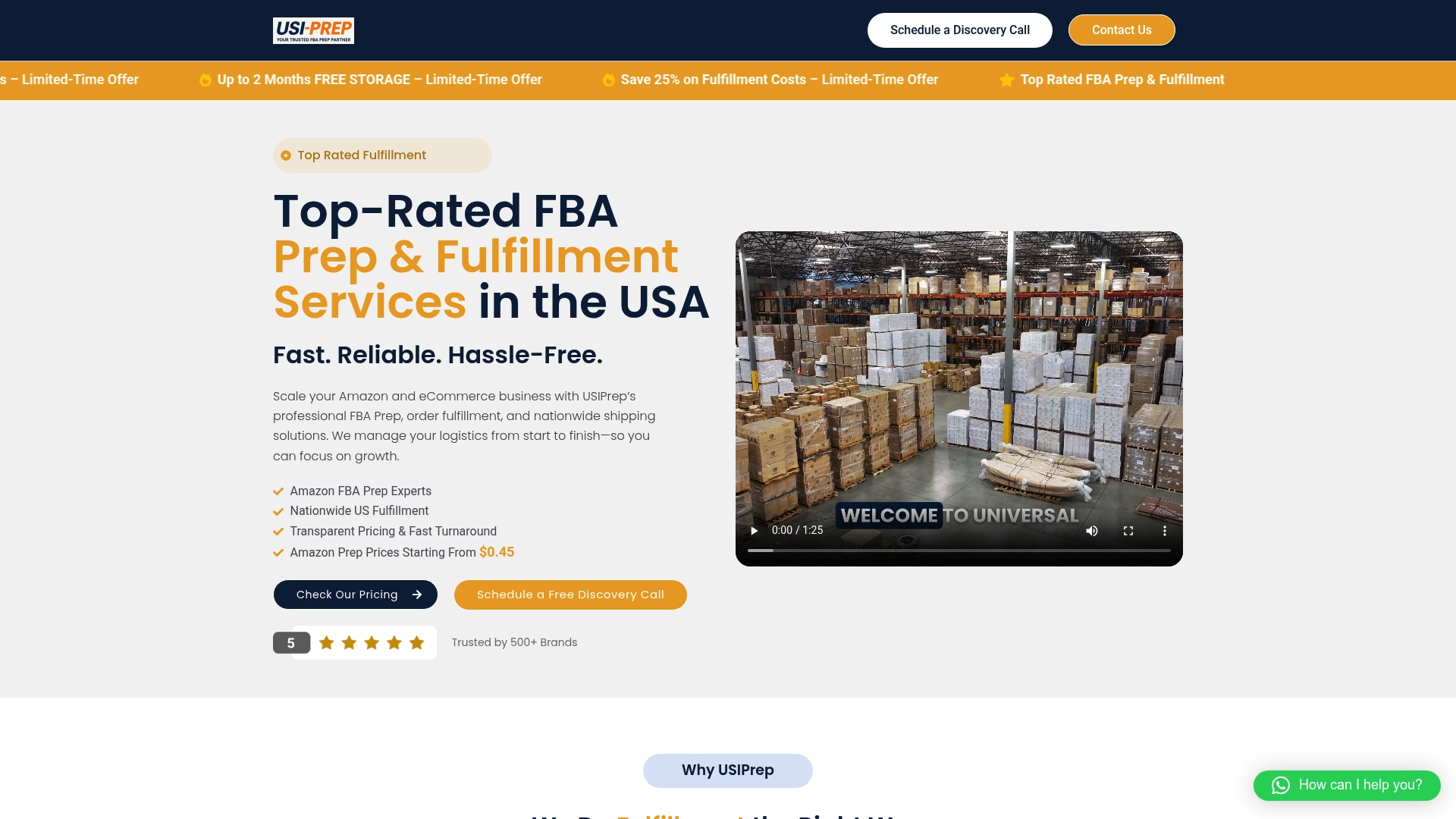
Usiprep was founded by former Amazon sellers who understood exactly where in-house prep breaks down at scale. The result is a prep and fulfillment service built around transparency, speed, and compliance accuracy. Usiprep delivers a 98.9% on-time delivery rate and has helped brands cut fulfillment costs by 30% through per-unit pricing that replaces unpredictable fixed overhead.
Every shipment processed through Usiprep syncs directly with Seller Central, giving you real-time inventory visibility without manual data entry. The team stays current on Amazon’s packaging and labeling requirements so your inbound shipments clear without delays. Start with the 2026 FBA prep checklist to see exactly what a certified prep partner should be handling on your behalf, then reach out to discuss your catalog and volume.
FAQ
What are the main benefits of outsourcing FBA prep?
The primary benefits are lower error rates, reduced costs at scale, and expert compliance management. Certified 3PLs maintain error rates below 0.5% and absorb compliance updates automatically, protecting your account health and inventory performance index.
When does outsourcing FBA prep make financial sense?
Outsourcing becomes cost-effective once you factor in labor burden, error-related Amazon fees, and warehouse overhead. For most sellers, the math favors outsourcing at volumes above 500 units per month or when SKU complexity includes bundling, fragile items, or seasonal spikes.
Does outsourcing FBA prep mean losing control of my inventory?
No. Technology-enabled prep centers sync directly with Seller Central and inventory management platforms, providing real-time check-in data and shipment status. Outsourcing shifts execution to specialists while keeping inventory decisions and product strategy with you.
How do I evaluate an FBA prep outsourcing partner?
Assess error rate data, Amazon certification, technology integration with Seller Central, pricing transparency, and warehouse capacity for peak volume. Run a pilot shipment of 100 to 200 units before committing to a long-term agreement.
What happened to Amazon’s own FBA Prep Services?
Amazon ended its U.S. FBA Prep Services on January 1, 2026, directing sellers to use third-party prep centers instead. Non-compliant inventory now faces removal fees averaging $0.50 to $1.50 per unit, making a certified 3PL partner more important than ever.