
If you’ve ever had a shipment rejected at an Amazon fulfillment center, you already know how expensive confusion gets. Understanding what are FBA packaging requirements is no longer optional. Since January 2026, Amazon stopped offering in-house prep services entirely, meaning every carton, label, and poly bag you send must meet their standards before it leaves your hands. Get it wrong and you’re looking at defect fees that can reach 1,600% of normal rates. This guide breaks down every rule you need to know, clearly and without the guesswork.
Table of Contents
- Key takeaways
- What are FBA packaging requirements: box dimensions and weight
- Poly bag rules and suffocation warning standards
- FNSKU labeling: what changed in 2026
- Heavy and oversized package labeling
- Packaging best practices for protection and processing
- My honest take on FBA packaging compliance
- How Usiprep handles FBA packaging compliance for you
- FAQ
Key takeaways
| Point | Details |
|---|---|
| Box size and weight limits | Max carton dimensions are 36"L x 25"W x 25"H with a 50 lb weight limit per box. |
| Poly bag transparency and warnings | Bags must be at least 1.5 mil thick with a suffocation warning on any opening 5 inches or wider. |
| FNSKU labels are now mandatory | Non-brand-registered sellers must apply FNSKU labels on every unit as of March 31, 2026. |
| Lift labels prevent rejection | Single items over 50 lbs need “Team Lift” labels; over 100 lbs requires “Mechanical Lift” labels. |
| Bundle packaging rules | Bundles must carry a “Sold as Set” label and one FNSKU for the entire set, not per item. |
What are FBA packaging requirements: box dimensions and weight
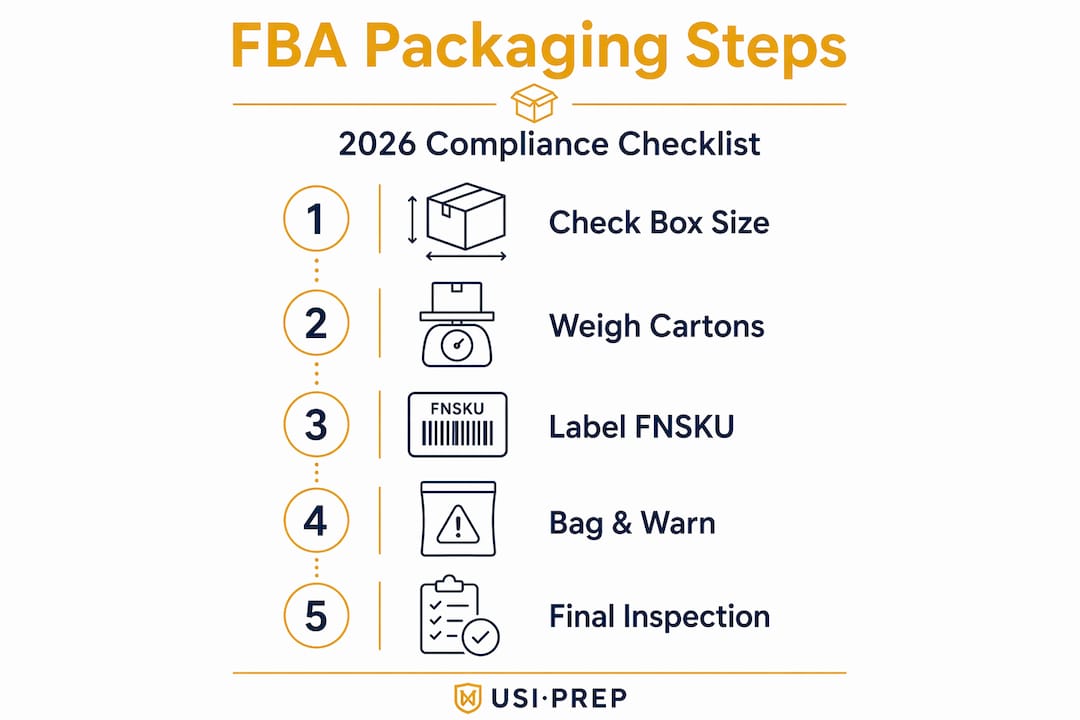
Before anything else, your cartons need to meet Amazon’s physical specs. Getting this wrong is one of the fastest ways to trigger a receiving refusal before a single unit gets scanned.
The standard carton limits are:
| Measurement | Standard limit |
|---|---|
| Maximum length | 36 inches |
| Maximum width | 25 inches |
| Maximum height | 25 inches |
| Maximum weight | 50 lbs |
| Minimum box size | 6" x 4" x 1" |
| Minimum weight | 1 lb |
That minimum weight rule catches a lot of sellers off guard. If your carton is too light, Amazon’s automated systems flag it as a potential mislabel or empty box, which delays check-in. Keep your boxes above 1 lb and at least 6" x 4" x 1" to stay clear of that issue.
For single oversized units that physically cannot fit within the standard dimensions, Amazon does allow exceptions. However, those cartons must include a “Team Lift” or “Mechanical Lift” label depending on their weight, which we’ll cover in a dedicated section below.
A few other box construction rules apply across the board:
- All cartons must be six-sided and rigid.
- All flaps must be fully sealed with tape. Open or partially sealed flaps cause rejection.
- No reused boxes with old labels visible. Cover or remove any previous shipping markings completely.
Pro Tip: Use 200 lb burst-strength corrugated boxes as your baseline. Anything lighter risks crushing under warehouse stacking, which leads to damage claims that come back to you.
Poly bag rules and suffocation warning standards
Poly bags are one of the most misunderstood areas of FBA packaging guidelines. The rules are specific, and small deviations cause real compliance failures.
Here is what Amazon requires for every poly bag used on FBA units:
- Minimum thickness of 1.5 mil. Thinner bags tear during transit and fail the receiving check.
- Fully transparent. Warehouse staff and scanners must be able to read the FNSKU label through the bag without removing it.
- Completely sealed. Use a self-adhesive strip or heat seal. Open bags are rejected.
- Barcode placement on a flat surface. Per FBA prep guidelines, barcodes must sit on a smooth, crease-free area of the bag with no folds or seams interfering with the scan.
- Suffocation warning on bags with openings of 5 inches or more. This is measured with the bag laid flat and unstretched.
That last point is where most sellers make mistakes. The 5-inch measurement must be taken with the bag flat on a surface, not open or inflated. If you measure an open bag, you will get a larger number and may skip the warning when it is actually required.
| Bag opening (measured flat) | Suffocation warning required? |
|---|---|
| Under 5 inches | No |
| 5 inches or more | Yes, 24-point font minimum |
The warning text must be printed directly on the bag or applied as a sticker, and it must be clearly visible. The minimum font size is 24-point, which is larger than most people expect. A tiny label tucked in a corner does not pass.
Pro Tip: Pre-print suffocation warnings on all poly bags during manufacturing rather than applying stickers at the prep stage. It removes one more variable from your QC process and prevents sticker placement errors.
FNSKU labeling: what changed in 2026
FNSKU labeling is now non-negotiable for most sellers. As of March 31, 2026, every seller without Brand Registry must apply an FNSKU label to each individual unit before sending inventory to a fulfillment center. This change closed the door on commingled inventory for non-registered sellers.
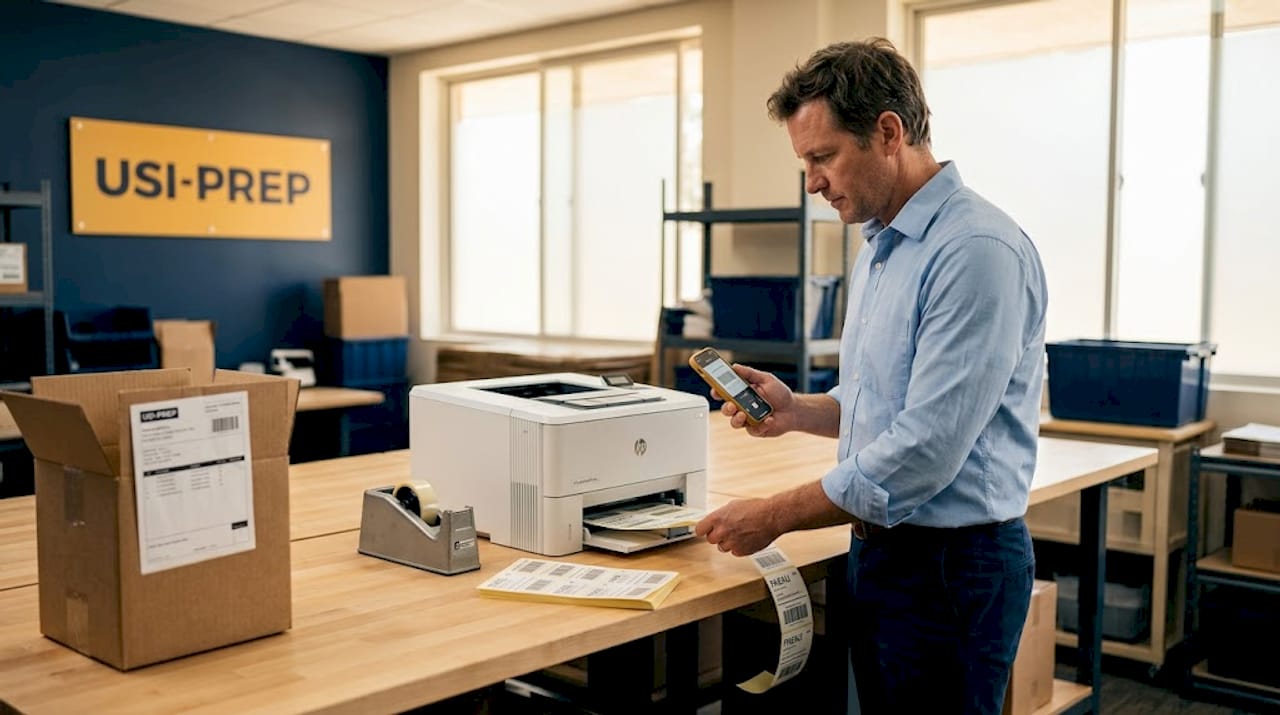
Here is what the label itself must look like and where it goes:
- Size: Either 1" x 2" or 2" x 3". The larger size is easier to scan and recommended for most products.
- Barcode format: Code 128. Other formats are not accepted.
- Print resolution: 300 DPI minimum on white matte label stock. Glossy labels cause scan failures.
- Placement: On a flat, unobstructed surface. The label must cover any existing manufacturer barcodes to prevent misrouting.
- Visibility through packaging: If the unit is inside a poly bag or shrink wrap, the FNSKU barcode must be scannable through the material without removing it.
The most common labeling mistakes sellers make are using glossy paper, printing below 300 DPI, and placing labels over curved surfaces or seams. All three cause scan failures at the receiving dock. For sellers working with Amazon product compliance, getting labeling right is one of the most direct ways to protect your account health.
Pro Tip: Print a test sheet of labels and scan them with a barcode scanner app before committing to a full print run. This takes two minutes and catches resolution and contrast problems before they become a shipment problem.
Heavy and oversized package labeling
Weight labeling is about warehouse safety, not just compliance. Amazon enforces these rules strictly because warehouse safety and operational efficiency depend on staff knowing what they are handling before they pick it up.
The thresholds are straightforward:
- “Team Lift” label: Required on any single-item carton weighing more than 50 lbs.
- “Mechanical Lift” label: Required on any single-item carton weighing more than 100 lbs.
- Placement: Labels must appear on the top and on all four sides of the carton.
Here is the part most sellers get wrong. These lift labels apply only to cartons containing a single item that exceeds the weight threshold. If you have a carton with multiple items that together weigh over 50 lbs, you cannot solve that with a lift label. That carton must be repacked into multiple boxes, each under the 50 lb limit.
Applying a lift label to an overweight multi-item carton leads to shipment refusal. It is not a workaround. It is a compliance violation that costs you time and money to fix after the fact.
Pro Tip: Weigh every carton after packing, not before. Packing materials add more weight than most sellers account for, and a box that was 48 lbs of product can easily tip over 50 lbs once taped and padded.
Packaging best practices for protection and processing
Meeting Amazon’s minimum specs keeps you compliant. Building your packaging around product protection keeps your return rate low and your reviews positive. These two goals work together.
Start with a drop test. A 3-foot drop test on all sides and corners of your packaged product is the single best way to validate whether your packaging can survive the fulfillment center environment. If something breaks or shifts during the test, it will break or shift in transit too.
Here is how to approach different product types:
- Fragile items: Use bubble wrap or foam inserts to immobilize the product inside the box. The product should not shift when the box is shaken.
- Liquids: Double-bag all liquid products in sealed poly bags. Place absorbent material inside the outer bag as a secondary containment layer.
- Bundles and multi-unit sets: Package everything as one unit. Bundles require a “Sold as Set” label visible on the outside and a single FNSKU for the entire bundle. Loose items rubber-banded together are rejected every time.
- Soft goods and apparel: Use poly bags with the suffocation warning if applicable, and fold items neatly so the barcode sits flat and scannable.
Beyond product type, packaging errors remain the top cause of shipment rejections across all FBA sellers. The fix is not more expensive materials. It is standardized measurement SOPs and QC photos at every stage of the prep process. Take a photo of each packed carton before sealing it. That photo is your proof of compliance if a dispute arises.
- Never use string, rope, or twine as a primary closure.
- Do not use paper bags or bags made of materials that can be torn by hand.
- Avoid loose packing peanuts without a secondary containment method.
- Keep all labels flat and crease-free before applying them.
Understanding Amazon FBA logistics at a deeper level helps you see why these rules exist and makes it easier to build packaging systems that hold up at scale.
My honest take on FBA packaging compliance
I’ve worked with hundreds of sellers navigating FBA prep requirements, and the pattern I see most often is not carelessness. It’s overconfidence in “close enough.”
A seller measures a poly bag opening while it is open instead of flat. A supplier prints labels at 280 DPI instead of 300 and assumes it will scan fine. A carton with three heavy items gets a “Team Lift” label instead of being repacked. Each of these feels like a minor shortcut. Each one results in a rejection, a delay, or a fee.
What I’ve learned is that the sellers who stay out of trouble are not the ones who memorize every rule. They are the ones who build checklists, take QC photos, and test their packaging before the first shipment goes out. A 3-foot drop test takes five minutes. Reprinting 500 labels because they failed at the dock takes two days and costs real money.
The 2026 removal of Amazon’s in-house prep option is the biggest shift I’ve seen in years. There is no safety net anymore. If your shipment arrives non-compliant, it comes back to you or gets disposed of. That makes getting your packaging process right the first time more important than it has ever been.
My advice: treat your first shipment to any new fulfillment center as a test run. Document everything. Then build your standard operating procedure from what you learn.
— Akbar
How Usiprep handles FBA packaging compliance for you
If the rules above feel like a lot to manage on top of running your actual business, that is exactly the problem Usiprep was built to solve. Founded by former Amazon sellers, Usiprep handles the full scope of FBA prep and fulfillment so your inventory arrives compliant every time. That includes FNSKU labeling at 300 DPI on white matte stock, poly bagging with correct suffocation warnings, bundle prep with proper “Sold as Set” labeling, and accurate weight labeling for heavy cartons.
Usiprep’s technology-driven process gives you real-time visibility at every stage, which means no more guessing whether your shipment is ready. Clients consistently see a 30% reduction in fulfillment costs and a 98.9% on-time delivery rate. Check out Usiprep’s pricing plans to see which option fits your volume and budget.
FAQ
What are the maximum carton dimensions for FBA shipments?
FBA cartons cannot exceed 36 inches in length, 25 inches in width, or 25 inches in height, with a maximum weight of 50 lbs. The minimum carton size is 6" x 4" x 1" and must weigh at least 1 lb.
When is a suffocation warning required on a poly bag?
A suffocation warning is required when the poly bag opening measures 5 inches or more when laid flat and unstretched. The warning must appear in at least 24-point font on the bag.
Do all FBA sellers need to apply FNSKU labels in 2026?
Yes, as of March 31, 2026, all sellers without Brand Registry must apply FNSKU labels to every individual unit before sending inventory to Amazon fulfillment centers.
What is the difference between a “Team Lift” and “Mechanical Lift” label?
A “Team Lift” label is required for single-item cartons over 50 lbs, while a “Mechanical Lift” label is required for single-item cartons over 100 lbs. Both labels must appear on the top and all four sides of the carton.
Can I use a lift label on a multi-item carton that exceeds 50 lbs?
No. Lift labels only apply to cartons containing a single item that exceeds the weight threshold. Multi-item cartons over 50 lbs must be repacked into separate boxes that each fall under the limit.