
Most sellers assume Amazon handles everything once inventory lands at a fulfillment center. That assumption is expensive in 2026. Understanding what is Amazon repackaging service means separating two very different processes: what Amazon does with returned items versus what you, the seller, are now fully responsible for before inventory ever ships. These are not the same thing, and confusing them has cost sellers thousands in defect fees and rejected shipments. This guide breaks down exactly how Amazon repackaging works, what changed this year, and how to use the system to your advantage.
Table of Contents
- Key Takeaways
- What Amazon repackaging service actually is
- How 2026 policy changes shifted seller responsibilities
- Benefits and challenges of Amazon repackaging for sellers
- How to prepare inventory to minimize repackaging needs
- Using Grade & Resell and other return options strategically
- My take on repackaging as a core seller strategy
- How Usiprep helps sellers stay compliant and recover more value
- FAQ
Key Takeaways
| Point | Details |
|---|---|
| Repackaging is for returns only | Amazon repackages eligible customer returns for resale, not inbound seller shipments. |
| 2026 prep rules changed everything | Amazon ended all in-house FBA prep and labeling services in the US as of January 1, 2026. |
| Grade & Resell recovers real value | Returned items graded Like New or Very Good recover far more than liquidation at 5–10% of value. |
| You cannot opt out of repackaging | Amazon’s repackaging service applies automatically to eligible returns and cannot be disabled by sellers. |
| Proactive prep reduces repack costs | Standardized packaging and quality control before shipping significantly lowers return and repack rates. |
What Amazon repackaging service actually is
The Amazon repackaging service is a post-return process. When a customer sends a product back to an Amazon fulfillment center, Amazon inspects that item and determines whether it can be resold. If the item qualifies, Amazon repackages the return using materials like polybags, bubble wrap, or new boxes, then relists it at a condition-appropriate price.
This is not the same as prep. Prep refers to how you package and label inventory before it ships to Amazon. Repackaging refers to what Amazon does with items that come back from customers. Mixing up these two processes is one of the most common and costly mistakes sellers make.
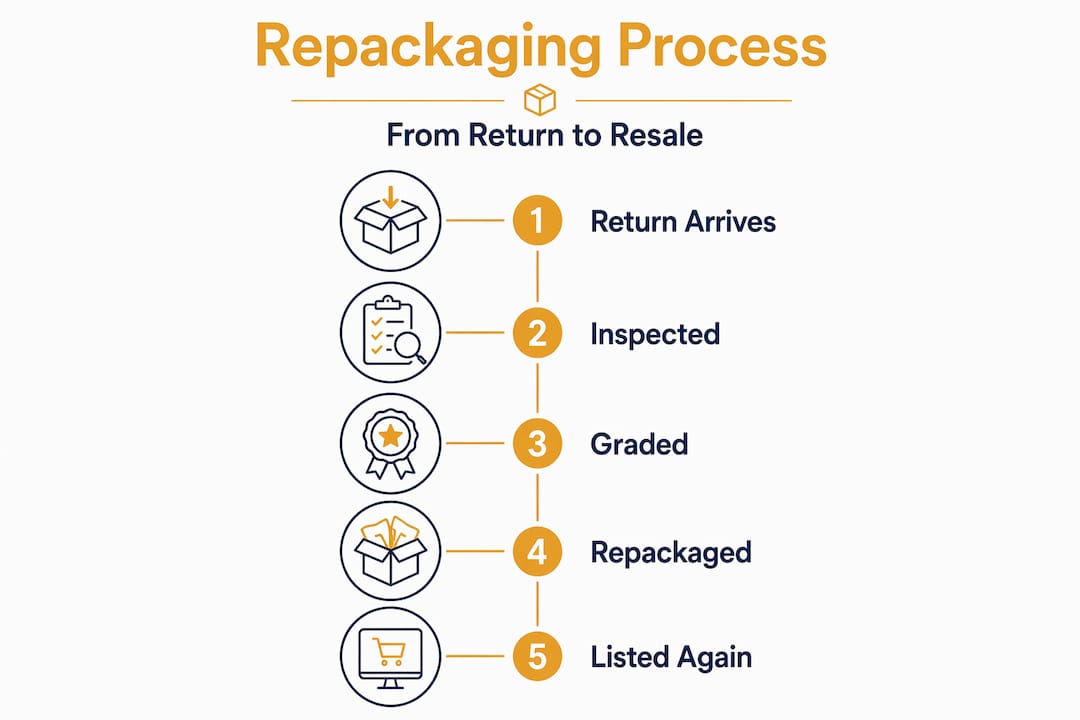
Here is how the repackaging process works step by step:
- A customer initiates a return on an FBA order
- Amazon receives the item and inspects its condition at the fulfillment center
- If the item passes inspection, Amazon grades it under the FBA Grade & Resell program
- Condition grades include Like New, Very Good, Good, and Acceptable
- Amazon applies new packaging materials as needed and relists the item as Used
- The relisted item sells through your existing product listing with a condition note visible to buyers
One critical point: you cannot turn this service off. Repackaging cannot be disabled by sellers, and it applies to both retail and FBA returns. Amazon makes this call automatically based on item condition and category eligibility.
Pro Tip: Review your Grade & Resell settings in Seller Central regularly. You can control which condition grades you allow for relisting, which gives you meaningful influence over how returned inventory represents your brand even though you cannot disable repackaging itself.
The Grade & Resell program is where repackaging and returns management intersect most directly. Third-party liquidation typically recovers only 5–10% of average selling value, while Grade & Resell allows you to recover significantly more depending on item condition. For a $40 product, that difference between 8% liquidation recovery and a $28 Used resale is real money at scale.
How 2026 policy changes shifted seller responsibilities
This is where many sellers got caught off guard. Amazon officially ended all in-house FBA prep and labeling services in the United States as of January 1, 2026. That means Amazon no longer preps, bags, labels, or fixes your inbound inventory when it arrives at a fulfillment center.
Every unit you ship to Amazon must now arrive fully compliant. No exceptions.
| Responsibility | Before 2026 | After January 1, 2026 |
|---|---|---|
| Poly bagging and wrapping | Amazon could handle for a fee | Seller or third-party must complete before shipping |
| FNSKU labeling | Amazon offered labeling service | Seller must apply labels prior to inbound shipment |
| Bubble wrap and fragile prep | Amazon prep service available | Seller responsible for all protective packaging |
| Non-compliant shipment outcome | Minor fees or Amazon correction | Rejection, return at seller’s expense, or major defect fees |
The financial stakes are serious. Defect fees for non-compliant shipments have increased by up to 1,600% in 2026. A single poorly prepped shipment can generate fees that dwarf the cost of hiring a professional prep service for an entire quarter.
The reason Amazon made this shift is straightforward. Most sellers already handle prep independently or through third parties, and Amazon’s focus has always been fulfillment speed, not prep work. Removing in-house prep lets Amazon concentrate on what it does best.
Pro Tip: Do not wait until a shipment gets rejected to audit your prep process. Run a compliance check on your most recent inbound shipment against Amazon’s current prep guidelines before your next send. One proactive review can prevent thousands in fees.
Amazon’s repackaging service for returns remains fully operational under these new rules. The policy change only affects inbound prep, not what happens to items after customers return them. These are separate systems, and understanding that separation is the foundation of smart FBA operations in 2026.
Benefits and challenges of Amazon repackaging for sellers
The repackaging service creates real financial value, but it also comes with tradeoffs that small and medium sellers need to understand before counting on it as a returns strategy.
The benefits are concrete:
- Returned items that qualify get relisted rather than disposed of, recovering revenue you would otherwise lose entirely
- You avoid removal order fees and disposal fees for eligible returned units
- Inventory keeps moving instead of sitting in limbo, which protects your sell-through metrics
- Grade & Resell listing transparency reduces buyer surprises because condition notes are visible before purchase, which lowers A-to-Z claims
The challenges are equally real:
- You have no control over how Amazon physically repackages the item. The materials used, the presentation quality, and the packaging style are all Amazon’s call.
- A resold “Acceptable” condition item can generate negative feedback that reflects on your brand even though you never touched that unit after the original sale.
- Allowing lower condition grades like Acceptable without active management creates brand risk that compounds over time.
- Customer-damaged items receive no reimbursement from Amazon. That cost is yours to absorb as part of normal business risk.
The sellers who get the most from repackaging treat it as a managed program, not a passive benefit. They check their Grade & Resell settings, monitor feedback on Used listings, and adjust which condition grades they allow based on their brand standards. Treating it as automatic revenue recovery without oversight is where brand problems start.
How to prepare inventory to minimize repackaging needs
The best way to reduce your repackaging costs is to reduce your return rate. That starts with what you send to Amazon in the first place.
-
Follow Amazon’s 2026 prep guidelines exactly. Download the current prep requirements from Seller Central for each product category you sell. Requirements differ by product type, and the standards tightened significantly this year.
-
Standardize your box sizes and void fill. Sellers who use uniform box sizes and conduct pre-shipment quality trials see fewer transit damages and fewer returns that require repackaging at the fulfillment center. Consistency reduces variables.
-
Run drop tests before finalizing packaging. A drop test takes 20 minutes and can reveal packaging failures before they become return events. Test your packaging at the heights and angles that match real shipping conditions.
-
Track return rates by SKU. If one product consistently generates returns that require repackaging, the packaging for that specific item is likely the problem. SKU-level data tells you exactly where to invest in better materials.
-
Use a third-party prep center for scalability. As your volume grows, maintaining prep quality in-house becomes harder. Professional prep services specialize in Amazon compliance and can handle labeling, poly bagging, and bundling at a lower error rate than most in-house operations at similar scale.
-
Review your product listings for accuracy. Returns often happen because the product did not match buyer expectations. Clear photos, accurate dimensions, and honest descriptions reduce the kind of returns that generate repackaging events in the first place.
Pro Tip: Pair your packaging investment with sustainable packaging practices that also meet Amazon’s material requirements. Sellers who align eco-friendly materials with Amazon’s prep specs often find they reduce both costs and return rates simultaneously.
Using Grade & Resell and other return options strategically

Grade & Resell is not your only option for returned inventory, but it is usually your best one. Here is how to use it well and when to consider alternatives.
Setting up Grade & Resell happens in Seller Central under the FBA returns settings. You can choose which condition grades you accept for relisting. Most sellers with brand-sensitive products allow Like New and Very Good only, which protects brand perception while still recovering meaningful value.
Comparing your options:
| Return option | Typical value recovery | Brand control | Effort required |
|---|---|---|---|
| Grade & Resell (Like New/Very Good) | 60–80% of sale price | Moderate | Active management needed |
| Grade & Resell (all grades) | 20–70% of sale price | Low | Active management critical |
| Liquidation | 5–10% of sale price | None | Minimal |
| Removal order | 0% recovery, fees apply | Full | Moderate |
The gap between Grade & Resell and liquidation is significant. For most product categories, allowing even selective Grade & Resell is more profitable than liquidating everything.
Actively managing your Grade & Resell settings also protects your online reputation on Amazon. A flood of Acceptable condition sales generating mixed reviews can drag down your overall seller metrics faster than the recovered revenue justifies.
Review your Grade & Resell performance quarterly. If a specific SKU generates disproportionate negative feedback from Used sales, either restrict the condition grades for that ASIN or move those returns to removal.
My take on repackaging as a core seller strategy
I’ve watched sellers treat Amazon repackaging as background noise for years. That approach worked when Amazon was more forgiving. It does not work now.
What I’ve learned from working with FBA sellers is that the sellers who consistently outperform their peers treat packaging and returns management as operations, not afterthoughts. The ones who struggled most in early 2026 were the ones who assumed Amazon would absorb their prep failures the way it used to. The fee increases were a shock to them. They should not have been.
My honest take: the repackaging service for returns is genuinely useful, but only if you are actively managing it. I’ve seen sellers recover 60 to 70 cents on the dollar from returns through Grade & Resell while their competitors liquidated the same product type for a fraction of that. The difference was not the program. The difference was attention.
The bigger lesson is that inbound prep quality and return management are the same problem viewed from different ends. Fix your packaging upstream and you generate fewer returns that need repackaging downstream. Manage your Grade & Resell settings and you recover more value from the returns that do happen. Neither of these is complicated. Both require consistent effort.
Sellers who treat their prep process as a cost center miss the point. It is a revenue protection tool. Every unit that arrives damaged, gets rejected, or triggers a defect fee is money that never needed to leave the business.
— Akbar
How Usiprep helps sellers stay compliant and recover more value
The 2026 policy changes put prep quality entirely in your hands, and the margin for error is smaller than it has ever been. Usiprep was founded by former Amazon sellers who built their prep and fulfillment service around exactly this problem.
Usiprep handles FNSKU labeling, poly bagging, bubble wrapping, bundle assembly, and full compliance checks before your inventory ships to Amazon. Their team works to Amazon’s current 2026 prep standards, which means shipments arrive ready for intake without defect fees or rejections. With a 98.9% on-time delivery rate and documented 30% fulfillment cost reductions for many clients, the numbers reflect a process that actually works.
If you are spending time managing prep in-house or absorbing defect fees from non-compliant shipments, explore FBA prep and fulfillment options at Usiprep. Transparent service pricing is available so you can compare the cost of professional prep against what you are currently spending on fees and rejections.
FAQ
What is Amazon repackaging service in simple terms?
Amazon repackaging service is the process where Amazon inspects returned items, grades their condition, repackages them with new materials like polybags or bubble wrap, and relists them for sale as Used. It applies automatically to eligible returns and cannot be disabled by sellers.
Does Amazon repackaging apply to inbound shipments?
No. Amazon repackaging only applies to customer returns. As of January 1, 2026, Amazon no longer preps or packages inbound seller shipments. Sellers must prep and label all inventory before shipping to FBA.
What is Amazon FBA repackaging under Grade & Resell?
FBA Grade & Resell is the program Amazon uses to relist repackaged returns at condition-based prices. Grades include Like New, Very Good, Good, and Acceptable, and sellers can control which grades they allow for relisting through Seller Central settings.
Can I opt out of Amazon’s repackaging service?
No. Amazon’s repackaging service for returns is automatic and cannot be turned off. However, you can manage which condition grades are eligible for relisting under Grade & Resell, giving you partial control over how returned inventory is sold.
What happens if my inbound shipment does not meet Amazon’s 2026 prep requirements?
Non-compliant shipments are rejected, returned at your expense, or subject to defect fees that have increased by up to 1,600% in 2026. Every unit must arrive fully prepped, labeled, and packaged before reaching the fulfillment center.