
Shipping products to Amazon sounds straightforward until you try it. Most sellers quickly discover that what is fba forwarding service really means is a specialized logistics solution built around Amazon’s strict, ever-changing requirements. Standard freight companies can move boxes, but they rarely know FNSKU labels from regular barcodes, and they definitely do not schedule delivery appointments at Amazon fulfillment centers. That gap between “shipped” and “accepted” is where sellers lose money. This guide breaks down exactly how FBA forwarding works, what compliance looks like in 2026, and why the right partner makes all the difference.
Table of Contents
- Key Takeaways
- What is an FBA forwarding service
- How FBA forwarding works step by step
- Amazon FBA compliance requirements sellers must meet
- Benefits of using a specialized FBA forwarding service
- How to choose an FBA forwarding service
- My take on FBA forwarding after years in the trenches
- Why Usiprep is the forwarding partner your brand needs
- FAQ
Key Takeaways
| Point | Details |
|---|---|
| FBA forwarding is specialized | It handles Amazon-specific tasks like FNSKU labeling, carton compliance, and delivery appointments that standard freight cannot. |
| Compliance rules got stricter | Amazon discontinued internal prep services in 2026, making sellers fully responsible for every shipment detail. |
| The handoff gap is costly | Splitting freight and prep between separate vendors creates miscommunication that leads to shipment rejection. |
| One provider reduces risk | Using a single integrated FBA forwarding service keeps coordination tight and errors low across the supply chain. |
| Provider selection matters | Choose forwarders with in-house prep, appointment scheduling technology, and direct knowledge of Amazon’s 2026 rules. |
What is an FBA forwarding service
An FBA forwarding service is an end-to-end logistics provider built specifically for Amazon sellers. It moves your inventory from your overseas supplier all the way to an Amazon fulfillment center while handling every Amazon-specific requirement along the route. Think of it as the difference between a general contractor and a specialist who has wired hundreds of Amazon warehouses.
Standard freight forwarders move cargo from point A to point B. They know shipping lanes, customs documentation, and container logistics. What they typically do not know is how Amazon’s receiving docks operate, what FNSKU labeling mandates look like in 2026, or why a carton weighing 51 pounds will get rejected outright. That knowledge gap is not a minor inconvenience. It translates directly into shipment rejections, inventory holds, and surprise fees.
An FBA forwarding service fills that gap by combining freight logistics with FBA-specific prep work. Here is what a full-service provider handles:
- FNSKU labeling: Printing and applying unique product barcodes that cover manufacturer codes to prevent commingling
- Carton prep: Polybagging, bundling, and palletizing per Amazon’s current carton and dimension standards
- Shipment plan creation: Generating FBA shipment IDs and carton labels synchronized with Seller Central
- Customs clearance: Managing import documentation, tariff codes, and compliance to avoid border delays
- Delivery appointment scheduling: Booking LTL and FTL drop-off windows at Amazon FCs 24 to 72 hours in advance
Pro Tip: Never assume your overseas manufacturer can handle FBA prep. Suppliers are rarely trained in export compliance or Amazon-specific packaging rules, which directly increases your risk of shipment delays and costly rejections.
Since Amazon discontinued internal prep and labeling services for U.S. shipments in 2026, sellers no longer have a safety net inside Amazon’s own system. If your inventory arrives non-compliant, Amazon will refuse it, charge you for remediation, or simply dispose of it.
How FBA forwarding works step by step
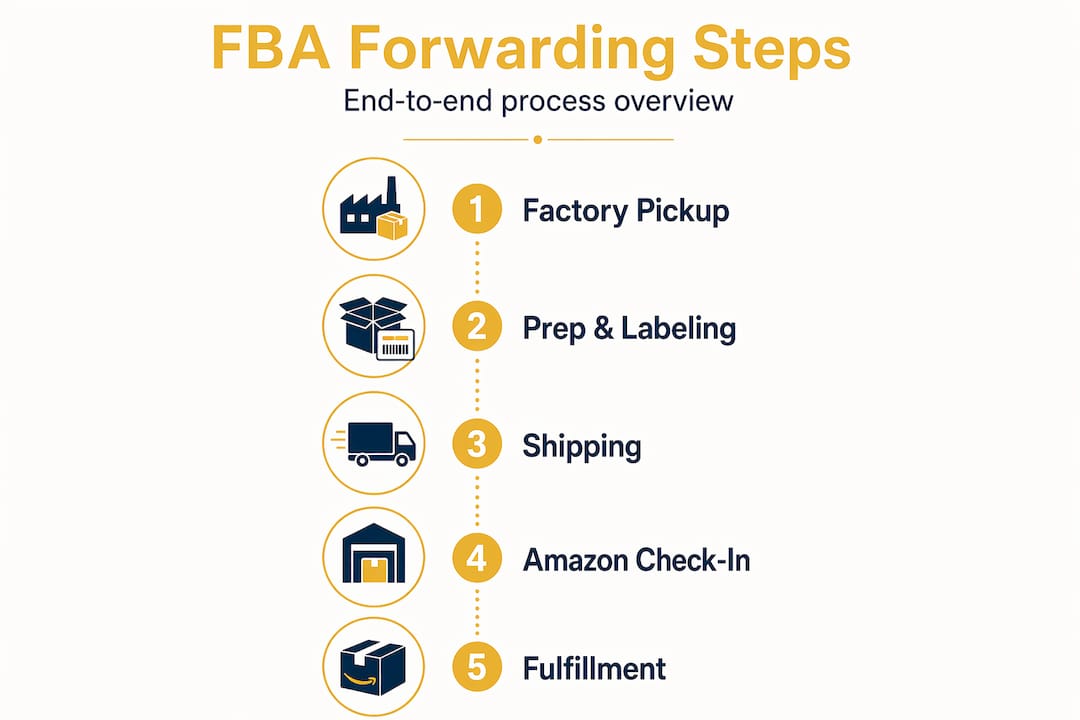
Understanding FBA forwarding explained in a process context helps sellers see exactly where things can go wrong and how a good provider prevents those failures. Here is the typical flow from supplier to fulfillment center:
-
Shipment plan creation: Your provider logs into Seller Central (or integrates via API) to build the shipment plan, assign FBA shipment IDs, and generate carton-level labels. Accurate plan creation is the foundation. Errors here cascade through every downstream step.
-
Supplier pickup: The forwarder arranges pickup from your overseas manufacturer, either via sea freight or air freight depending on timeline and cost. This pickup also triggers quality checks on packaging before goods leave the factory.
-
In-house FBA prep: Once cargo arrives at the prep facility, it goes through labeling, polybagging, carton weight checks, and palletizing. This is the most Amazon-specific part of the process and the step where non-specialized providers make the most mistakes.
-
Customs clearance: Your provider manages the import declaration, harmonized tariff codes, and all documentation required at the U.S. port of entry. Freight forwarders with deep Amazon knowledge handle these codes accurately, which reduces the legal risk and border delays that inexperienced suppliers routinely create.
-
Delivery appointment scheduling: For LTL and FTL shipments, Amazon requires delivery appointments made 24 to 72 hours ahead of the drop-off window. Missing or skipping this step means your truck gets turned away, full stop.
-
Final delivery and check-in: Small parcel delivery (SPD) shipments typically check in within three to five days without an appointment. Palletized LTL shipments take longer and require stricter documentation at the receiving dock.
The entire process sounds manageable on paper. In practice, every handoff is a chance for something to fall through. A shipment plan built correctly but with wrong carton weights leads to rejection. Labels printed at the right size but placed on the wrong surface trigger scanning failures. A forwarder who does not know Amazon’s appointment system leaves your freight sitting in a parking lot.
According to Amazon’s receiving requirements, SPD shipments check in within three to five days, while LTL requires scheduled windows and proper documentation. That difference in receiving speed alone can affect your inventory availability by a week or more during peak selling periods.
Amazon FBA compliance requirements sellers must meet
Amazon’s compliance standards are not suggestions. Non-compliance with FBA shipping guidelines results in fees, shipment rejection, or inventory disposal. A good FBA forwarding service exists partly to make sure none of those outcomes happen to you.
Here is how the key standards break down:
| Requirement | 2026 Standard | Why it matters |
|---|---|---|
| Carton weight limit | 50 lbs max (Team Lift label required above 50 lbs) | Overweight cartons are refused at receiving |
| Carton dimensions | No side longer than 25 inches | Oversized cartons cannot be processed by Amazon’s automation |
| FNSKU label size | 4 x 6 inches, placed flat on the largest carton surface | Scannable labels prevent mis-routing and commingling |
| Barcode coverage | Manufacturer barcodes must be fully covered by FNSKU labels | Exposed barcodes trigger commingling of your inventory |
| Delivery appointment | Required for LTL/FTL, booked 24 to 72 hours ahead | Missed appointments result in carrier turnaways |
The FNSKU label requirement deserves special attention. Amazon’s 2026 mandate requires covering manufacturer barcodes completely to prevent commingling and maintain accurate tracking. Commingling occurs when your product gets mixed with another seller’s identical product, and if their units are counterfeit or damaged, your account takes the hit.
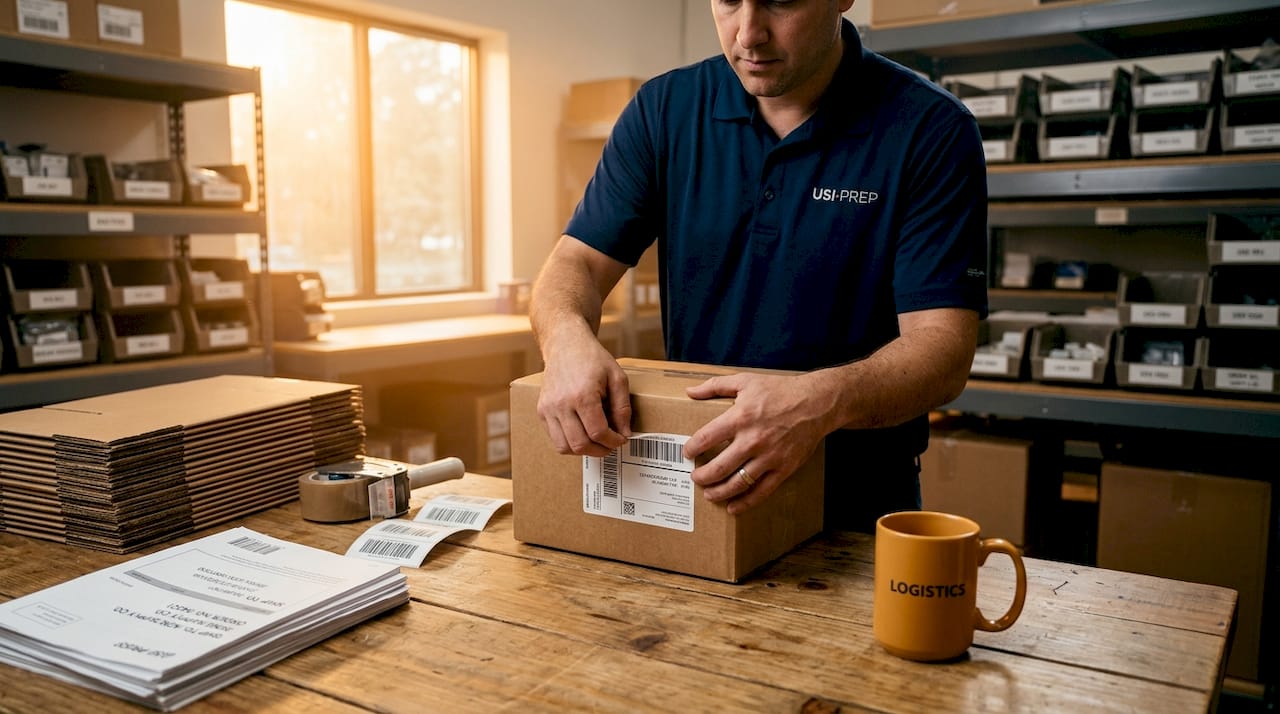
Pro Tip: Always request a pre-shipment photo report from your FBA forwarding provider showing label placement and carton sealing before cargo leaves the prep center. This single step catches most compliance failures before they become Amazon problems.
Label placement and scannability are equally critical. A label that curls at the edges, sits over a box seam, or prints at the wrong resolution will fail Amazon’s scanner. That means your carton gets flagged for manual processing, which delays check-in and risks misplacement in the fulfillment center.
Benefits of using a specialized FBA forwarding service
The most compelling argument for a specialized FBA forwarding service is what logistics professionals call the handoff gap. When you use separate vendors for manufacturing, freight forwarding, and FBA prep, each handoff creates an opportunity for miscommunication. The manufacturer thinks the forwarder will handle labels. The forwarder thinks the prep center already prepped everything. The prep center never got the right instructions. Your inventory arrives at Amazon’s dock wrong, and none of those vendors is standing there to fix it.
Integrated FBA forwarding eliminates that gap by making one provider accountable for the entire chain. The benefits stack up quickly:
- Fewer rejections: One provider manages the full compliance checklist, so nothing falls between vendors
- Faster turnaround: No waiting for two or three vendors to communicate and coordinate
- Lower total cost: Avoiding one shipment rejection pays for months of premium forwarding service fees
- Better visibility: A single provider gives you one point of contact and one status dashboard instead of three different tracking systems
- Scalability: Multi-SKU shipments and seasonal surges are easier to manage when one provider holds the full picture
High-growth brands increasingly prefer specialized third-party FBA forwarders over Amazon’s own automated supply chain services because they need personalized handling for complex, multi-SKU shipments. Amazon’s system optimizes for speed and automation. It does not accommodate the nuances of a brand with 40 SKUs, bundled products, and custom packaging requirements.
Using website analytics to track e-commerce performance alongside your forwarding operations also helps identify patterns in delays and costs, giving you leverage to negotiate better terms with providers.
How to choose an FBA forwarding service
Not every logistics company that claims FBA expertise actually has it. Here is what to evaluate before signing with a provider:
- Amazon rule fluency: Ask directly about 2026 compliance changes. A provider who cannot speak to FNSKU coverage requirements or carton dimension updates is not ready for your freight.
- In-house prep capability: The prep must happen under the same roof as the freight coordination. Outsourced prep reintroduces the handoff gap you are trying to eliminate.
- Appointment scheduling technology: Technology platforms that synchronize with Amazon’s delivery appointment system reduce the chance of missed windows and late check-ins.
- Shipment plan integration: Your provider should be able to sync with Seller Central directly, ensuring accurate shipment ID generation and carton labels that match your plan exactly.
- Track record with rejections: Ask for rejection rates. A good provider will share this number. A vague answer is a red flag.
The biggest pitfall sellers fall into is letting their overseas supplier manage the shipping process. Suppliers are not trained in logistics compliance or export codes, which directly increases your risk of delays and non-compliant shipments reaching Amazon’s docks. Handing that responsibility to your factory is not a cost saving. It is a liability transfer.
Pro Tip: When evaluating providers, request a sample shipment plan walkthrough. A qualified FBA forwarding service should be able to demonstrate exactly how they generate shipment IDs, apply labels, and schedule delivery appointments before you commit to a contract.
My take on FBA forwarding after years in the trenches
I have watched sellers spend months optimizing their Amazon listings while treating shipping as an afterthought. That approach almost always ends the same way: a rejected shipment, a depleted inventory buffer, and a few weeks of lost sales during a critical ranking window.
What I have learned is that the DIY approach to FBA shipping is not really a cost saver. It is a delayed cost creator. Every hour spent figuring out delivery appointment scheduling, customs codes, and FNSKU placement is an hour not spent on sourcing, marketing, or customer experience. And when mistakes happen, the costs are not just financial. Stockouts hurt your Amazon search rank in ways that take months to recover from.
The 2026 changes amplified this reality. With Amazon removing its internal prep services, there is no backstop for non-compliant inventory anymore. Sellers who have not upgraded their logistics setup are flying without a safety net.
My honest advice: find a provider who was built by people who actually sold on Amazon. They know where the problems hide because they lived them. Generic freight forwarders are not wrong for your business. They are just not right for Amazon specifically.
— Akbar
Why Usiprep is the forwarding partner your brand needs
If reading this guide made you realize your current logistics setup has gaps, you are not alone. Usiprep was founded by former Amazon sellers who built the service they wished existed when they were shipping freight and hoping for the best. Every part of the operation, from FBA prep and fulfillment to delivery appointment coordination, runs in-house and in sync with Amazon’s 2026 requirements.
Usiprep clients see a 98.9% on-time delivery rate and an average 30% reduction in fulfillment costs. That is not a marketing number. It is the result of eliminating the handoff gap, catching compliance issues before the dock, and managing shipment plans with accuracy that generic freight companies cannot match. If you are ready to stop guessing and start shipping with confidence, explore Usiprep’s pricing and services to see what a purpose-built FBA forwarding partner looks like.
FAQ
What does an FBA forwarding service actually do?
An FBA forwarding service manages your entire supply chain from overseas supplier to Amazon fulfillment center, handling FNSKU labeling, carton prep, customs clearance, and delivery appointment scheduling. It combines freight logistics with Amazon-specific compliance in one integrated solution.
How is FBA forwarding different from standard freight forwarding?
Standard freight forwarders move cargo but lack knowledge of Amazon’s specific requirements like FNSKU labels, carton dimension limits, and mandatory delivery appointments. FBA forwarding providers specialize in those compliance details, reducing the risk of shipment rejection.
What happens if my shipment does not meet Amazon’s requirements?
Non-compliant shipments can result in fees, inventory rejection, or disposal at your expense. Since Amazon ended its internal U.S. prep services in 2026, sellers are fully responsible for meeting every carton and labeling standard before freight arrives.
Do I really need a delivery appointment to ship to Amazon?
Yes, for LTL and FTL shipments you must schedule a delivery appointment 24 to 72 hours in advance. Showing up without one means your carrier gets turned away, adding cost and delay to your entire shipment timeline.
Can my overseas supplier handle FBA prep instead?
Suppliers are not trained in logistics compliance or Amazon-specific requirements, which significantly raises your risk of non-compliant shipments and delays. Using a dedicated FBA forwarding service with in-house prep is the only reliable way to protect your inventory from rejection at Amazon’s receiving docks.