
If you’ve ever had a shipment rejected or been hit with unexpected prep fees, there’s a good chance polybagging was the culprit. Understanding what the polybagging requirement for Amazon FBA actually entails is one of the most overlooked compliance topics among sellers at every level. Known formally as poly bag packaging, this requirement governs how certain products must be enclosed in protective plastic bags before they arrive at a fulfillment center. Get it wrong and you’re looking at delayed inventory, surprise charges, or outright rejection. Get it right and your products move through Amazon’s inbound process without a hitch.
Table of Contents
- Key Takeaways
- What the polybagging requirement for Amazon actually means
- Technical specifications: what your polybag must include
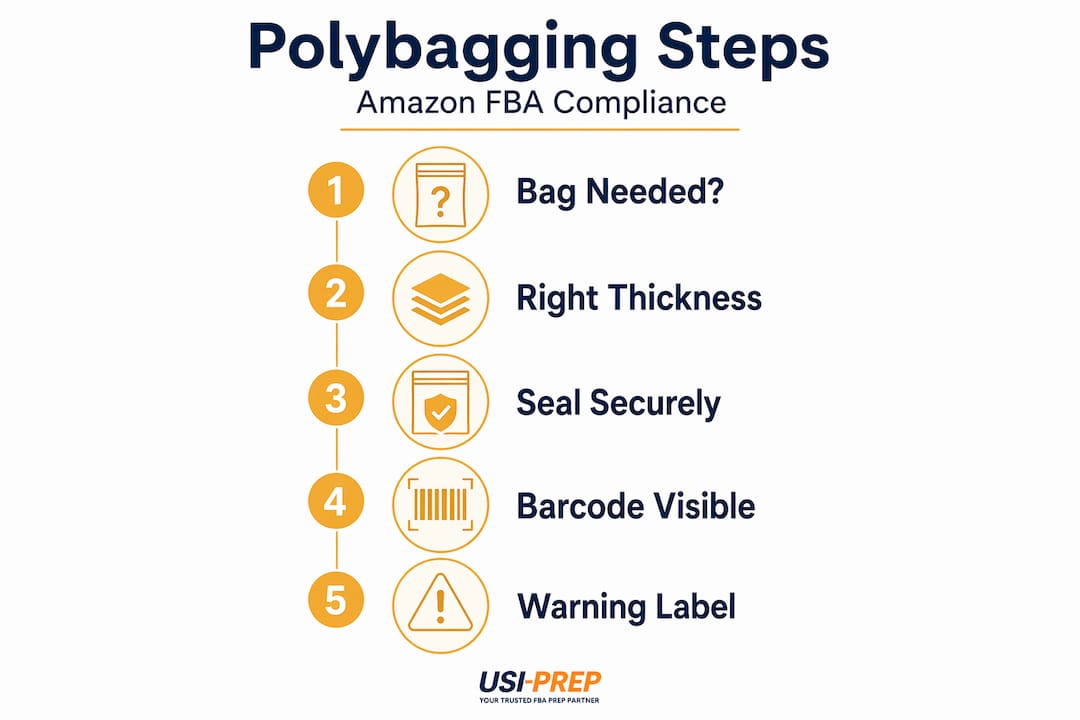
- How to polybag products correctly, step by step
- Common mistakes and consequences of getting it wrong
- Best practices and staying current with Amazon’s rules
- My take on polybagging: where sellers lose money unnecessarily
- How Usiprep handles polybagging so you don’t have to
- FAQ
Key Takeaways
| Point | Details |
|---|---|
| Know which products require bagging | Items with loose parts, scents, small sizes, or adult content typically need poly bags. |
| Meet the 1.5 mil thickness standard | Bags thinner than 1.5 mil will tear in handling and won’t pass Amazon’s inspection. |
| Suffocation warnings are mandatory | Any bag with a 5-inch or larger opening must display a clearly visible suffocation warning. |
| Barcode visibility is non-negotiable | Your product barcode must scan through the bag or be placed on the bag exterior. |
| Non-compliance costs real money | Rejected shipments and prep fees add up fast when packaging doesn’t meet Amazon’s standards. |
What the polybagging requirement for Amazon actually means
Amazon’s polybagging rules sit inside a broader set of FBA packaging requirements that govern how products must be prepared before reaching a fulfillment center. At its core, poly bag packaging means placing a product inside a clear (or in some cases opaque) plastic bag, sealing it completely, and meeting specific physical standards before it ships to Amazon.
Why does Amazon care? The answer comes down to three things: product protection, worker safety, and scanning efficiency. Loose items can get lost. Products with scents can contaminate neighboring inventory. Small parts can fall out and cause fulfillment headaches. The rules exist to prevent those outcomes at scale across millions of units.
Products requiring polybagging typically fall into these categories:
- Items that can collect dust or be damaged by exposure during storage or transit
- Products with loose parts that could scatter if the outer packaging opens
- Small items that could easily get lost inside a larger shipment box
- Products containing strong scents that could transfer to other nearby goods
- Adult content items that require opaque packaging for privacy compliance
Amazon provides a bagging decision tree within Seller Central to help you determine whether your specific product needs a poly bag. Use it. Don’t guess based on what similar sellers are doing, because categories shift and Amazon updates its requirements.
Pro Tip: If you’re unsure whether your product needs polybagging, check Amazon’s prep requirements tool in Seller Central under the “Inventory” section. Enter your ASIN and the tool will tell you exactly what prep is required before your shipment is accepted.
Technical specifications: what your polybag must include
This is where sellers most often slip up. Knowing that a product needs a poly bag is only half the job. The bag itself must meet a specific set of physical standards, and each one matters.
Thickness and material
Poly bags must be at least 1.5 mil thick to survive handling without tearing. “Mil” refers to thousandths of an inch, not millimeters. A 1.5 mil bag feels noticeably more substantial than a thin produce bag. If you’re buying poly bags in bulk, verify the mil rating with your supplier before committing to a large order.

Transparency and barcode visibility
For most products, bags must be clear. The reason is practical: barcodes must be scannable either through the bag film or from a label placed on the outside of the bag. Fulfillment center workers and automated scanners need to read that barcode without opening the package. If your bag creates glare or distortion, place the FNSKU label on the exterior surface of the bag instead.
One important exception: adult products require opaque bags for privacy compliance. This directly conflicts with the transparency rule for general items, so categorize your product correctly before choosing your bag type.
Sealing requirements
Poly bags must be completely sealed with tape or adhesive so the unit cannot open during handling. An unsealed or loosely folded bag is a compliance failure. The seal needs to hold through drops, compression, and the general roughness of moving through a warehouse system.
Suffocation warnings
Here’s the rule that surprises most sellers: bags with a flat opening of 5 inches or larger must display a suffocation warning. Measure the opening when the bag lies flat, not when it’s stretched open. The warning text must be clearly visible and meet Amazon’s size and legibility standards.
| Bag Opening (flat measurement) | Suffocation Warning Required? |
|---|---|
| Under 5 inches | No |
| 5 inches or larger | Yes |
| Opaque bag (adult products) | Yes, if 5 inches or larger |
Suffocation warnings can be printed directly on the bag or applied as a permanent sticker. Both methods are acceptable as long as the label meets visibility and durability requirements. Many sellers find it easier to source bags with the warning pre-printed rather than applying stickers individually.
Pro Tip: Order a test batch of poly bags before committing to your full inventory run. Verify the mil thickness, measure the flat opening, and confirm the suffocation warning placement before your first FBA shipment.
How to polybag products correctly, step by step
Translating the rules into a repeatable process protects you from errors at volume. Here’s how to do it right:
-
Select the correct bag size. The bag should fit the product snugly without excessive excess material. Too much slack creates folding issues that can block barcodes or make sealing unreliable.
-
Choose clear or opaque based on product category. Standard products get clear bags. Adult-categorized items get opaque bags. Confirm your ASIN’s category in Seller Central before sourcing bags.
-
Place the barcode where it can be scanned. If the bag film is clear and the product’s own barcode is visible through it, you may not need an external label. If there’s any doubt about scan reliability, apply the FNSKU label to the outside surface of the bag.
-
Apply the suffocation warning if required. Pre-printed bags are the most reliable option. If you’re using sticker labels, use permanent adhesive and apply them before sealing so they don’t shift or peel off during handling.
-
Seal the bag completely. Use heat sealing for high-volume operations or pressure-sensitive tape for lower volumes. The seal must hold without peeling. Test your seal method with a few units before running a full batch.
-
Handle liquids differently. Products containing liquids need cap seals or additional containment measures beyond the poly bag itself. A poly bag alone is not sufficient for leak protection on liquid products.
For sellers moving more than a few hundred units per week, manual bagging becomes a bottleneck fast. Automated bagging systems paired with barcode blocking poly bags can handle high volumes while simultaneously solving barcode scanning problems. These specialized bags block the internal product barcode so only the external FNSKU scans correctly at Amazon’s receiving stations.
Pro Tip: If you’re scaling up, look at poly bag automation equipment that integrates with barcode blocking bags. The upfront cost pays for itself quickly in reduced relabeling and fewer prep errors.
Common mistakes and consequences of getting it wrong
Amazon’s poly bag rules serve a dual purpose: they protect product integrity and prevent scanning failures during inbound processing. When those rules aren’t followed, the consequences are real and measurable.
The most frequent problems sellers run into include:
- Bags that are too thin. Sub-1.5 mil bags tear during conveyor handling, exposing products to damage and triggering prep fees.
- Missing suffocation warnings. Amazon’s receiving teams check for this. A bag without the required warning gets flagged as non-compliant.
- Barcode scanning failures. Glossy or tinted bag film can cause scan errors at the fulfillment center, which delays check-in and can result in your inventory sitting in a “problem” queue.
- Multiple barcodes visible inside the bag. If your product has a manufacturer barcode and you’ve also placed an FNSKU label inside the bag, scanners may read the wrong one. Barcode blocking bags solve this by preventing internal barcodes from being read through the bag film.
- Loose or partial sealing. Amazon fulfillment center associates can and do reject units that aren’t fully sealed. Your product ends up in a prep queue, you get charged a per-unit fee, and your inventory check-in is delayed.
Non-compliance with polybagging standards doesn’t just cost you prep fees. It delays your inventory availability, which means lost sales velocity during the window when your products should already be live and selling.
Review your FBA prep requirements checklist before each shipment cycle. A quick audit takes less time than disputing a prep fee.
Best practices and staying current with Amazon’s rules
Amazon updates its packaging requirements periodically, and sellers who rely on memory instead of documentation get caught off guard. A few habits keep you ahead of those changes.
- Bookmark Amazon’s official prep requirements page in Seller Central. This is the authoritative source. Any third-party guide (including this one) reflects Amazon’s rules as of a specific date, but Amazon can change them without notice.
- Use the Seller Central decision tree before each new product launch. What applied to your last product may not apply to your next one, especially if you’re expanding into new categories.
- Run a quarterly packaging audit. Pull a few units from your current inventory, inspect the bag condition, check seal integrity, and verify suffocation warning placement. This catches drift before it becomes a compliance problem.
- Consider using an FBA prep service for high-risk or high-volume SKUs. Prep centers that specialize in Amazon FBA know the current requirements and handle the physical prep work so you don’t have to.
- Document your packaging specifications. Keep a record of the bag dimensions, mil rating, sealing method, and warning label source for each SKU. If Amazon flags an issue, you need that documentation to respond quickly.
My take on polybagging: where sellers lose money unnecessarily
I’ve seen a lot of sellers treat polybagging as an afterthought, and it ends up costing them far more than the few cents a compliant bag would have cost in the first place. In my experience, the two most common mistakes are inconsistent bag sourcing and ignoring suffocation warnings until Amazon forces the issue.
What I’ve found is that sellers who standardize early, choosing one bag supplier, locking in the right mil thickness, and pre-printing suffocation warnings on every bag in the applicable size range, almost never deal with prep fees related to packaging. The sellers who keep switching suppliers to save a fraction of a cent per bag are the ones who end up with a batch of sub-spec bags and a surprise fee invoice.
The barcode visibility issue is the one that frustrates me most to see, because it’s entirely avoidable. If your bag film creates any ambiguity at all about which barcode a scanner will read, fix it before the shipment leaves your hands. Either apply the FNSKU label to the bag exterior or switch to barcode blocking bags. Standardizing your bag film properties early is genuinely one of the highest-leverage packaging decisions you can make.
The hidden cost of non-compliance isn’t just the prep fee. It’s the delay in inventory availability, the time spent disputing charges, and the distraction from actually growing your business. Polybagging done right should be invisible. It should just work, every time.
— Akbar
How Usiprep handles polybagging so you don’t have to
Usiprep was built by former Amazon sellers who know exactly how much time and money packaging compliance can burn when it’s not handled correctly. Our FBA prep team applies Amazon’s poly bag packaging standards across every unit we process, from verifying bag thickness and sealing integrity to applying suffocation warnings and placing FNSKU labels on bag exteriors when needed. You get complete visibility into every step of the prep process, and our 98.9% on-time delivery rate means your inventory reaches Amazon’s fulfillment centers ready to check in without delays. If you want to stop worrying about prep fees and rejected shipments, explore our complete prep checklist or get started with our FBA shipment checklist to see exactly what Usiprep covers.
FAQ
What products require polybagging for Amazon FBA?
Products that require polybagging include items with loose parts, those susceptible to dust damage, small units that could get lost, scented products, and adult content items. Use Amazon’s prep requirements tool in Seller Central to confirm requirements for your specific ASIN.
How thick does an Amazon poly bag need to be?
Amazon requires poly bags to be at least 1.5 mil thick. Bags thinner than this standard will tear during fulfillment center handling and do not meet Amazon’s poly bagging standards.
When is a suffocation warning required on a poly bag?
A suffocation warning is required when the bag’s flat opening measures 5 inches or more. The warning can be printed on the bag or applied as a permanent sticker label, as long as it’s clearly visible and meets Amazon’s durability standards.
What happens if my polybagging doesn’t meet Amazon’s requirements?
Amazon may charge you a per-unit prep fee, delay your inventory check-in, or reject the shipment entirely. Non-compliant units sit in a problem queue until prep is completed, which delays your products going live and costs you sales.
Can the product barcode be inside the poly bag?
Yes, if the bag is clear and the barcode is scannable through the film without distortion. If there’s any risk of scanning errors or multiple barcodes inside the bag, apply the FNSKU label to the exterior surface of the bag instead.