
If you’re selling on Walmart Marketplace and handling fulfillment yourself, you’re probably already feeling the friction. Late shipment penalties, labeling errors, chargebacks that seem to arrive from nowhere. The reason why Walmart sellers need 3PL, or third-party logistics support, comes down to one hard truth: Walmart’s fulfillment standards are not designed for sellers who wing it. This guide breaks down exactly what makes Walmart’s logistics demands different, how a specialized 3PL protects your margins, and what to look for when choosing a partner that actually understands the platform.
Table of Contents
- Key takeaways
- Why Walmart sellers need 3PL support
- How a 3PL handles Walmart compliance for you
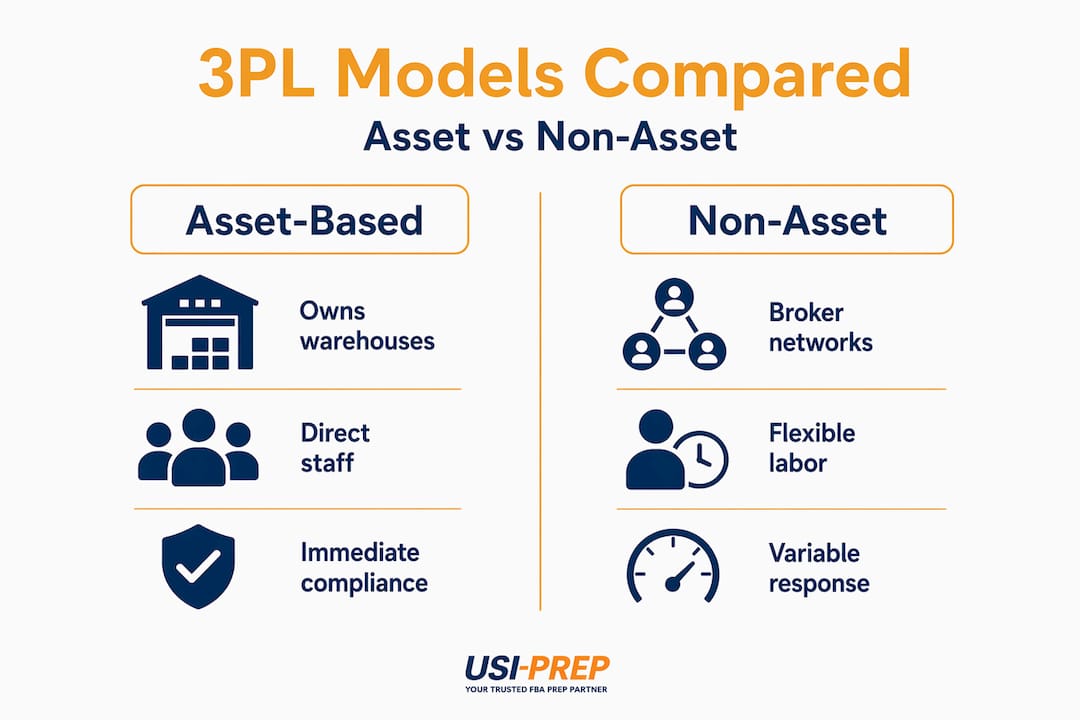
- Asset-based vs. non-asset 3PL models
- How to choose the right 3PL as a Walmart seller
- My take on where most Walmart sellers go wrong
- How Usiprep helps Walmart sellers stay compliant
- FAQ
Key takeaways
| Point | Details |
|---|---|
| Walmart compliance is strict | OTIF and SQEP programs impose financial penalties for late, incomplete, or mislabeled shipments. |
| Generic warehousing falls short | Basic storage facilities lack Walmart-specific labeling, documentation, and routing capabilities. |
| Asset-based 3PLs offer more accountability | Providers who own their own warehouses deliver more reliable service under high-volume, compliance-heavy conditions. |
| Tech integration is non-negotiable | Connecting your 3PL to Walmart’s systems reduces chargeback disputes and speeds up order management. |
| Transparency lowers total cost | Clear pricing and documented escalation paths help sellers avoid hidden fees and repeat compliance failures. |
Why Walmart sellers need 3PL support
Most sellers discover the hard way that Walmart is not Amazon. The compliance structure is fundamentally different, and the penalties for non-compliance hit fast. Walmart’s supply chain requirements were built around large retail suppliers, and when marketplace sellers enter that ecosystem, they inherit those same expectations.
Walmart’s OTIF (On-Time In-Full) and SQEP (Supplier Quality Excellence Program) compliance programs are where most sellers first run into trouble. OTIF and SQEP programs impose strict performance thresholds, including fines of up to 3% of cost of goods sold for late or incomplete shipments, plus per-defect fees for packaging violations. These are not one-time penalties. If the root cause is not fixed at the operational level, they recur every single cycle.
Beyond performance scores, Walmart’s inbound logistics structure adds another layer of complexity. Here are the key compliance and operational requirements Walmart sellers must meet:
- OTIF compliance: Shipments must arrive on time and in full, down to the case count. Even partial shortfalls trigger chargebacks.
- SQEP requirements: Packaging must meet exact specifications. Labeling errors, including wrong placement or incorrect barcode formats, generate per-unit fines.
- Prepaid Consolidation Program: Walmart’s Prepaid Consolidation Program consolidates inbound shipments under a single national purchase order, which Walmart then routes to regional distribution centers. This simplifies logistics but requires suppliers to follow precise routing and case-handling rules.
- Regional distribution center routing: Walmart expects shipments routed to specific regional DCs, not a single national warehouse. Sellers shipping without this understanding face refusal or rerouting fees.
- Speed to shelf: Walmart’s distribution model prioritizes fast replenishment. Delayed inventory does not just hurt your metrics. It can pull your products off the shelf entirely.
A general warehousing provider has no framework for any of this. They store boxes. A Walmart-focused 3PL understands the routing, the documentation, and the timing that keeps your account in good standing.
How a 3PL handles Walmart compliance for you
The practical value of Walmart third-party logistics comes from specialization. A 3PL that works regularly with Walmart sellers builds institutional knowledge that a solo seller simply cannot match at scale. Here is how that knowledge translates to day-to-day operational protection:
- System integration: A quality 3PL connects directly to Walmart’s Supplier Center and your order management platform. This means ASNs (Advance Ship Notices), POs, and BOLs are generated and submitted accurately without manual intervention. Integrating across these data sources substantially reduces deduction rates and speeds up dispute resolution when chargebacks do occur.
- Compliance documentation and dispute support: When a chargeback lands, the clock starts immediately. Your 3PL should be able to retrieve and cross-reference POs, ASNs, carrier proofs, and BOLs within hours, not days. Sellers who manage this manually almost always miss dispute windows.
- Labeling and packaging services: Walmart’s label placement, GS1 barcodes, and case configuration requirements are not suggestions. A 3PL with a dedicated prep team handles these to spec before shipments leave the warehouse.
- Returns management: Returns on Walmart Marketplace need to be processed, inspected, and restocked or disposed of according to Walmart’s guidelines. A full-service 3PL handles this without pulling your internal team into a manual process.
- Access to the national distribution network: Walmart-approved providers, including participants in the Prepaid Consolidation Program, offer region-specific pricing without extra markups, connecting sellers directly to Walmart’s distribution infrastructure.
Pro Tip: Before signing with any 3PL, ask them to walk you through exactly how they handle a Walmart chargeback dispute from receipt to resolution. The specificity of their answer will tell you everything about their actual Walmart experience.
Technology visibility throughout the inventory lifecycle is what separates a capable 3PL from a storage locker with a label printer. You need to see inventory status, outbound shipment confirmations, and exception alerts in real time.
Asset-based vs. non-asset 3PL models
Not all 3PLs are structured the same way, and this matters more for Walmart sellers than for almost any other channel. The two primary models are asset-based and non-asset, and choosing the wrong one for your volume and compliance needs can create the exact problems you were trying to avoid.

| Feature | Asset-based 3PL | Non-asset 3PL |
|---|---|---|
| Warehouse ownership | Owns and operates its own facilities | Brokers space from third-party networks |
| Labor control | Directly employs warehouse staff | Subcontracts labor, variable quality |
| Accountability | Single point of contact for all issues | Escalation often routed through brokers |
| Capacity stability | Predictable under volume surges | Vulnerable during peak freight periods |
| Walmart compliance fit | High, direct operational control | Moderate to low, depends on subcontractors |
Asset-based 3PLs own their warehouses and employ their labor directly, which means when a compliance issue arises, you are talking to the people who actually control the process. During the freight volatility period from 2020 to 2024, asset-based providers consistently maintained better service continuity and direct escalation paths compared to broker-heavy non-asset models.
Non-asset 3PLs are not without merit. For sellers with highly variable, unpredictable volume, access to a broader subcontracted network can provide geographic flexibility. But Walmart’s requirements are predictable and stringent. That combination favors providers who have direct operational accountability baked into their structure.
Pro Tip: If you are processing more than 500 Walmart orders per month, the stability of an asset-based provider is almost always worth the slightly higher per-unit cost. The chargeback savings alone will cover the difference.
How to choose the right 3PL as a Walmart seller
Outsourcing logistics for Walmart sellers is a significant operational decision. The wrong choice does not just cost money. It damages your seller scorecard, which directly affects your Buy Box eligibility and product visibility. Here is what to evaluate before committing:
- Walmart-specific compliance knowledge: Ask for documented procedures around OTIF, SQEP, and the Prepaid Consolidation Program. A 3PL that has to look those up is not ready to serve you.
- Tech integration capabilities: Confirm they can connect to Walmart’s Supplier Center and your existing order management system. Technology integration between sellers, 3PLs, and Walmart’s systems is a foundational capability, not a bonus feature.
- Transparent pricing structure: Hidden fees in fulfillment are common. Look for itemized pricing on receiving, storage, pick and pack, labeling, and returns. Compare total cost per order, not just advertised base rates. Understanding your fulfillment cost components before signing a contract prevents painful surprises at invoice time.
- Chargeback management support: Ask how they handle chargeback disputes. Do they provide documentation retrieval? Do they have a dedicated compliance team? Pricing transparency and escalation procedures directly protect your margins when things go wrong.
- Geographic distribution coverage: Walmart’s regional DC network means your 3PL needs facilities or carrier relationships that reach multiple regions reliably. A single-warehouse provider in one region is a bottleneck waiting to happen.
- Scalability: If your Walmart volume doubles during Q4, can your 3PL absorb it without dropping compliance metrics? Get this in writing, not just as a verbal assurance.
One often-overlooked consideration: ask for references specifically from Walmart marketplace sellers, not just general eCommerce clients. The operational demands are different enough that general fulfillment experience does not fully transfer.
My take on where most Walmart sellers go wrong
I’ve watched sellers make the same mistake repeatedly. They graduate from self-fulfillment to a generic warehouse, see initial improvement, and assume the problem is solved. Then the chargebacks start again, and they spend months trying to figure out why.
The real issue is that most warehouses are built for storage, not retail compliance. Knowing that a shipment needs to be OTIF-compliant is not the same as having staff trained to build compliant pallets, generate correct ASNs, and flag routing exceptions before a truck leaves the dock.
What I’ve learned is that the 3PL selection decision is really a compliance infrastructure decision. You are not just buying logistics capacity. You are buying expertise, systems, and accountability. The sellers I’ve seen scale successfully on Walmart all share one trait: they treated their 3PL selection as carefully as a key hire, not a vendor purchase.
The other thing most sellers overlook is ongoing compliance monitoring. Walmart updates its routing guides and compliance requirements regularly. A 3PL that tracks those changes proactively, rather than waiting for you to forward an email from your category manager, is worth every cent of the premium.
— Akbar
How Usiprep helps Walmart sellers stay compliant
If you are a Walmart seller tired of chargeback cycles and fulfillment gaps, Usiprep was built for exactly this situation. Founded by former Amazon sellers, Usiprep’s fulfillment services deliver the Walmart-specific prep, labeling, and documentation support that generic warehouses cannot provide. With a 98.9% on-time delivery rate and documented 30% fulfillment cost reductions for many clients, the results are measurable.
Usiprep offers full visibility throughout the inventory lifecycle, faster check-ins than industry standard, and transparent pricing with no hidden markups. For sellers entering the Prepaid Consolidation Program or managing SQEP requirements, their prep team handles compliance documentation from the ground up. Start with the FBA prep requirements checklist to see exactly how Usiprep’s process maps to your Walmart fulfillment needs. Scale without the bottlenecks that have been holding your account back.
FAQ
What is a 3PL and why do Walmart sellers use one?
A third-party logistics provider (3PL) handles warehousing, fulfillment, and shipping on a seller’s behalf. Walmart sellers use 3PLs to meet strict compliance programs like OTIF and SQEP without building that operational infrastructure in-house.
How do Walmart chargebacks work and can a 3PL prevent them?
Walmart issues chargebacks for late shipments, packaging defects, and documentation errors, with fines up to 3% of COGS per violation. A specialized 3PL reduces chargebacks by handling compliant labeling, accurate ASN submission, and dispute documentation.
What is Walmart’s Prepaid Consolidation Program?
The Prepaid Consolidation Program lets sellers ship under one national purchase order to a single location, which Walmart distributes to regional centers. It simplifies inbound logistics and lowers costs when managed with the right 3PL partner.
What is the difference between asset-based and non-asset 3PLs?
Asset-based 3PLs own their warehouses and employ their own staff, providing direct accountability and operational control. Non-asset 3PLs broker capacity through subcontracted networks, which can reduce stability under Walmart’s compliance-heavy requirements.
Does Walmart Multichannel Solutions replace a 3PL?
Walmart Multichannel Solutions fulfills orders from multiple channels using a shared inventory pool and does not charge referral fees on non-Walmart orders. However, it requires WFS enrollment and has product eligibility limits, making a dedicated 3PL the better fit for sellers with complex compliance or prep needs.