
Costly FBA prep errors are labeling, packaging, shipment, and inventory mistakes that trigger punitive Amazon fees and operational disruptions severe enough to erase months of profit. Unplanned prep fees jumped from roughly $0.20 to $1.00 or more per unit in 2026, meaning a single batch of mislabeled products can cost five times what proper prep would have. The Amazon FNSKU system, unplanned prep fee structure, and Inventory Performance Index (IPI) scoring all penalize sellers who treat prep as an afterthought. The examples below show exactly where sellers lose money and how to stop it.
1. Common labeling mistakes that lead to costly FBA prep errors
Labeling is the single most frequent source of expensive FBA preparation pitfalls, and the errors are almost always preventable.
- Using ASIN barcodes instead of FNSKU labels. Amazon’s fulfillment network identifies your specific inventory through FNSKU codes, not ASINs. Shipping ASIN barcodes instead of FNSKU labels causes units to land in unidentified inventory, where they become invisible to normal inventory management tools. One seller reported hundreds of stuck units that required case escalations lasting weeks, blocking both sales and removal orders.
- Missing FNSKU labels entirely. Amazon will either reject the shipment at the receiving dock or charge $1.00 or more per unit to apply labels on your behalf. At 500 units per shipment, that is a $500 charge for a label print-and-apply job that costs pennies when done correctly.
- Unscannable barcodes from poor placement. Label placement that looks clean before packaging can fail after application. Curved surfaces, wrinkled poly bags, and glossy packaging all degrade scan reliability. A barcode that fails at the receiving scanner triggers the same unplanned fee as a missing label.
- Covering manufacturer barcodes without proper masking. If the original UPC is still visible through or around your FNSKU label, Amazon’s scanners can read the wrong code and misclassify the unit.
Pro Tip: Scan every final packaged unit with a consumer-grade barcode scanner app before sealing the carton. If your phone reads it cleanly, Amazon’s equipment almost certainly will too.
2. How improper packaging triggers costly FBA prep fees
Packaging errors are the second largest category of common FBA errors, and they carry both direct fees and shipment rejection risk.
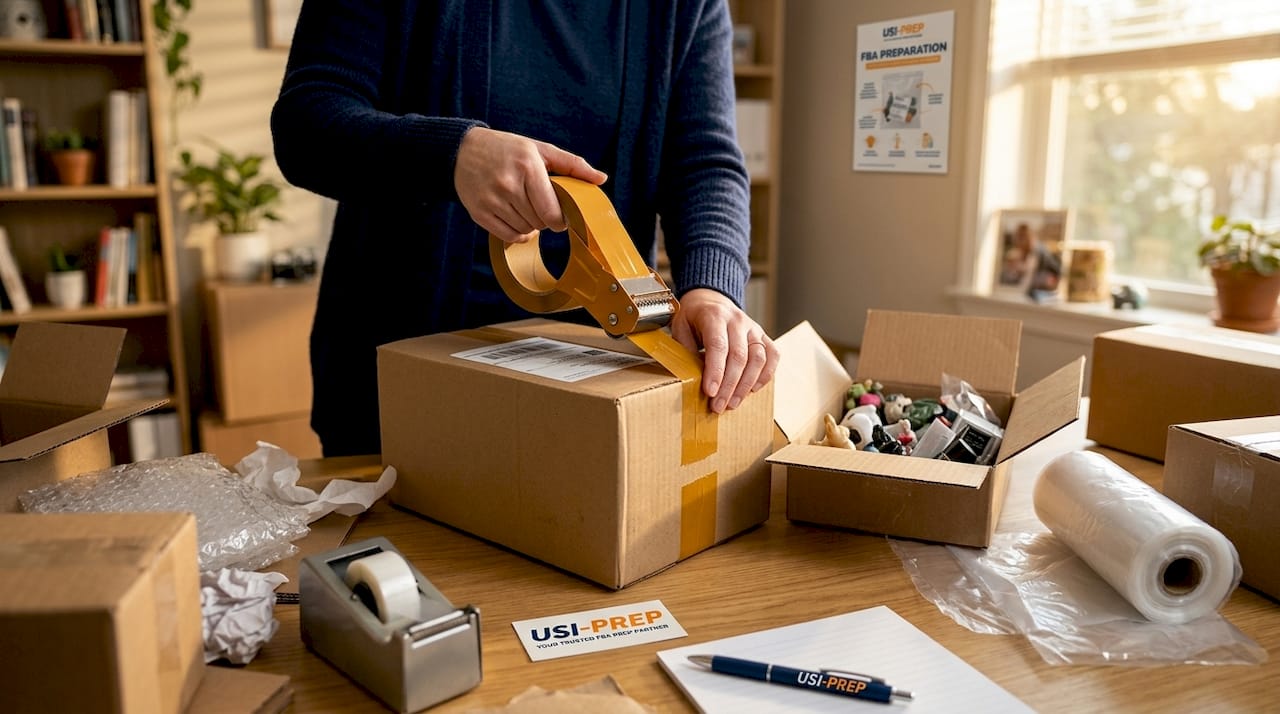
The most frequent packaging mistake is failing to polybag items that require it. Amazon mandates polybagging for products that contain multiple loose components, have exposed foam or fabric, or could cause injury if handled without containment. Sellers who skip polybagging face shipment rejection or an Amazon-applied polybag fee. Doing it yourself costs roughly $0.30 to $0.75 per unit at a prep center. Amazon’s remediation charge is consistently higher, and the delay adds stockout risk on top.
Suffocation warnings are a separate but related requirement. Missing suffocation warnings on polybags trigger a $1.00 per unit charge for Amazon to apply the sticker post-receipt. The warning must be printed directly on the bag or applied as a label before shipment. It is not optional for bags with openings larger than five inches.
Box weight and dimension compliance is equally critical. Amazon’s receiving docks reject overweight cartons, and the FBA packaging requirements for 2026 include strict limits on box weight (typically 50 lbs maximum for standard items) and dimension ratios. An overweight box does not just get flagged. It can cause the entire shipment to be held pending re-palletization.
| Packaging error | Seller-managed cost | Amazon-applied penalty |
|---|---|---|
| Missing polybag | $0.30–$0.75 per unit | Shipment rejection or higher remediation fee |
| No suffocation warning | Under $0.05 per unit (label) | $1.00 per unit applied by Amazon |
| Overweight carton | Repack labor cost | Shipment hold, potential rejection |
| Prohibited void fill | Minimal replacement cost | Receiving delay, possible return |
Packages must also survive Amazon’s three-foot drop test standard. If a box fails during receiving inspection, the entire shipment can be quarantined for repackaging at your expense.
3. Shipment and inventory mistakes that amplify FBA costs
Shipment creation errors and inventory mismanagement are where expensive FBA prep issues compound into serious financial damage.
- Wrong shipping plan or incorrect shipment splits. Amazon’s inbound placement system routes inventory to specific fulfillment centers. Incorrect shipment setup including wrong packaging labels or misclassified shipment types causes check-in delays and can result in the entire shipment being rejected at the dock.
- Missing or incorrect bill of lading. LTL and FTL shipments require a bill of lading that matches the shipment ID exactly. A mismatch causes the carrier to be turned away, adding freight re-delivery costs on top of the delay.
- Quantity discrepancies between the shipment plan and physical units. Sending more or fewer units than declared creates inventory reconciliation problems. Amazon may hold the overage or charge for manual counting. Missing units trigger a discrepancy investigation that can take 30 to 45 days to resolve.
- Overstocking without demand forecasting. One brand paid over $50,000 in removal fees after overstocking, despite initial shipping costs of only $2,000 to $4,000. Aged inventory surcharges accumulate monthly, and removal orders add per-unit fees on top.
Pro Tip: Track your inbound defect rate as a monthly KPI. Divide the number of units flagged for prep errors by total units shipped. A rate above 2% signals a systemic process problem, not a one-off mistake.
| Shipment error | Direct cost | Secondary impact |
|---|---|---|
| Incorrect shipment split | Carrier re-routing fees | Check-in delays, stockouts |
| Quantity discrepancy | Manual counting fees | 30–45 day reconciliation hold |
| Overstocking | Storage and removal fees | IPI score reduction |
| Missing bill of lading | Freight re-delivery cost | Lost sales during delay |
4. What ignoring FBA prep error prevention actually costs you
The financial case for proactive prep is straightforward once you model the numbers honestly.
At $0.20 per unit for planned prep, a seller processing 1,000 units per month pays $200. A 5% error rate at the new $1.00 or more unplanned fee rate adds $50 or more in correction fees on top of the base cost, plus operational delays. That sounds manageable until you scale. At 10,000 units per month with the same 5% error rate, correction fees alone exceed $500 monthly, and that figure ignores the downstream costs of rejected shipments.
Rejected shipments do not just cost money in fees. They create stockouts that reduce your IPI score, which in turn limits your future storage capacity at Amazon fulfillment centers. The financial damage compounds across multiple business metrics simultaneously.
Shipping errors have cascading effects including cancelled shipping plans, delayed listings, and reduced IPI scores that erode profitability beyond the direct fee impact. Sellers who treat prep compliance as an integrated system, covering freight forwarding, carton labeling, and inventory classification together, consistently outperform those who address each element in isolation.
Measuring your inbound defect rate monthly lets you compare the fixed cost of proper prep against the variable cost of errors. Most sellers who run this calculation find that investing in compliant prep upfront is cheaper than paying Amazon to fix mistakes after the fact.
5. Practical strategies to avoid costly FBA prep errors
Prevention is cheaper than remediation at every scale. These approaches address the most common FBA errors before they reach Amazon’s receiving dock.
- Verify label types before every shipment. Confirm that every unit carries an FNSKU label, not an ASIN or UPC. Use Amazon Seller Central’s shipment creation workflow to generate and download the correct FNSKU file for each SKU. Review the FBA shipment creation process to understand where label type selection happens in the workflow.
- Implement a final scan-test protocol. Scan every labeled unit after packaging and before carton sealing. This single step catches placement failures, wrinkle distortion, and print quality issues that visual inspection misses.
- Use a prep center with documented 2026 compliance knowledge. Not all third-party prep centers update their procedures when Amazon changes its requirements. Ask specifically about their suffocation warning process, polybag thickness standards, and box weight verification steps.
- Audit inventory age every 30 days. Use the FBA Inventory Age report in Seller Central to identify units approaching the 180-day and 365-day aged inventory thresholds. Create removal orders before surcharges apply rather than after. Usiprep’s inventory check-in best practices guide covers how to build this audit into a repeatable monthly workflow.
- Standardize your shipment creation checklist. A written checklist covering label type, polybag requirement, suffocation warning, box weight, and shipment plan confirmation reduces human error more reliably than memory alone. Follow a step-by-step shipment checklist to build your own version.
Pro Tip: When working with freight forwarders, send them your Amazon shipment ID and carton label files directly rather than relying on verbal instructions. Miscommunication at the freight stage is a leading cause of bill of lading mismatches.
Key takeaways
Costly FBA prep errors in labeling, packaging, shipment setup, and inventory management trigger fees that scale from $0.20 to $1.00 or more per unit, making proactive compliance the only financially sound approach for Amazon sellers at any volume.
| Point | Details |
|---|---|
| FNSKU labels are non-negotiable | Using ASIN barcodes instead of FNSKU causes inventory misclassification and blocks remediation. |
| Packaging compliance has a direct price tag | Missing polybags or suffocation warnings cost $0.75 to $1.00 or more per unit in Amazon-applied fees. |
| Overstocking compounds costs fast | One seller paid $50,000 in removal fees on a $2,000 to $4,000 initial shipment investment. |
| Error rates scale painfully | A 5% error rate at 10,000 units per month generates $500 or more monthly in correction fees alone. |
| Prevention beats remediation | Scan-testing, checklists, and prep center vetting cost a fraction of unplanned fee exposure. |
Why I think most sellers underestimate prep errors until it’s too late
I have seen sellers treat FBA prep as a box-checking exercise rather than a financial control point. That mindset is expensive. The 2026 fee changes make this concrete: Amazon is no longer absorbing the cost of seller prep mistakes. The accountability has shifted permanently, and the fee structure reflects it.
What surprises most sellers is not the per-unit fee itself. It is the compounding effect. A rejected shipment delays your listing reactivation, drops your IPI score, and limits your next inbound shipment’s storage allocation. You pay once in fees and three more times in lost sales, reduced capacity, and recovery labor.
The sellers I have watched handle this well share one habit: they track inbound defect rate as seriously as they track advertising cost of sale. When prep errors show up as a KPI on a weekly dashboard, they get fixed. When they stay buried in a fee report that nobody reads until month-end, they keep recurring.
Investing in a reliable prep center with documented compliance procedures is not overhead. It is risk management. The math on unplanned fees versus planned prep costs makes this obvious once you run it. Most sellers just never run it.
— Akbar
How Usiprep helps sellers eliminate costly FBA prep errors
Usiprep was built by former Amazon sellers who experienced these exact prep failures firsthand. Every shipment processed through Usiprep goes through a compliance-focused workflow that covers FNSKU label verification, polybag and suffocation warning checks, box weight confirmation, and shipment plan matching before anything leaves the facility. Sellers using Usiprep report a 30% reduction in fulfillment costs and benefit from a 98.9% on-time delivery rate. Start with the 2026 FBA prep checklist to see exactly which requirements your current process may be missing, and explore Usiprep’s FBA prep services to find out how a compliance-first prep partner changes your cost structure.
FAQ
What is the most costly FBA prep error for Amazon sellers?
Using ASIN barcodes instead of FNSKU labels is among the most damaging errors because it causes permanent inventory misclassification and blocks standard removal or relabeling processes. The financial impact combines direct fees with weeks-long reconciliation delays.
How much do unplanned FBA prep fees cost per unit in 2026?
Unplanned prep fees rose to $1.00 or more per unit in 2026, up from roughly $0.20 previously. A 5% error rate on 1,000 monthly units increases correction costs from approximately $10 to $50 or more, not counting operational delays.
Do packaging errors cause shipment rejection at Amazon?
Yes. Missing polybags, absent suffocation warnings, and overweight cartons all trigger shipment rejection or hold at Amazon’s receiving dock. Sellers must meet Amazon’s packaging standards, including the three-foot drop test, before units are accepted into the fulfillment network.
How can I avoid FBA prep errors when using a freight forwarder?
Send your freight forwarder the Amazon shipment ID and carton label files directly rather than relying on verbal instructions. Confirm that the bill of lading matches your shipment plan exactly, since mismatches cause carrier rejections and add re-delivery costs.
What is the inbound defect rate and why does it matter?
The inbound defect rate measures the percentage of units flagged for prep errors out of total units shipped. Tracking this monthly lets you compare fixed prep costs against variable error correction costs, making the financial case for process improvements visible and measurable.