
If you’re still counting on Amazon to handle your prep work, that window has closed. Amazon ended all in-house FBA prep services starting January 1, 2026, which means every labeling, poly-bagging, and packaging task now falls on you or a third party you hire. The FBA prep requirements checklist 2026 has never mattered more. Miss a step and you’re looking at real penalties, delayed inventory, and lost sales velocity. This article walks you through exactly what you need to know, check, and do before a single box leaves your hands.
Table of Contents
- Key Takeaways
- 1. Understand the core FBA prep compliance criteria
- 2. Print and apply FNSKU labels correctly
- 3. Apply suffocation warnings where required
- 4. Choose the right packaging materials
- 5. Prep fragile, oversized, and hazmat products
- 6. Build an accurate shipment plan in Seller Central
- 7. Compare your prep method options
- 8. Stay current on category-specific policy changes
- My take on the 2026 FBA prep shift
- How Usiprep handles your 2026 FBA prep needs
- FAQ
Key Takeaways
| Point | Details |
|---|---|
| Amazon prep services are gone | All FBA prep tasks became seller responsibility on January 1, 2026. |
| Penalties hit fast and hard | Inbound Defect Fees can reach $0.60 per unit, adding up quickly on large shipments. |
| FNSKU label specs are non-negotiable | Labels must print at 300 DPI minimum on white stock with correct placement to scan. |
| 3PL centers are now standard | Most mid-size and large sellers outsource to prep centers charging $0.40–$0.70 per unit. |
| Factory-level prep cuts costs most | Source-level labeling runs $0.05–$0.15 per unit, the lowest cost option available today. |
1. Understand the core FBA prep compliance criteria
Before you build your checklist, you need a clear picture of what Amazon actually requires in 2026. These are the compliance foundations every shipment must meet, no exceptions.
FNSKU label standards. Every unit needs a scannable FNSKU barcode that covers any original manufacturer barcode. Proper FNSKU printing requires at least 300 DPI resolution, black ink on a white background, and placement on a flat surface with no wrinkles, folds, or smearing. A label that fails to scan triggers relabeling fees of $0.30 per unit plus processing delays.
Packaging protection requirements. Products must arrive at fulfillment centers undamaged. Amazon only accepts high-quality corrugated boxes with a minimum 32 ECT rating and a maximum weight of 50 pounds per box. Use adequate void fill, and never reuse damaged boxes.
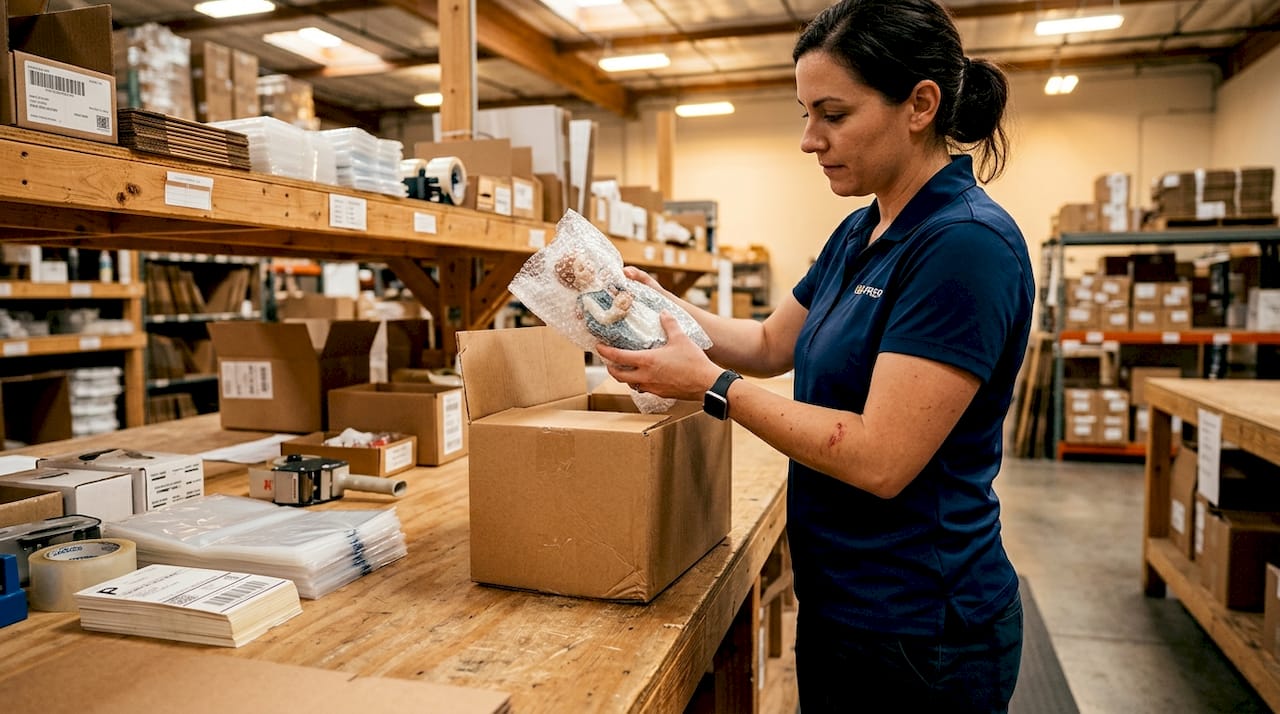
Product-specific prep rules. Certain categories require poly-bagging, bubble wrapping, or both. Items with sharp edges need extra protection. Any poly bag with an opening over five inches must display a suffocation warning.
Common penalties to know:
- Inbound Defect Fees: up to $0.60 per unit for labeling or prep defects
- Relabeling fees: $0.30 per unit applied by Amazon when labels fail
- Shipment rejection: full return of boxes that fail packaging standards
- Quarantine holds: items flagged for missing prep can be held indefinitely
Pro Tip: Run a sample audit of 10 units from every new product batch before sending a full shipment. Catching a label placement error on 10 units costs almost nothing. Catching it on 500 units after the fact costs you $300 in penalty fees.
2. Print and apply FNSKU labels correctly
This is the step that trips up more sellers than any other. Getting your FNSKU labels right is the single fastest way to avoid unnecessary costs in 2026.
Print labels at 300 DPI or higher. Use a thermal label printer if possible since inkjet labels smear under humidity or friction during transit. Your label dimensions must match what Seller Central specifies for your product type. Standard label size is 1" x 2-5/8" for most units.
Place the label on the flattest surface of the packaging, centered and straight. It cannot overlap any seams, edges, or other barcodes. If your product has a manufacturer UPC, cover it completely with the FNSKU label. Amazon scanners should only read one barcode per unit.
Pro Tip: Order a batch of pre-printed FNSKU labels from a professional print service when you first launch a new ASIN. The per-unit cost is negligible, and the scan quality is consistently better than labels you print in-house on a budget printer.
3. Apply suffocation warnings where required
Poly-bagging with suffocation warnings is required for apparel, plush toys, and any product in a transparent bag where the opening exceeds five inches. This is both a safety standard and an Amazon compliance requirement.
The warning text must be printed directly on the bag or on a label affixed to it. Font size requirements scale with bag size. For bags up to 50 square inches, the minimum font size is 10 points. Larger bags require proportionally larger text.
Do not assume your supplier has added this label correctly. Check every bag before it goes into the shipping box.
4. Choose the right packaging materials
The materials you use directly affect whether your shipment survives fulfillment center handling and whether Amazon accepts it without issue.
For boxes, use new, single-wall corrugated cardboard with a minimum 32 ECT burst strength. Double-wall boxes are preferred for heavier or fragile items. Never exceed 50 pounds per box. If a single unit weighs more than 50 pounds, it must be marked “Team Lift” with two-inch labels on all four sides and the top.
For inner packaging, use bubble wrap for fragile items, poly bags for soft goods, and foam or air pillows for void fill. Avoid loose packing peanuts, which Amazon fulfillment centers flag as non-standard.
5. Prep fragile, oversized, and hazmat products
These categories carry the strictest prep rules and the harshest penalties for getting it wrong.
Fragile items must be individually wrapped in bubble wrap and able to pass a three-foot drop test without breaking. If a single item doesn’t pass that test with your current packaging, double-box it.
Oversized items need “Team Lift” or “Mechanical Lift” labels depending on weight. Items over 100 pounds require a “Mechanical Lift” label in addition to standard prep.
Hazardous materials require Safety Data Sheets (SDS) submitted through Seller Central, proper UN labeling on outer packaging, and category-specific compliance documentation. Check whether your product falls under any FDA, DOT, or IATA restrictions before creating your shipment plan. Getting this wrong does not result in a fee. It results in a shipment refusal or a regulatory issue.
6. Build an accurate shipment plan in Seller Central
Creating accurate shipment plans in Seller Central is a compliance requirement, not an administrative task. Every quantity, SKU, and box detail must match your physical shipment exactly.
Steps to complete your shipment plan correctly:
- Log into Seller Central and navigate to “Send to Amazon”
- Select all ASINs included in the shipment with exact quantities
- Assign units to boxes and enter per-box weights and dimensions
- Generate FBA shipment labels and apply them to the correct boxes
- Enter tracking numbers before the shipment closes to avoid processing delays
Mismatched shipment plans are one of the most common causes of receiving delays, chargebacks, and inventory discrepancies. Match the plan to reality, not the other way around.
7. Compare your prep method options
The biggest operational decision you face in 2026 is where the prep work happens. Each option has a different cost structure and complexity level.
| Prep Method | Cost Per Unit | Best For | Key Trade-off |
|---|---|---|---|
| In-house DIY | $0.10–$0.25 | Low-volume sellers | Requires staff time and space |
| 3PL prep center | $0.40–$0.70 | Mid to large sellers | Higher cost, faster turnaround |
| Factory/source-level | $0.05–$0.15 | High-volume importers | Requires supplier coordination |
| Hybrid model | Variable | Multi-SKU brands | Balances cost and complexity |
Factory labeling costs average just $0.05 to $0.15 per unit versus $0.40 to $0.70 at US-based 3PL centers. If you import from overseas manufacturers, integrating prep at the source is the single highest-leverage cost reduction available to you right now.
3PL prep centers have become the standard for most mid-size Amazon sellers in 2026. They handle labeling, poly-bagging, kitting, and box-level compliance without requiring you to manage warehouse space or hire prep staff.
Key factors when choosing your model:
- Your monthly unit volume (DIY makes sense below 500 units per month)
- SKU complexity and category-specific prep needs
- Whether your suppliers can reliably execute prep to Amazon’s specs
- Your tolerance for managing prep quality control remotely
8. Stay current on category-specific policy changes
Amazon updates its prep requirements regularly, and category-specific rules shift with very little notice. The sellers who get caught off guard are the ones who set up their prep process once and never check it again.
Set a calendar reminder to review the Amazon FBA Prep Requirements help page at least once per quarter. Subscribe to Amazon Seller Central email updates for your specific categories. If you sell in apparel, toys, health, or grocery, those categories have historically seen the most frequent updates.
When a policy changes, audit your current prep setup against the new standard before your next shipment. Do not wait to see if Amazon catches it first.
My take on the 2026 FBA prep shift
I’ve watched a lot of sellers treat prep compliance as a logistics problem when it’s really an operations strategy problem. The sellers who are doing well right now didn’t scramble to find a 3PL after January 2026. They built their prep infrastructure six months earlier and tested it with small batches.
What I see underestimated most often is the compound effect of small defects. One labeling error on a 500-unit shipment costs $300 in Inbound Defect Fees. Do that four times a year and you’ve lost $1,200 plus the inventory delays that hurt your sales rank. That’s not a compliance cost. That’s an operational failure that compounds.
My honest recommendation: if you’re moving more than 1,000 units per month, stop doing prep in-house unless you’ve built a real system for it. The economics of a good 3PL partner almost always beat the cost of your own labor and error rate once you factor in everything. And if you’re importing, the operational infrastructure you build at the factory level pays dividends for years.
The sellers who will struggle in 2026 and beyond are the ones who see prep as a box to check rather than a competitive advantage. Consistent, clean inbound shipments mean faster receiving, better inventory availability, and less time dealing with Amazon support. That’s time and money that goes back into growing your business.
— Akbar
How Usiprep handles your 2026 FBA prep needs
Usiprep was founded by former Amazon sellers who understand exactly what’s at stake when prep goes wrong. Every service is designed around the 2026 FBA prep guidelines, from FNSKU labeling and poly-bagging to box-level compliance and shipment plan verification. With a 98.9% on-time delivery rate and a track record of cutting fulfillment costs by 30% for growing brands, Usiprep gives you the infrastructure to scale without the operational headaches. Transparent pricing plans mean no surprises, and faster inventory check-ins keep your stock available and ranked. If your current prep process isn’t airtight, now is the right time to change that.
FAQ
What changed about FBA prep requirements in 2026?
Amazon ended all in-house prep services on January 1, 2026, meaning sellers must now handle all labeling, poly-bagging, bubble wrapping, and packaging themselves or through a third party.
What are the penalties for non-compliant FBA shipments?
Non-compliant shipments face Inbound Defect Fees of up to $0.60 per unit, relabeling fees of $0.30 per unit, and potential shipment rejection or quarantine holds.
What DPI is required for FNSKU label printing?
FNSKU labels must be printed at a minimum of 300 DPI, using black ink on a white background, placed on a flat surface without overlapping seams or other barcodes.
Should I use a 3PL prep center or do prep in-house?
If you ship more than 1,000 units per month, a 3PL prep center typically offers better economics and fewer errors than in-house prep. Sellers importing from overseas can reduce costs further by integrating prep at the factory level for $0.05 to $0.15 per unit.
How do I avoid shipment plan errors in Seller Central?
Match every quantity, SKU, and box detail in your Seller Central shipment plan exactly to your physical shipment, and enter tracking numbers before the shipment closes to prevent processing delays.