
Ecommerce fulfillment is the end-to-end process of receiving inventory, storing it, picking and packing orders, shipping them to customers, and handling returns. It is the operational backbone of every online store, and it directly determines whether a customer orders from you again. Unlike traditional wholesale logistics, ecommerce fulfillment handles high volumes of small parcels with speed and accuracy demands that brick-and-mortar supply chains never faced. Get it right and you build loyalty. Get it wrong and you lose the sale before the box even ships.
What is ecommerce fulfillment and how does it work?
Ecommerce fulfillment covers every step between a customer clicking “buy” and receiving their order. The process is more layered than most new sellers expect, and each step creates a point where errors compound.
The fulfillment process in ecommerce follows a consistent sequence:
- Inbound receiving. Inventory arrives at a warehouse or fulfillment center. Staff count, inspect, and log each unit against the purchase order. Accuracy here prevents every downstream problem.
- Storage. Products are assigned bin locations in a warehouse management system (WMS). Organized storage cuts pick times and reduces mispicks.
- Order transmission. When a customer places an order on Shopify, WooCommerce, or Amazon, the order flows automatically into the fulfillment system. Manual entry is a bottleneck and an error source.
- Picking and packing. A picker pulls the correct SKU from its bin. A packer places it in the right box with protective material and a shipping label. These two steps account for most accuracy failures in small operations.
- Carrier selection and shipping. The system selects a carrier (UPS, FedEx, USPS, or a regional carrier) based on weight, destination, and cost. The label prints and the parcel moves to outbound staging.
- Last-mile delivery. The carrier delivers to the customer’s door. This final leg is the most expensive part of the journey.
- Reverse logistics. Returns flow back to the warehouse for inspection, restocking, or disposal. Returns generate roughly 6.9% of annual retail sales. Automating the returns process speeds up refunds and reduces restocking errors.
Pro Tip: Audit your inbound receiving process before anything else. Inventory errors at check-in multiply by the time an order ships. A 1% receiving error rate can translate to hundreds of mispicks per month at scale.
Which fulfillment models exist and how do they compare?

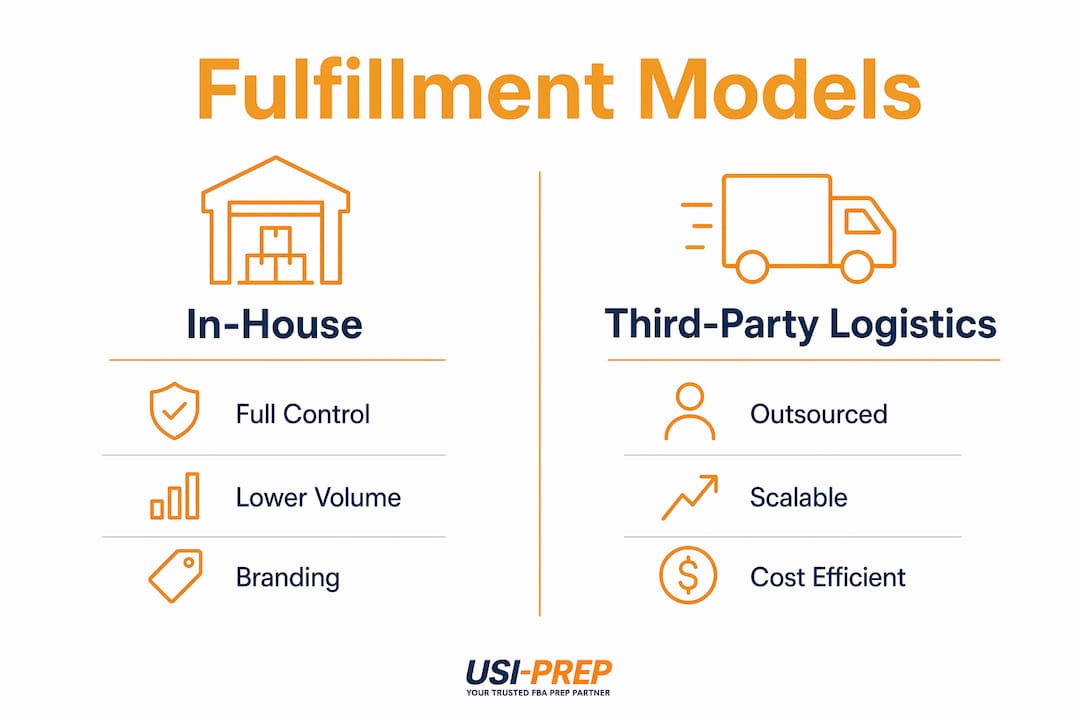
Understanding fulfillment services means knowing which model fits your current volume and growth trajectory. Three primary models exist, plus a hybrid approach that many growing brands use.
In-house fulfillment
You store inventory, pick orders, and ship from your own space. This model gives you full control over packaging, branding, and quality. The tradeoff is cost and capacity. Rent, labor, packing supplies, and carrier negotiations all fall on you. Most sellers find this model works well below 400 monthly orders.
Third-party logistics (3pl)
A 3PL provider warehouses your inventory and handles the entire fulfillment process in ecommerce on your behalf. You pay per unit stored and per order shipped. Businesses typically switch to a 3PL when monthly orders reach 400–500 units, because the fixed costs of in-house fulfillment outpace the per-unit fees a 3PL charges. The key to making a 3PL work is software integration. Platform integration with Shopify or WooCommerce matters more than which 3PL you choose, because poor integration creates the same manual bottlenecks you were trying to escape.
Dropshipping
The supplier ships directly to your customer. You never touch inventory. Margins are thin, delivery times are often slow, and you have zero control over packaging or quality. Dropshipping works for testing products, not for building a brand.
Hybrid models
Many mid-size sellers keep fast-moving SKUs in-house and outsource slow-moving or bulky inventory to a 3PL. This approach balances cost control with flexibility.
| Model | Cost | Control | Scalability | Complexity |
|---|---|---|---|---|
| In-house | Low at small volume | High | Limited | Low |
| 3PL | Variable per unit | Medium | High | Medium |
| Dropshipping | Lowest upfront | None | High | Low |
| Hybrid | Mixed | High | High | High |
What technologies optimize fulfillment performance in 2026?
Modern ecommerce logistics solutions rely on software as much as physical infrastructure. The right tech stack reduces errors, speeds up orders, and gives you visibility at every stage.
-
Warehouse management system (WMS). A WMS tracks every SKU by bin location and automates pick lists. Integrated WMS tools reduce fulfillment errors by 50–80% and push on-time delivery rates above 95%. That error reduction alone justifies the software cost for most sellers above 200 monthly orders.
-
Automated order import. Direct API connections between your store (Shopify, WooCommerce, BigCommerce) and your WMS eliminate manual order entry. Orders flow in, pick lists generate, and labels print without human intervention.
-
Batch picking. Instead of picking one order at a time, a picker pulls items for 20–30 orders in a single warehouse pass. Batch picking cuts pick time by 30–50% in most warehouse layouts.
-
Multi-carrier rate shopping. Software like ShipStation or EasyPost compares live rates across UPS, FedEx, USPS, and DHL at the moment of label creation. Choosing the cheapest carrier per shipment compounds into significant savings at volume.
-
Cycle counts. Rather than shutting down for an annual full inventory count, cycle counts audit a rotating portion of inventory weekly. This catches discrepancies before they cause stockouts or overselling. Most sellers who skip cycle counts discover the problem only after a customer complaint.
-
Branded tracking notifications. Automated SMS and email updates sent through tools like AfterShip or Route reduce “where is my order” support tickets by keeping customers informed at every scan point.
Pro Tip: Set up cycle counts on your top 20% of SKUs by order volume. These items cause 80% of fulfillment errors when inventory counts drift. Catching a 10-unit discrepancy early costs nothing. Catching it after 200 mispicks costs customers.
How do fulfillment costs break down?
Knowing your fulfillment cost components is the first step to controlling them. Most sellers underestimate total fulfillment spend because they only track postage.
The major cost categories are:
- Last-mile delivery. This is the single largest expense. Last-mile delivery accounts for 40–53% of total shipping costs. Reducing it requires carrier diversification and zone-based warehouse placement.
- Storage fees. Monthly storage charges at a 3PL are based on cubic feet or pallet positions. Slow-moving inventory accumulates storage costs without generating revenue.
- Pick and pack labor. Whether in-house or outsourced, each order requires human or automated labor to pick, pack, and label. Per-order pick fees at a 3PL typically range from $1.50 to $4.00 depending on SKU complexity.
- Dimensional weight charges. Carriers charge based on whichever is greater: actual weight or dimensional weight. Strategic packaging that avoids oversized boxes directly cuts freight charges. A product that weighs 1 pound shipped in a 12x12x12 box can cost as much to ship as a 5-pound item.
- Returns processing. Each return requires inspection, restocking, or disposal labor. Returns are a cost center that most sellers do not budget for explicitly.
- Hidden contract fees. Account setup fees, minimum monthly charges, fuel surcharges, and special handling fees appear in 3PL contracts and add up fast. Review the hidden fees in fulfillment contracts before signing anything.
The most effective cost control strategy combines right-sized packaging, multi-carrier rate shopping, and a 3PL with transparent per-unit pricing. Outsourcing becomes cost-effective for most sellers at the 400–500 monthly order threshold, where 3PL per-unit fees fall below the combined cost of in-house rent, labor, and supplies.
Key takeaways
Ecommerce fulfillment is a multi-step operational system where technology integration, cost control, and model selection determine whether your business scales or stalls.
| Point | Details |
|---|---|
| Fulfillment covers six core steps | Receiving, storage, picking, packing, shipping, and returns each require accuracy to avoid downstream errors. |
| Model choice depends on volume | In-house works below 400 monthly orders; a 3PL becomes cost-effective at 400–500 units per month. |
| Software integration drives accuracy | WMS tools reduce fulfillment errors by 50–80% and push on-time delivery above 95%. |
| Last-mile is your biggest cost | Last-mile delivery accounts for 40–53% of total shipping spend; carrier diversification is the primary lever. |
| Cycle counts prevent stockouts | Regular partial inventory audits catch discrepancies before they cause mispicks or overselling. |
Why fulfillment is your strongest brand signal
I have watched dozens of small sellers obsess over ad spend and product photography while their fulfillment operation quietly destroyed their reviews. A customer who receives the wrong item or waits 10 days for a 2-day order does not complain to your face. They leave a one-star review and never come back.
Poor fulfillment increases cart abandonment and kills repeat purchase rates. That is not an operational problem. It is a revenue problem. The brands I have seen grow fastest treat their fulfillment partner the same way they treat their best supplier: with clear SLAs, regular performance reviews, and a willingness to switch if results slip.
The mistake most small sellers make is choosing a 3PL based on price alone. Price matters, but the integration between your store and the 3PL’s system matters more. A cheap 3PL with a clunky manual order import process will cost you more in errors and support tickets than a slightly more expensive partner with a clean Shopify or WooCommerce API connection. I have seen this play out repeatedly. The sellers who compare fulfillment center features before signing a contract avoid the six-month nightmare of switching providers mid-growth.
Fulfillment is not overhead. It is the last impression your brand makes on every customer, every single order.
— Akbar
How Usiprep helps sellers ship faster and spend less
Usiprep was built by former Amazon sellers who experienced firsthand what unreliable fulfillment does to a growing brand. The result is a fulfillment service designed around transparency, speed, and real integration with the platforms sellers already use.
Usiprep delivers a 98.9% on-time delivery rate and has helped brands cut fulfillment costs by 30% through faster inventory check-ins and carrier optimization. For Amazon sellers, the FBA prep requirements checklist gives you a step-by-step resource to prep shipments correctly the first time. Whether you are shipping 100 orders a month or scaling past 5,000, Usiprep’s transparent pricing and dedicated support mean you always know what you are paying and why. Explore Usiprep’s pricing to see how the numbers work for your volume.
FAQ
What is ecommerce fulfillment in simple terms?
Ecommerce fulfillment is the process of storing inventory, processing orders, and shipping products to customers after an online purchase. It includes every step from receiving stock at a warehouse to delivering the package to the customer’s door.
What is the difference between fulfillment and shipping?
Shipping is one step within the broader fulfillment process. Fulfillment covers receiving, storage, picking, packing, and returns, while shipping refers specifically to the carrier transport of a packed order to the customer.
When should i outsource ecommerce order fulfillment?
Most sellers benefit from outsourcing to a 3PL when they reach 400–500 monthly orders, because the per-unit cost of a 3PL drops below the combined expense of in-house rent, labor, and supplies at that volume.
How does a 3pl integrate with my ecommerce store?
A 3PL connects to platforms like Shopify or WooCommerce via API, automatically importing orders and syncing inventory levels. Strong software integration is the most critical factor in a successful 3PL relationship.
What is dimensional weight and why does it affect my costs?
Dimensional weight is a pricing method carriers use that charges based on package size rather than actual weight when the box is large relative to its contents. Choosing right-sized packaging directly reduces this charge and lowers your per-shipment cost.